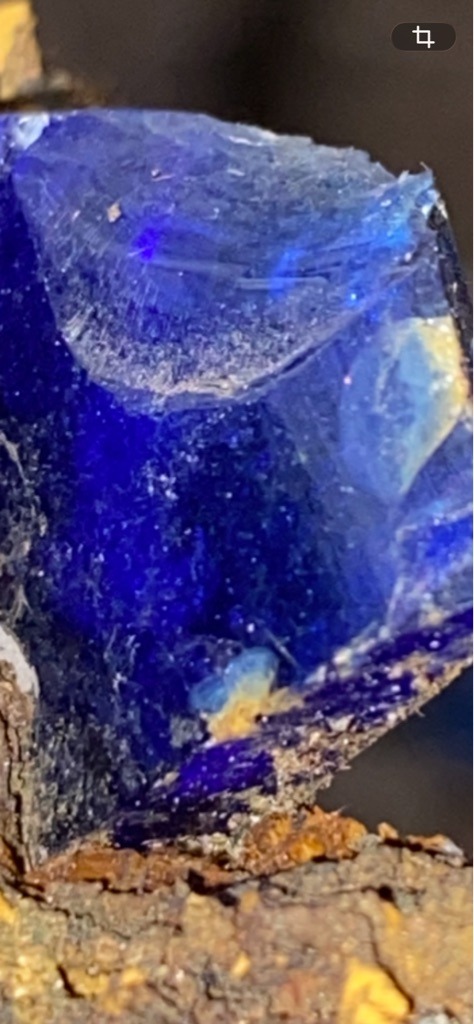
The specimen appears to be a mineral crystal, likely Linarite or Azurite on a matrix, rather than a diamond. It lacks the isometric crystal structure and optical properties of a diamond.
The specimen appears to be a mineral crystal, likely Linarite or Azurite on a matrix, rather than a diamond. It lacks the isometric crystal structure and optical properties of a diamond. · Rough/Uncut Crystal (Tabular/Monoclinic habit)
Not Applicable (Rough Specimen) Cut
Carat
Difficult to estimate without scale, but visual suggests a specimen size of 5-15 carats for the primary crystal cluster.
Color
Deep Electric Blue; non-standard for white diamond scale. If it were a diamond, it would be 'Fancy Vivid Blue'.
Clarity
Included (I3 equivalent or Translucent); visible internal fracturing and matrix attachments.
Shape
Rough/Uncut Crystal (Tabular/Monoclinic habit)
Overall Assessment
This is a natural mineral specimen, most likely a copper-based sulfate or carbonate. It is not a diamond, as evidenced by its crystal habit, fracture patterns, and color saturation, which are inconsistent with carbon-based gemstones.
Cut Quality
Not Applicable (Rough Specimen)
Brilliance
Low; vitreous to sub-adamantine luster rather than the high refractive brilliance of diamond.
Fire
None detected; the material is too opaque and lacks the dispersion power of diamond.
Scintillation
Limited to surface reflections from crystal faces.
Proportions
Not Applicable (Irregular rough form)
Symmetry
Poor (Natural uncrystallized growth)
Polish
None (Natural matte/vitreous luster)
Fluorescence
None observed; the color is inherent to the mineral's chemical composition (copper-based).
Inclusions
Heavy internal cleavages, color zoning, and matrix inclusions (iron oxides/limonite).
Blemishes
Contact points, fractures, and surface abrasion typical of raw mineral specimens.
Origin
Likely secondary oxidation zones of copper deposits (e.g., Arizona, USA or Tsumeb, Namibia).
Treatment Detection
None apparent; appears to be a natural raw specimen.
Estimated Value
$50 - $200 as a mineral specimen; negligible if evaluated as a diamond due to misidentification.
Certification Estimate
Gemological labs like GIA or IGI would likely identify this as a copper-bearing mineral, not a diamond.
Investment Potential
Low for gemstone markets; moderate for mineral specimen collectors specializing in copper secondaries.
Similar Diamonds
None. This material is distinct from Blue Boron-type IIb diamonds which have different crystal structures.
Setting Suggestions
Wire-wrapped pendant or kept as a cabinet specimen; too soft (Mohs 2.5-4) for standard jewelry settings.
Care & Maintenance
Avoid ultrasonic cleaners, acids, and heat. This material is very soft and may dissolve or change color if exposed to chemicals.
Interesting Facts
The vibrant blue color of minerals like Linarite is caused by the presence of copper in the crystal lattice.