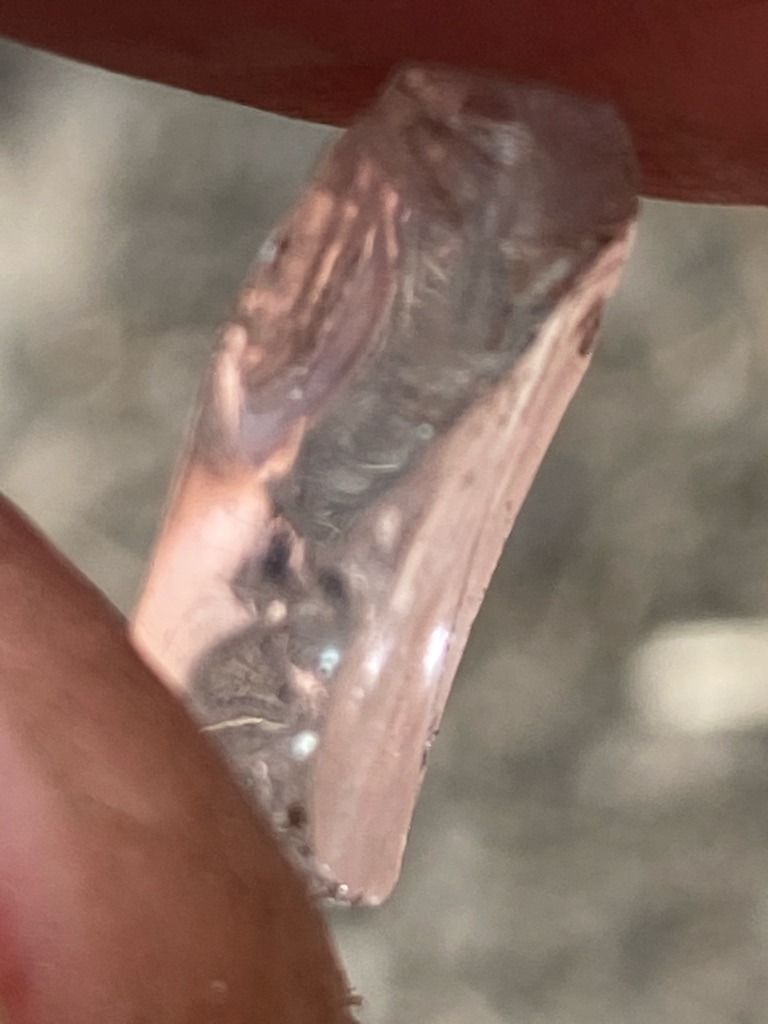
Natural rough diamond crystal
Natural rough diamond crystal · Uncut octahedral or irregular rough crystal form
Not applicable (Rough, un-cut stone) Cut
Carat
Estimated 1.5 to 2.5 carats
Color
Natural brownish-pink or champagne undertones
Clarity
Included (I1-I3 range in rough form)
Shape
Uncut octahedral or irregular rough crystal form
Overall Assessment
An interesting and authentic natural rough diamond crystal displaying characteristic growth features, ideal for mineral collectors or custom organic jewelry design.
Cut Quality
Not applicable (Rough, un-cut stone)
Brilliance
Low (due to rough, unpolished surface)
Fire
Minimal dispersion in current rough state
Scintillation
Limited flash due to natural crystal faces rather than facets
Proportions
Natural uncut morphology, non-standard geometric proportions
Symmetry
Natural crystal symmetry showing octahedral growth lines
Polish
Natural rough crystal faces (trigons and growth striations visible)
Fluorescence
Unable to determine without UV testing (likely none to moderate)
Inclusions
Internal clouds, feather fractures, and dark mineral inclusions visible
Blemishes
Natural surface pitting, rough skin, and trigons
Origin
Likely alluvial or primary kimberlite pipe deposit (African or Canadian origin)
Treatment Detection
No treatments detected; completely natural rough specimen
Estimated Value
Varies widely based on potential yield after cutting, roughly $300 - $800 in rough form
Certification Estimate
GIA or similar major lab if submitted for rough certification and tracking
Investment Potential
Moderate as a collector's mineral specimen, highly dependent on cutting yield if faceted
Similar Diamonds
Other natural unpolished industrial or specimen-grade rough diamonds
Setting Suggestions
Best preserved as a raw mineral specimen or set in a custom organic bezel setting
Care & Maintenance
Store separately to prevent scratching other stones; clean gently with warm soapy water and a soft brush
Interesting Facts
Rough diamonds retain the natural journey from the Earth's mantle, often showcasing the triangular growth marks known as trigons.