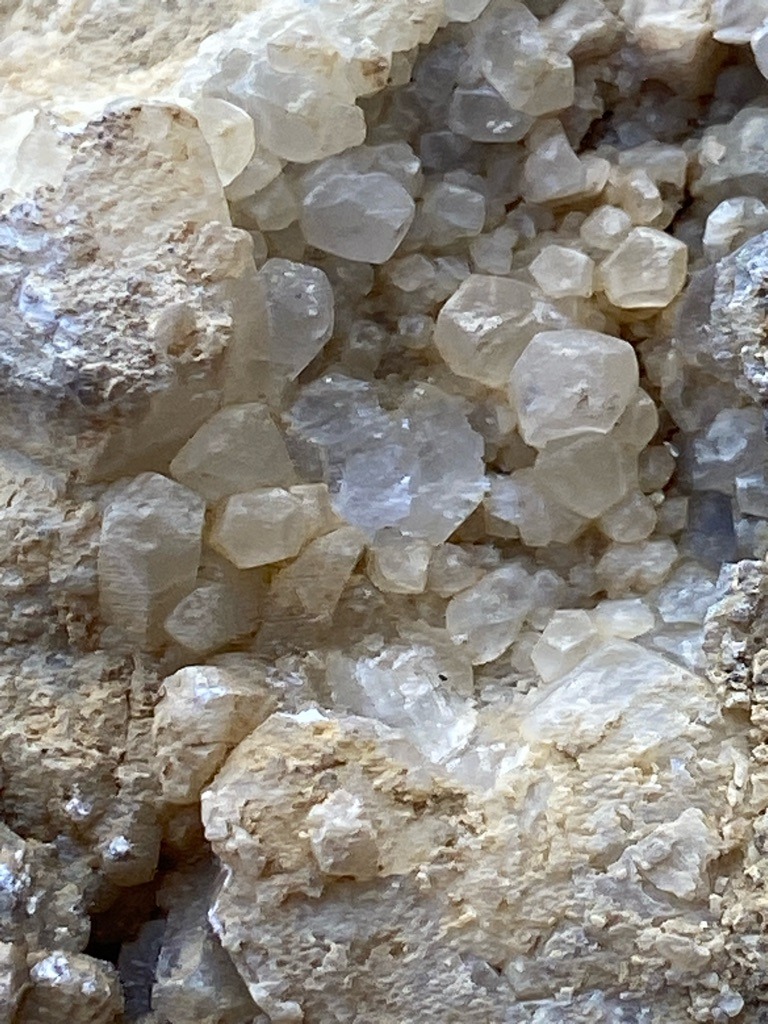
Not a diamond; the image shows raw crystalline mineral formations in a matrix, likely quartz or calcite geode clusters rather than carbon-based diamond crystals.
Not a diamond; the image shows raw crystalline mineral formations in a matrix, likely quartz or calcite geode clusters rather than carbon-based diamond crystals. · Rough crystal habit (subhedral to euhedral raw crystals, not cut or polished).
Not applicable (raw, uncut, natural crystal formation). Cut
Carat
Not applicable; raw mineral matrix with aggregate crystals.
Color
Colorless to pale white and yellowish-white.
Clarity
Included (contains numerous internal fractures, cloudy zones, and mineral inclusions typical of raw matrix minerals).
Shape
Rough crystal habit (subhedral to euhedral raw crystals, not cut or polished).
Overall Assessment
The image depicts a natural raw mineral matrix containing crystalline clusters rather than faceted diamonds, representing a fascinating geological specimen.
Cut Quality
Not applicable (raw, uncut, natural crystal formation).
Brilliance
Vitreous to sub-vitreous luster typical of rough crystalline minerals, less intense than cut diamond.
Fire
Low dispersion compared to diamond.
Scintillation
Limited flash effect due to uneven, unpolished natural crystal surfaces.
Proportions
Irregular raw crystal dimensions; standard cut proportions do not apply.
Symmetry
Natural crystal symmetry (trigonal/hexagonal or rhombohedral depending on exact mineral species).
Polish
Unpolished, natural crystal faces and rough fracture surfaces.
Fluorescence
Unknown without UV testing, though common quartz/calcite may exhibit weak fluorescence.
Inclusions
Abundant natural fractures, cloudiness, and possible fluid or mineral inclusions.
Blemishes
Surface etching, natural growth irregularities, and matrix attachment marks.
Origin
Natural geological formation within host rock matrix.
Treatment Detection
No obvious signs of artificial treatment; appears completely natural.
Estimated Value
Nominal decorative mineral specimen value, depending on exact mineral composition and aesthetics.
Certification Estimate
Gemological identification report rather than a diamond grading report (e.g., standard mineralogical identification).
Investment Potential
Low investment value as a gemstone, valued primarily as a decorative or educational mineral specimen.
Similar Diamonds
Not comparable to cut diamonds; similar to quartz geodes, calcite clusters, or raw pegmatite pocket minerals.
Setting Suggestions
Best displayed as a raw mineral specimen in a natural state or custom wire-wrapped pendant if polished into cabochons.
Care & Maintenance
Clean gently with warm soapy water and a soft brush; avoid harsh acids if the matrix contains carbonate minerals like calcite.
Interesting Facts
Geodes and crystal vugs form when mineral-rich groundwater deposits crystals inside hollow cavities in rocks over thousands of years.