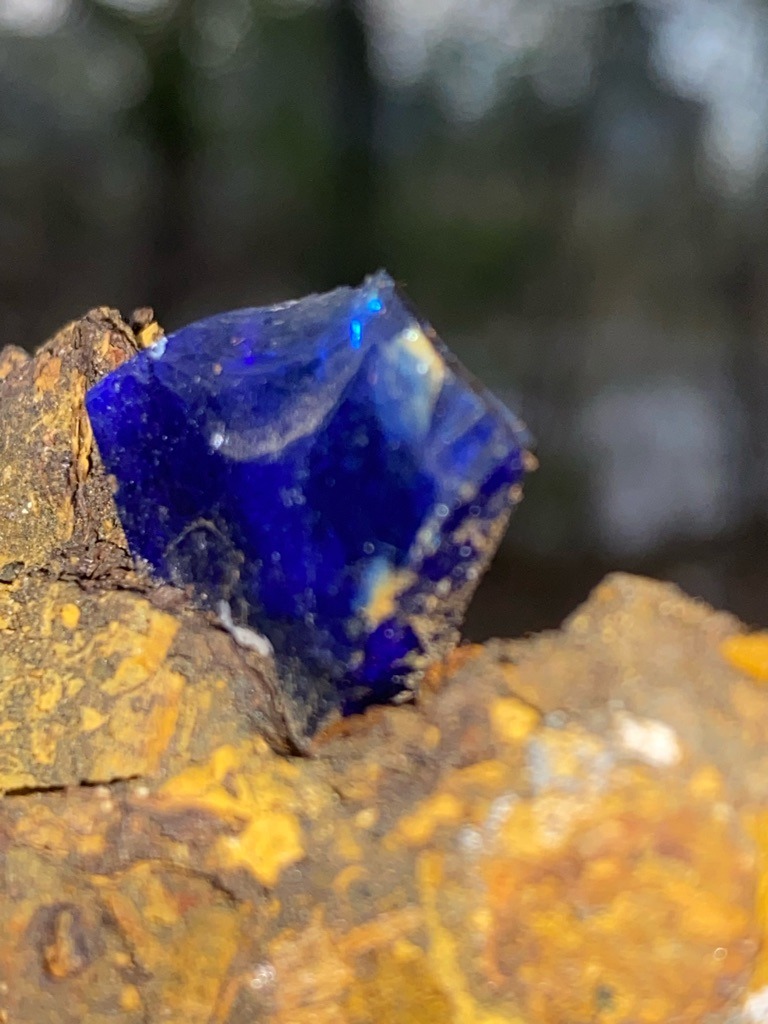
The specimen appears to be Lapis Lazuli, Sodalite, or potentially Blue Glass/Slag rather than a diamond. It does not possess the cubic crystal structure of a natural diamond.
The specimen appears to be Lapis Lazuli, Sodalite, or potentially Blue Glass/Slag rather than a diamond. It does not possess the cubic crystal structure of a natural diamond. · Rough / Uncut mineral specimen with a somewhat rhombohedral or vitreous fracture appearance.
N/A (Rough/Raw specimen). Cut
Carat
Estimated 25 to 50 carats based on size relative to the matrix grain, though density varies by mineral type.
Color
Deep Cobalt Blue / Royal Blue (Not applicable to the D-Z diamond scale).
Clarity
Opaque to Translucent (Included). Not applicable to standard diamond clarity grading.
Shape
Rough / Uncut mineral specimen with a somewhat rhombohedral or vitreous fracture appearance.
Overall Assessment
This is not a diamond. It is a blue mineral specimen, likely Lapis Lazuli or Sodalite, or a piece of cobalt glass nestled in a terrestrial matrix of limonite or clay.
Cut Quality
N/A (Rough/Raw specimen).
Brilliance
Very Low; the material is primarily opaque and does not reflect light internally like a diamond.
Fire
None; there is no light dispersion or spectral separation visible.
Scintillation
None; the surface is matte with some vitreous luster on fracture planes.
Proportions
N/A (Irregular natural crystal habit).
Symmetry
N/A (Rough specimen).
Polish
N/A (Rough/Natural surface).
Fluorescence
Unknown without UV light; many blue minerals like Sodalite show orange fluorescence.
Inclusions
Dense internal clouding, potential pyrite flecks, and matrix host rock remnants.
Blemishes
Heavy surface abrasion, conchoidal fractures, and adhering matrix material.
Origin
Potentially Afghanistan (if Lapis) or possibly man-made slag found in industrial areas.
Treatment Detection
Unable to determine from image; could be dyed or manufactured glass.
Estimated Value
$5 - $50 USD depending on whether it is a natural mineral specimen or man-made material.
Certification Estimate
GIA or IGI Colored Stone Identification Report (likely 'Natural Mineral' or 'Glass').
Investment Potential
Minimal. This is a common mineral specimen or decorative stone with little resale value.
Similar Diamonds
None. This does not resemble any known natural blue diamond such as the Hope Diamond.
Setting Suggestions
Wire-wrapped pendant or kept as a raw mineral specimen for a collection.
Care & Maintenance
Avoid harsh chemicals and ultrasonic cleaners, as many blue minerals (like Lapis) are porous or soft.
Interesting Facts
The deep blue color is often caused by the presencia of sulfur or lazurite in natural minerals.