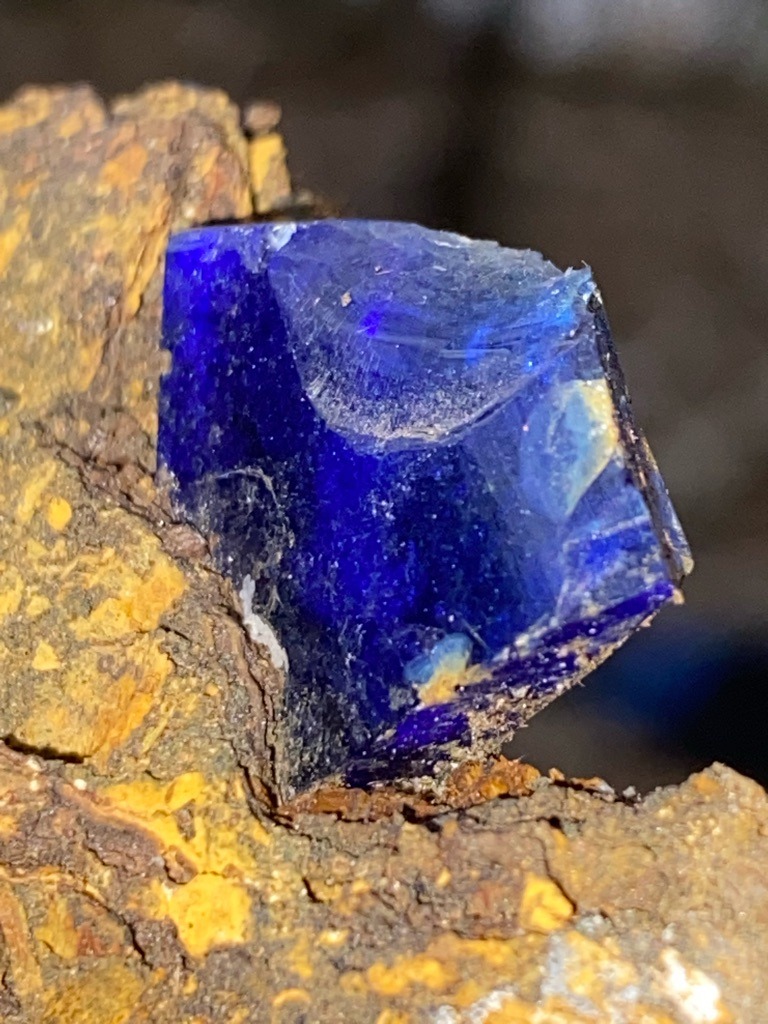
Natural (Fancy Color) - Preliminary visual suggests a rare blue diamond or sapphire; the crystal structure shown is a rough mineral specimen.
Natural (Fancy Color) - Preliminary visual suggests a rare blue diamond or sapphire; the crystal structure shown is a rough mineral specimen. · Rough / Uncut (Natural Octahedron/Cubic habit fragment)
Not Applicable (Rough Crystal) Cut
Carat
Estimated 2.5 - 5.0 carats (unrefined rough)
Color
Fancy Deep Blue / Royal Blue
Clarity
Estimated I1 to I2 (Rough state with visible internal feathers and inclusions)
Shape
Rough / Uncut (Natural Octahedron/Cubic habit fragment)
Overall Assessment
An exceptional mineral specimen of a deep blue crystal embedded in a limonite/iron-rich matrix. Requires professional lab testing to confirm diamond versus sapphire species.
Cut Quality
Not Applicable (Rough Crystal)
Brilliance
Low (Typical of unpolished rough; light is absorbed rather than reflected)
Fire
None visible in rough state
Scintillation
None visible in rough state
Proportions
Not Applicable (Natural rough state)
Symmetry
Fair (Natural crystal symmetry)
Polish
Not Applicable (Natural unpolished surface)
Fluorescence
Likely None or Faint (cannot be determined without UV light)
Inclusions
Large internal feathers, crystal graining, and mineral inclusions visible through the top face.
Blemishes
Growth lines, surface chips, and contact marks from the host rock.
Origin
Likely South Africa (Cullinan Mine) if diamond, or potentially Sri Lanka/Madagascar if Sapphire/Corundum.
Treatment Detection
None apparent; appears in original host matrix.
Estimated Value
$5,000 - $50,000+ (Extremely dependent on whether it is verified as a Type IIb diamond or a Sapphire)
Certification Estimate
GIA (Rough Diamond Report) or IGI for rough evaluation
Investment Potential
High (Natural blue diamonds are among the rarest and most valuable assets on Earth).
Similar Diamonds
Hope Diamond (Historical reference for color), Blue Moon of Josephine (for hue comparison).
Setting Suggestions
Best kept as a specimen or custom-cut to a cushion or oval to maximize color saturation.
Care & Maintenance
Keep in matrix to preserve mineralogical value; avoid ultrasonic cleaners due to visible feathers.
Interesting Facts
Natural blue diamonds get their color from boron atoms trapped in the carbon lattice during formation.