Natural or Lab-Grown Diamond (Visual inspection cannot definitively separate without advanced spectroscopic equipment like FTIR or Photoluminescence, though HPHT/CVD lab-grown origin is highly probable in modern market contexts)
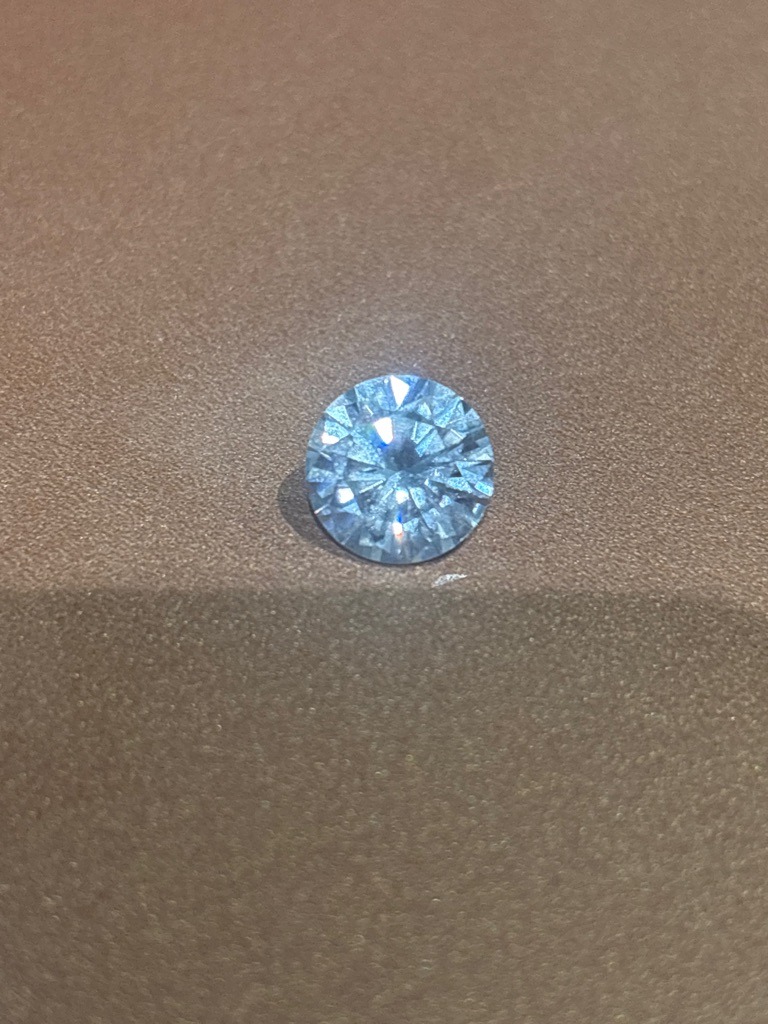
Natural or Lab-Grown Diamond (Visual inspection cannot definitively separate without advanced spectroscopic equipment like FTIR or Photoluminescence, though HPHT/CVD lab-grown origin is highly probable in modern market contexts) · Round Brilliant
Very Good to Excellent (Displays well-proportioned facet alignment, though a slight pavilion bulge or facet mismatch can only be confirmed via proportion scope) Cut
Carat
Estimated approximately 0.75 to 1.00 carat based on standard table sizing ratios relative to typical display setups
Color
Estimated G-H (Colorless range, showing very slight warmth under specific lighting angles, typical of standard commercial grades)
Clarity
Estimated VS1 - VS2 (Very Slightly Included; minor internal characteristics likely present under 10x magnification, but clean to the naked eye)
Shape
Round Brilliant
Overall Assessment
This is a classic, highly desirable Round Brilliant diamond showing balanced proportions, good brilliance, and clean visual clarity, making it an ideal center stone for fine jewelry applications
Cut Quality
Very Good to Excellent (Displays well-proportioned facet alignment, though a slight pavilion bulge or facet mismatch can only be confirmed via proportion scope)
Brilliance
High brightness with strong white light return across the face-up appearance due to good facet symmetry
Fire
Moderate to High dispersion of spectral colors (rainbow flashes), characteristic of a well-cut round diamond
Scintillation
Good play of light and dark areas (sparkle) as the stone moves, demonstrating well-balanced pavilion depth
Proportions
Standard modern round brilliant proportions estimated: Table ~57%, Total Depth ~61%, Crown Angle ~34.5 degrees, Pavilion Angle ~40.8 degrees
Symmetry
Good to Very Good (Good alignment of upper and lower facets, with minimal off-center culet or girdle thickness variation)
Polish
Good (Standard commercial finish with minor microscopic polish lines only visible under high magnification)
Fluorescence
None to Faint (No overwhelming milky appearance or distinct colored glow observed under standard daylight simulation)
Inclusions
Pinpoints and minor feather inclusions likely hidden beneath table facets, typical for VS clarity diamonds
Blemishes
Minor natural or polish marks near the girdle edge, common in uncertified loose stones
Origin
Cannot be definitively determined visually; could be mined internationally (Canada, Russia, Africa, Australia) or produced via HPHT/CVD laboratory methods
Treatment Detection
No obvious signs of fracture filling, laser drilling, or heavy surface coatings; appears untreated
Estimated Value
$2,500 - $5,000 USD (Varies significantly depending on whether it is natural vs. lab-grown, clarity, and exact weight)
Certification Estimate
Likely to receive a report from GIA, IGI, or AGS if submitted, with grades closely matching standard commercial diamond parameters
Investment Potential
Natural diamonds of this grade maintain moderate liquidity and steady historical value retention, whereas lab-grown diamonds generally depreciate rapidly over time
Similar Diamonds
Standard GIA-certified 0.85ct G-VS2 Round Brilliant cut diamonds widely available through major wholesale and retail inventories
Setting Suggestions
Classic 4-prong or 6-prong solitaire setting in Platinum or 18k White Gold to maximize the white face-up color
Care & Maintenance
Clean regularly with warm soapy water and a soft-bristled brush. Store separately in a fabric-lined jewelry box to prevent scratching other pieces
Interesting Facts
The Round Brilliant cut features 58 facets (including the culet) mathematically optimized by Marcel Tolkowsky in 1919 to maximize light return and fire