Natural Rough Crystal / Industrial Grade Diamond
Natural Rough Crystal / Industrial Grade Diamond · Uncut / Rough Crystal
None (Rough/Uncut) Cut
Carat
Estimated 2.0 to 5.0 carats based on visual density and macro scale
Color
Likely J-L range (Near Colorless to Faint Yellow)
Clarity
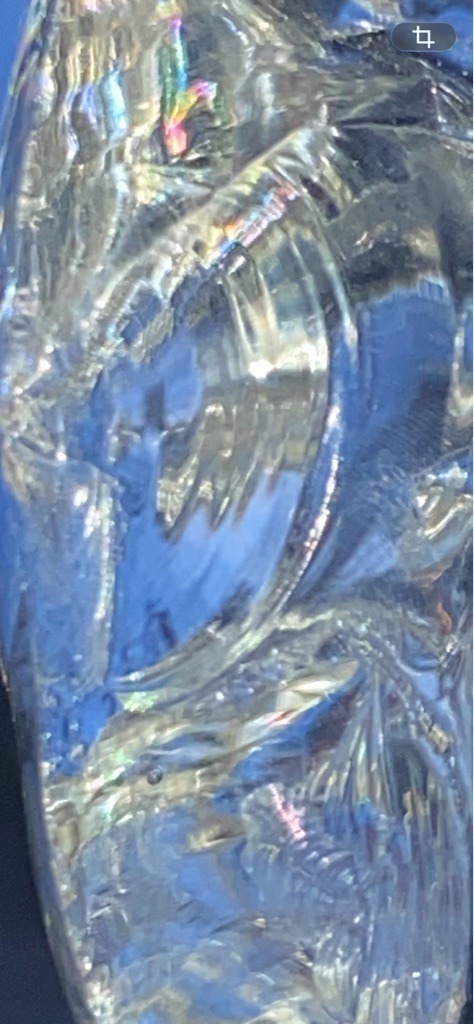
I1 to I3 (Included) due to heavy internal twinning and fractures
Shape
Uncut / Rough Crystal
Overall Assessment
This is a natural rough diamond crystal displaying significant internal strain and inclusions. While it shows beautiful natural dispersion (fire) in specific lighting, its heavy internal features make it more suitable as a collector's specimen or for unique rough-diamond jewelry rather than for facet cutting into a high-clarity gem.
Cut Quality
None (Rough/Uncut)
Brilliance
Low (Surface reflection only, no internal light return due to lack of facets)
Fire
Moderate (Natural dispersion visible in high-relief fracture zones)
Scintillation
Low (Static surface luster)
Proportions
N/A (Non-faceted)
Symmetry
Poor (Natural as-mined state)
Polish
Poor (Natural crystalline surface)
Fluorescence
Indeterminate without UV light source
Inclusions
Extensive internal twinning, knot-like structures, and internal cleavage planes
Blemishes
Natural trigons and surface growth indentations characteristic of kimberlite extraction
Origin
Likely African (DRC or Botswana) based on surface texture and luster
Treatment Detection
None detected; appears in natural raw state
Estimated Value
$150 - $400 USD (Value is primarily as a specimen or for industrial cutting)
Certification Estimate
GIA Rough Diamond Report (likely graded as Industrial or Near-Gem)
Investment Potential
Low (Specimen value only; high risk and cost associated with cutting/polishing)
Similar Diamonds
Natural conflict-free rough specimens found in artisanal mining collections
Setting Suggestions
Rough diamond specimen pendant using a 'claw' or 'cage' setting to preserve the natural shape
Care & Maintenance
Avoid ultrasonic cleaners which may expand internal fractures; clean with lukewarm soapy water and soft brush
Interesting Facts
Rough diamonds often look like pieces of glass to the untrained eye but possess unique 'trigons' (triangular pits) on their surface that prove their identity