Indeterminate Non-Diamond (Likely Glass or Quartz)
Indeterminate Non-Diamond (Likely Glass or Quartz) · Rough / Irregular Curved Slicing
Poor (Non-geometric, lacks faceted symmetry) Cut
Carat
Unknown (Insufficient scale, but appearing large)
Color
Near Colorless / Transparent
Clarity
I3 (Prominent internal fracturing and structural flaws)
Shape
Rough / Irregular Curved Slicing
Overall Assessment
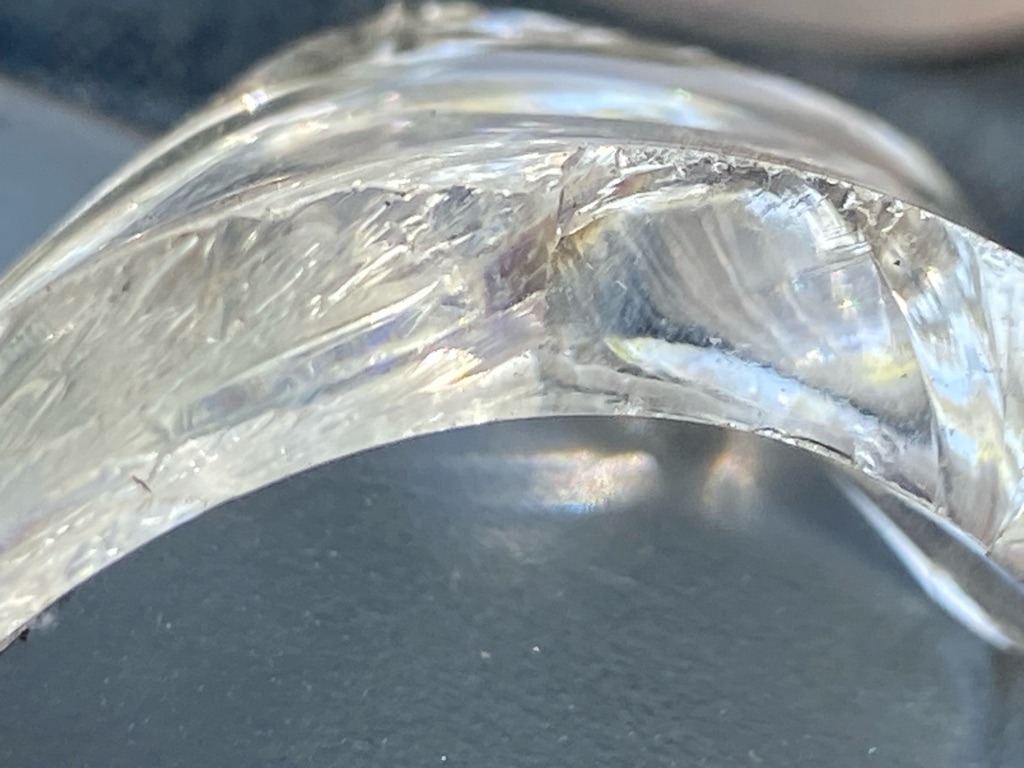
This specimen lacks the optical properties, refractive index, and crystal structure of a diamond. The visible fracturing and surface texture suggest it is most likely a shard of glass or a common silica mineral.
Cut Quality
Poor (Non-geometric, lacks faceted symmetry)
Brilliance
Very Low (Lacks critical internal reflection)
Fire
Very Low (No significant dispersion noted)
Scintillation
None (Glassy, matte appearance in shadows)
Proportions
N/A (Lacks traditional diamond proportions)
Symmetry
Poor / Asymmetric
Polish
Poor (Surface shows abrasion and coarse texture)
Fluorescence
None observable under standard lighting
Inclusions
Conchoidal fracturing, large internal cleavage planes, and swirl-like textures
Blemishes
Severe surface abrasions, pitting, and jagged edges
Origin
Terrestrial (Likely industrial or silica-based)
Treatment Detection
None detected; appears to be raw broken material
Estimated Value
Minimal to Commercial Utility Value
Certification Estimate
Unlikely to be graded by GIA/AGS as a gemstone
Investment Potential
None
Similar Diamonds
Comparable to industrial grade bort or cullet glass
Setting Suggestions
Not recommended for jewelry due to low durability and clarity
Care & Maintenance
Avoid impact; material appears brittle with existing fractures
Interesting Facts
The conchoidal (shell-like) fracture pattern is highly characteristic of glass or amorphous silica rather than crystalline diamond.