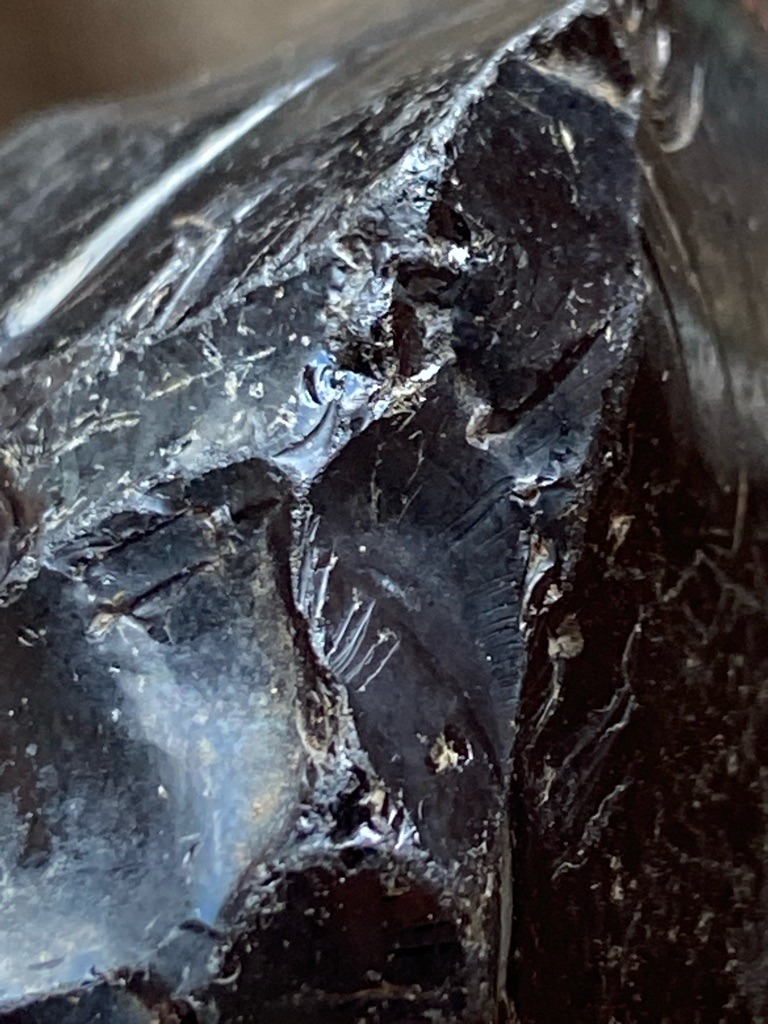
Not a diamond; this specimen appears to be black obsidian or another dark, amorphous glass/mineral exhibiting conchoidal fracture patterns typical of volcanic glass, not crystalline carbon.
Not a diamond; this specimen appears to be black obsidian or another dark, amorphous glass/mineral exhibiting conchoidal fracture patterns typical of volcanic glass, not crystalline carbon. · Raw, uncut, and unpolished irregular mineral matrix with conchoidal fractures.
Not applicable (Rough, unfaceted mineral specimen showing natural conchoidal breakage). Cut
Carat
Not applicable; gemstone grading standards do not apply to raw amorphous volcanic rocks.
Color
Opaque black (Natural dark color phase of volcanic glass).
Clarity
Not applicable; contains inherent natural mineral inclusions, flow patterns, and internal stress fractures common in volcanic glass.
Shape
Raw, uncut, and unpolished irregular mineral matrix with conchoidal fractures.
Overall Assessment
The visual evidence confirms that this specimen is a natural dark volcanic glass (obsidian) rather than a diamond. It displays classic conchoidal fracture lines and vitreous luster, completely lacking the crystal structure, hardness, brilliance, and optical properties of a diamond.
Cut Quality
Not applicable (Rough, unfaceted mineral specimen showing natural conchoidal breakage).
Brilliance
Low to moderate vitreous reflection along polished or freshly fractured glass-like surfaces.
Fire
None; glass and obsidian do not possess the high refractive index or dispersion of diamond.
Scintillation
Poor; lacks internal facet reflections and pattern play found in cut gemstones.
Proportions
Not applicable; lacks standard gemstone facets, table, depth, crown, or pavilion.
Symmetry
Asymmetrical due to random natural fracturing and cooling patterns.
Polish
Raw and unpolished; exhibits natural vitreous to greasy luster on fracture surfaces.
Fluorescence
None observed under standard visual inspection.
Inclusions
Microlites, mineral dust, and internal gas bubbles typical of natural volcanic rock formation.
Blemishes
Natural conchoidal fracture scars, chipped edges, and surface weathering marks.
Origin
Volcanic regions worldwide where rapid cooling of felsic lava occurs (e.g., USA, Mexico, Iceland).
Treatment Detection
None; appears to be entirely natural untreated volcanic material.
Estimated Value
Nominal decorative or specimen value (typically low market value as a raw mineral/obsidian sample).
Certification Estimate
Not certifiable by standard gemological grading laboratories (GIA, AGS, IGI) as a gemstone; requires mineralogical identification.
Investment Potential
None as an investment asset; valued primarily for educational, lapidary, or decorative purposes.
Similar Diamonds
None; this specimen shares no physical, optical, or chemical properties with diamonds.
Setting Suggestions
Typically utilized in wire-wrapped pendants, lapidary carvings, or displayed as a raw mineral specimen rather than traditional fine jewelry settings.
Care & Maintenance
Store separately to prevent scratching softer materials; clean gently with warm soapy water and a soft cloth; avoid harsh chemicals and impact due to brittle fracture tendencies.
Interesting Facts
Obsidian was historically used by ancient civilizations to create sharp cutting tools, arrowheads, and mirrors due to its extremely sharp conchoidal edges.