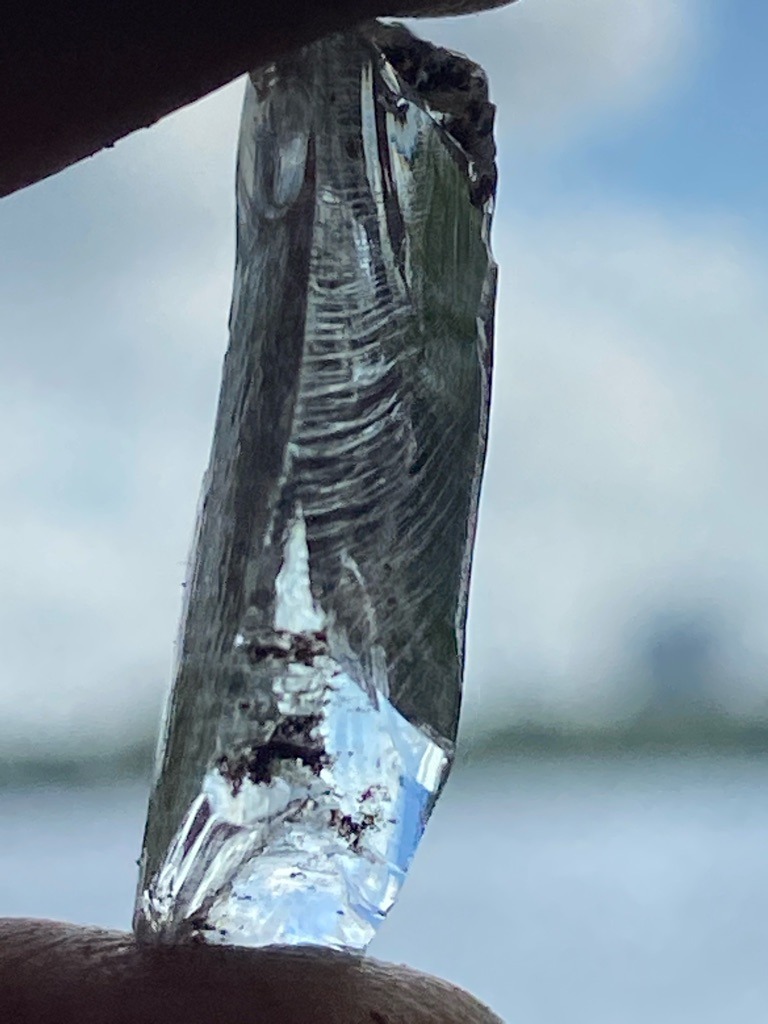
Natural diamond rough crystal, displaying characteristic elongated form and surface striations (growth lines).
Natural diamond rough crystal, displaying characteristic elongated form and surface striations (growth lines). · Uncut or raw elongated crystal, potentially an octahedral or distorted dodecahedral habit.
Not applicable as this is a raw, unpolished rough crystal rather than a faceted gem. Cut
Carat
Estimated to be roughly between 2.0 to 4.0 carats based on visual proportions held against fingers.
Color
Appears near-colorless to slightly tinted, likely in the H-J range, though difficult to grade accurately in raw form.
Clarity
Estimated at I1 to I3 due to visible dark inclusions, cloudiness, and internal fractures near the base.
Shape
Uncut or raw elongated crystal, potentially an octahedral or distorted dodecahedral habit.
Overall Assessment
An interesting, natural rough diamond crystal displaying classic growth features and inclusions, serving as a fascinating specimen of natural diamond formation before human cutting and polishing.
Cut Quality
Not applicable as this is a raw, unpolished rough crystal rather than a faceted gem.
Brilliance
Low brilliance in its current rough state; light transmission is hindered by internal inclusions and lack of facets.
Fire
Minimal dispersion or fire observed due to the lack of precision-cut facets and rough surface finish.
Scintillation
Almost no scintillation in its uncut state, though raw faces reflect ambient light broadly.
Proportions
Elongated rough form; table and depth percentages do not apply as it has not been faceted.
Symmetry
Natural crystal symmetry showing elongation and typical growth striations along the faces.
Polish
Natural crystal faces, unpolished; displaying raw texture and trigons or striations.
Fluorescence
Cannot be determined without UV light testing, but typical natural rough often exhibits faint to medium blue fluorescence.
Inclusions
Noticeable dark carbon spots and mineral inclusions concentrated towards the lower half, along with internal feather fractures.
Blemishes
Natural surface pitting, rough edges, irregular growth marks, and abrasion along the exterior.
Origin
Likely from alluvial deposits or primary kimberlite pipes in regions such as Africa, Russia, or Canada.
Treatment Detection
No signs of enhancement; appears entirely untreated and in its natural mined state.
Estimated Value
Valued primarily as an industrial or specimen-grade rough diamond, typically ranging from $50 to $200 depending on weight and purity.
Certification Estimate
Major gemological labs (GIA, IGI) would grade this as rough diamond, typically issued as an identification report rather than a standard grading report.
Investment Potential
Low investment potential for standard resale; primarily of interest to mineral collectors, educational purposes, or custom organic jewelry designers.
Similar Diamonds
Comparable to other raw industrial or collector-grade diamond crystals of similar size and clarity.
Setting Suggestions
Best showcased in a bespoke, organic-style wire-wrap or custom bezel setting that preserves its raw, natural crystal shape.
Care & Maintenance
Handle with care to prevent chipping along natural cleavage planes; clean gently with warm soapy water and a soft brush.
Interesting Facts
The parallel striations seen on the surface are growth lines that indicate how the carbon atoms stacked together during the diamond's formation deep within the Earth.