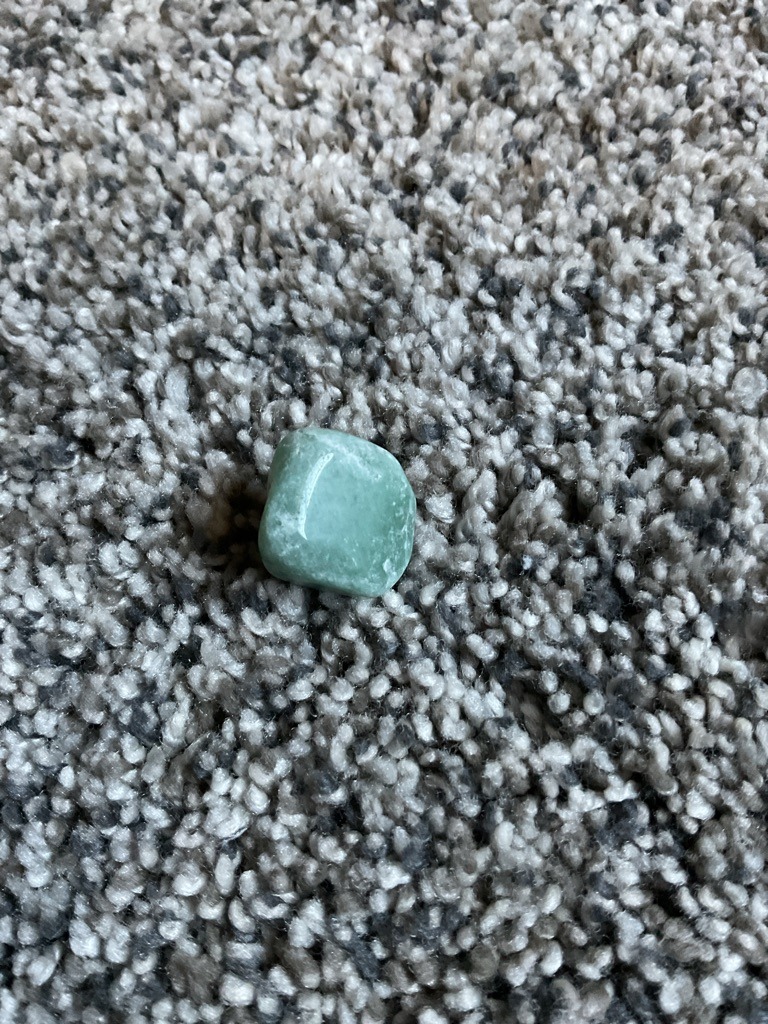
Non-Diamond. The specimen possesses characteristics consistent with a common green ornamental stone, such as Adventurine, Jadeite, or Nephrite, rather than a diamond.
Non-Diamond. The specimen possesses characteristics consistent with a common green ornamental stone, such as Adventurine, Jadeite, or Nephrite, rather than a diamond. · Rough Tumbled / Freeform. The stone lacks a professional gemological cut and is instead rounded and polished into a pebble-like shape.
N/A (Tumble Polish). There are no defined facets to evaluate for light performance. Cut
Carat
Estimated 8-12 carats, assuming a density typical of common minerals like quartz or jade.
Color
Opaque Seafoam Green. This does not fall under the GIA D-Z diamond scale.
Clarity
Opaque / Translucent. The stone is not transparent enough for standard diamond clarity grading.
Shape
Rough Tumbled / Freeform. The stone lacks a professional gemological cut and is instead rounded and polished into a pebble-like shape.
Overall Assessment
The specimen provided is not a diamond. It is a tumbled green mineral used for decorative or metaphysical purposes. It lacks the crystal structure, hardness, and refractive properties required for diamond identification.
Cut Quality
N/A (Tumble Polish). There are no defined facets to evaluate for light performance.
Brilliance
None. The stone absorbs light rather than reflecting it internally.
Fire
None. The material does not possess the refractive index or dispersion necessary for fire.
Scintillation
None. There are no facets to create light-dark patterns.
Proportions
Non-geometric. The specimen is a rounded, irregular mass with no crown, pavilion, or table.
Symmetry
Poor/Asymmetrical. The stone follows a natural, irregular organic shape.
Polish
Good for a tumbled stone, showing some surface luster but no gem-quality mirror finish.
Fluorescence
None observed visually under standard lighting.
Inclusions
Cloudy internal structures and white mottling consistent with mineral grains in metamorphic stones.
Blemishes
Visible surface pits and uneven texture typical of tumbled rocks.
Origin
Terrestrial mineral; possibly sourced from metamorphic rock deposits containing quartz or silicates.
Treatment Detection
Tumble-polished; may have been dyed or wax-stabilized to enhance surface luster.
Estimated Value
Minimal market value, likely $1 to $5 USD as a decorative or healing stone.
Certification Estimate
Unlikely to be graded by GIA or AGS as it is not a diamond or high-end gemstone.
Investment Potential
Low/None. This is a common decorative mineral rather than a financial asset.
Similar Diamonds
None. This specimen does not resemble any known grade of diamond.
Setting Suggestions
Wire-wrap pendant or a macrame holder for casual, bohemian-style jewelry.
Care & Maintenance
Avoid harsh chemicals; clean with lukewarm water and a soft cloth.
Interesting Facts
Stones of this color are often associated with Green Aventurine, which is sometimes called the Stone of Opportunity.