Likely Non-Diamond (Commonly Glass or Quartz)
Likely Non-Diamond (Commonly Glass or Quartz) · Rough / Irregular (Broken Fragment)
Uncut / Raw / Natural Cleavage Cut
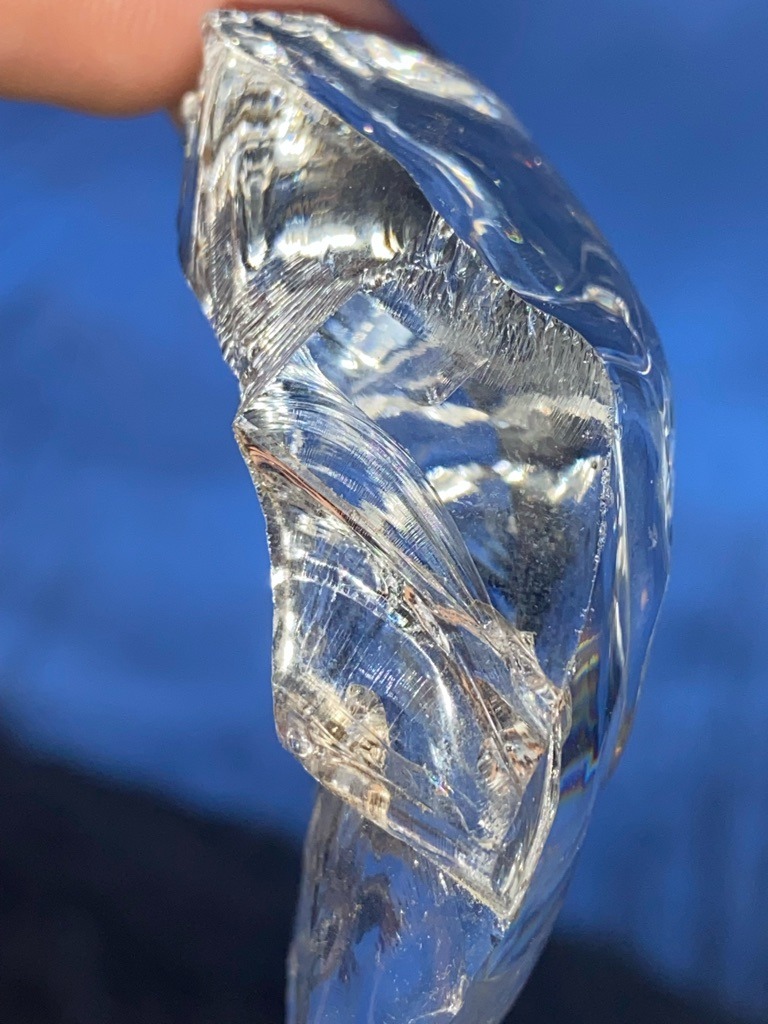
Carat
Estimated 10-15 carats (visual size in hand)
Color
Colorless (equivalent to D-E range)
Clarity
Translucent with heavy surface distortions
Shape
Rough / Irregular (Broken Fragment)
Overall Assessment
The specimen displays physical characteristics inconsistent with diamond. The surface texture, fracture pattern, and light behavior strongly suggest it is a fragment of glass or clear quartz rather than a gemstone.
Cut Quality
Uncut / Raw / Natural Cleavage
Brilliance
Low; lacks the high refractive index of diamond
Fire
Very Low; minimal dispersion visible
Scintillation
None; surface reflections rather than internal sparkle
Proportions
N/A (Irregular geometry)
Symmetry
N/A (Rough stone)
Polish
None (Surface exhibits conchoidal fracturing)
Fluorescence
None observed
Inclusions
Bubbles or stress lines visible internally; lack of crystal habit
Blemishes
Heavy surface scuffing and impact marks consistent with glass
Origin
Man-made industrial glass or common quartz
Treatment Detection
N/A
Estimated Value
Minimal to zero (decorative/specimen value)
Certification Estimate
N/A; most labs (GIA) would identify this as non-diamond/glass
Investment Potential
None
Similar Diamonds
None; visually distinct from rough diamond crystal habits
Setting Suggestions
Not recommended for fine jewelry; wire wrapping if kept as a specimen
Care & Maintenance
Avoid impact; glass is prone to further chipping and breaking
Interesting Facts
The curved, shell-like (conchoidal) fractures on the surface are a diagnostic indicator of glass or quartz, as diamonds cleave along flat planes.