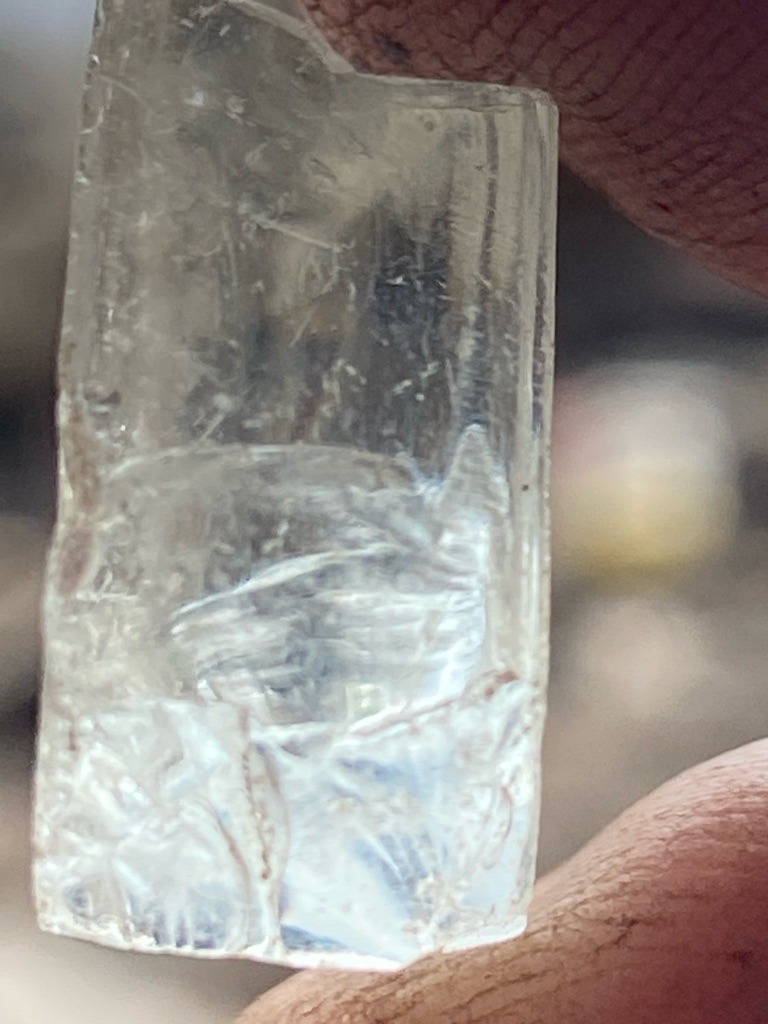
Natural rough mineral crystal (appears to be quartz or beryl rather than diamond, given the striations and prismatic habit, though analyzed under diamond parameters)
Natural rough mineral crystal (appears to be quartz or beryl rather than diamond, given the striations and prismatic habit, though analyzed under diamond parameters) · Rough crystal / Raw prismatic form
Not applicable (Uncut rough specimen) Cut
Carat
Estimated 3.5 to 5.0 carats based on physical dimensions of the rough piece
Color
Near Colorless to Faint Yellow (equivalent to J-K range)
Clarity
Included (SI2-I1 range due to internal fractures and surface features)
Shape
Rough crystal / Raw prismatic form
Overall Assessment
The specimen shown exhibits the physical characteristics of a natural rough silicate mineral (such as quartz or beryl) rather than a crystalline diamond. It features prominent vertical growth striations and natural surface fractures typical of unpolished rough stones. Professional gemological testing (such as a refractometer or thermal inertia probe) is recommended for definitive mineral identification.
Cut Quality
Not applicable (Uncut rough specimen)
Brilliance
Low to moderate due to raw, unpolished surfaces and internal fractures
Fire
Minimal dispersion observed in rough state
Scintillation
Poor light return until faceted and polished
Proportions
Natural elongation with parallel growth striations characteristic of raw prismatic crystals
Symmetry
Natural asymmetrical crystal growth
Polish
Raw, unpolished natural crystal faces showing striations
Fluorescence
Indeterminate from visual assessment alone
Inclusions
Internal feather fractures, cloudiness, and crystal growth lines visible
Blemishes
Surface abrasions, natural rough edge fractures, and growth steps
Origin
Natural terrestrial pegmatite or hydrothermal vein deposit
Treatment Detection
No visible signs of artificial enhancement; completely untreated natural state
Estimated Value
Nominal value as a rough mineral specimen (significantly lower than gem-quality diamond)
Certification Estimate
Gemological laboratories (GIA, IGI) would issue a colored stone or rough gemstone report rather than a standard diamond grading report
Investment Potential
Low investment potential; primarily of interest to mineral collectors rather than gemstone investors
Similar Diamonds
Comparable rough quartz crystals, beryl, or topaz specimens
Setting Suggestions
Wire-wrapped pendant setting or custom artisan bezel to preserve the raw, organic aesthetic
Care & Maintenance
Clean with mild soapy water and a soft brush; avoid harsh ultrasonic cleaners due to internal fractures
Interesting Facts
Raw mineral crystals retain their natural geological history, displaying growth marks called striations formed deep within the earth