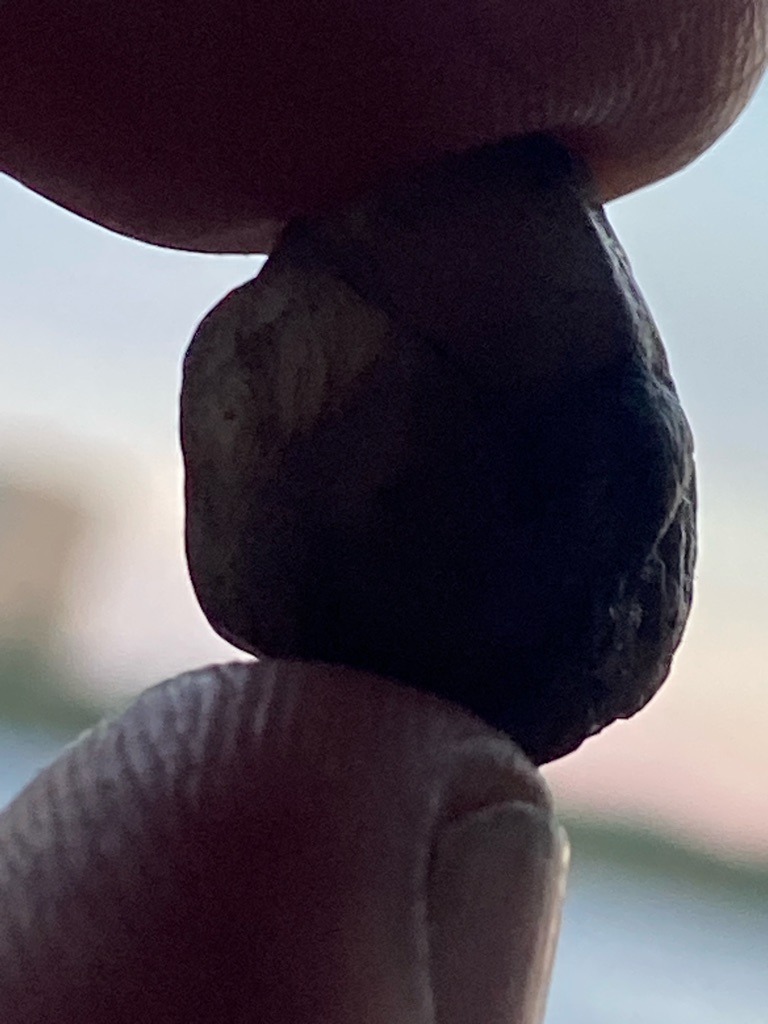
Natural rough diamond crystal
Natural rough diamond crystal · Uncut octahedral or irregular crystal rough
Not applicable (uncut natural rough stone) Cut
Carat
Estimated 1.5 to 3.0 carats based on typical finger scale appearance
Color
Difficult to assess accurately in silhouette; appears near-colorless to light brown rough
Clarity
Not applicable (rough unpolished crystal; inclusions hidden internally)
Shape
Uncut octahedral or irregular crystal rough
Overall Assessment
An authentic natural rough diamond crystal held between fingers, presenting a fascinating raw form before potential cutting and faceting.
Cut Quality
Not applicable (uncut natural rough stone)
Brilliance
None in current uncut rough state
Fire
None in current uncut rough state
Scintillation
None in current uncut rough state
Proportions
Natural rough proportions, requires sawing and faceting planning
Symmetry
Natural crystal symmetry (octahedral/dodecahedral tendencies)
Polish
Natural crystal faces (trigons, natural growth lines)
Fluorescence
Cannot be determined without UV light testing
Inclusions
Likely internal feathers, carbon spots, or crystal inclusions typical of rough
Blemishes
Natural surface skin, pitting, and rough texture
Origin
Natural alluvial or primary kimberlite deposit origin
Treatment Detection
No signs of artificial treatment; completely natural rough crystal
Estimated Value
Varies widely based on internal quality upon cutting, roughly $500 to $3,000 as rough
Certification Estimate
Requires GIA Rough Diamond Evaluation or Kimberley Process documentation
Investment Potential
Moderate, high risk/reward depending on the outcome of cutting and polishing
Similar Diamonds
Standard run-of-mine natural industrial/gem grade rough diamond crystals
Setting Suggestions
Can be set raw in a rustic organic bezel setting or cut into a round brilliant
Care & Maintenance
Store safely; rough diamonds are durable (10 on Mohs scale) but can chip along cleavage planes
Interesting Facts
Rough diamonds show natural growth features like curved faces and triangular etch marks called trigons