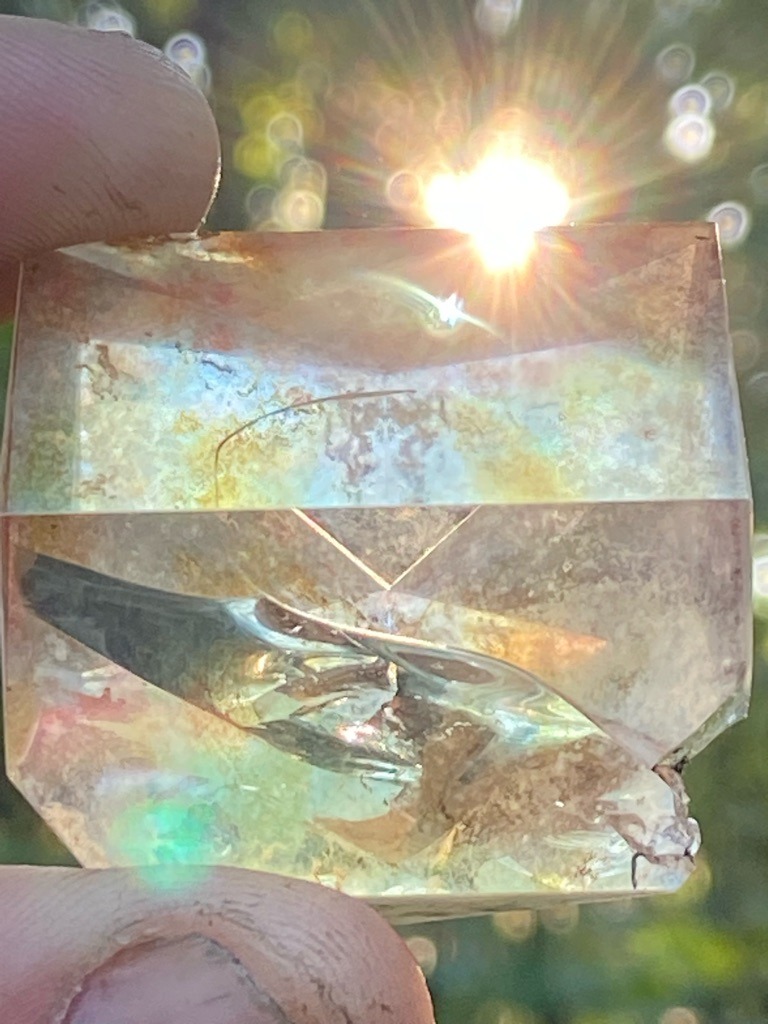
Natural diamond crystal or a specialized collector mineral specimen, showing complex internal features that require microscopic verification to confirm exact identity and matrix composition.
Natural diamond crystal or a specialized collector mineral specimen, showing complex internal features that require microscopic verification to confirm exact identity and matrix composition. · Rough or partially modified crystalline form with natural habit combined with faceted or cleaved planes.
Not applicable to standard cut grading as this appears to be a natural or partially worked crystal rather than a professionally cut gemstone. Cut
Carat
Difficult to assess visually from a single two-dimensional photograph due to unknown depth and irregular dimensions, but likely significant if genuine diamond material.
Color
Fancy Brown-Yellow with iridescent surface interference colors.
Clarity
Included (I3) due to heavy internal feathers, fractures, and prominent mineral inclusion or structural flaw visible through the table/crown.
Shape
Rough or partially modified crystalline form with natural habit combined with faceted or cleaved planes.
Overall Assessment
This specimen displays heavy internal inclusions, structural fractures, and irregular form. While visually fascinating with optical play of light, it does not conform to standard gem-quality diamond parameters.
Cut Quality
Not applicable to standard cut grading as this appears to be a natural or partially worked crystal rather than a professionally cut gemstone.
Brilliance
Low brilliance due to heavy internal inclusions and fractures obstructing light return.
Fire
Minimal dispersion observed; optical effects appear mostly as surface iridescence or interference colors rather than true dispersion from facets.
Scintillation
Poor scintillation due to lack of standard facet patterns and high internal obstruction.
Proportions
Non-standard proportions due to rough/natural crystal morphology.
Symmetry
Irregular natural crystal symmetry with asymmetrical facet development.
Polish
Varied surface texture combining natural crystal faces with cleaved or partially polished areas.
Fluorescence
Cannot be definitively determined without ultraviolet (UV) light testing.
Inclusions
Prominent dark internal inclusion/feather running through the pavilion area and surface-reaching fractures.
Blemishes
Natural surface pitting, rough spots, and potential abrasion along edges.
Origin
Likely natural geological formation, though specific mine origin cannot be determined visually.
Treatment Detection
Potential signs of surface coating or fracture-filling iridescence; microscopic analysis needed to check for clarity enhancement treatments.
Estimated Value
Nominal or specimen-grade value depending on exact mineral composition; significantly lower than a gem-quality polished diamond due to severe clarity impairments.
Certification Estimate
Major gemological laboratories (such as GIA) would issue a colored diamond or technical report noting treatment or heavy inclusions if confirmed as natural diamond.
Investment Potential
Low investment potential for resale liquidity; valuable primarily as a unique geological or mineral specimen.
Similar Diamonds
Industrial-grade diamond crystals, heavily included industrial stones, or collector mineral specimens.
Setting Suggestions
Custom bezel or protective cage setting to safeguard vulnerable fracture lines if mounted as a unique collector jewelry piece.
Care & Maintenance
Extreme care required; avoid ultrasonic cleaning, harsh chemicals, or thermal shock due to extensive internal fractures and structural weaknesses.
Interesting Facts
Stones with prominent internal features and natural character are often treasured by mineral collectors who appreciate the raw geological history over commercial perfection.