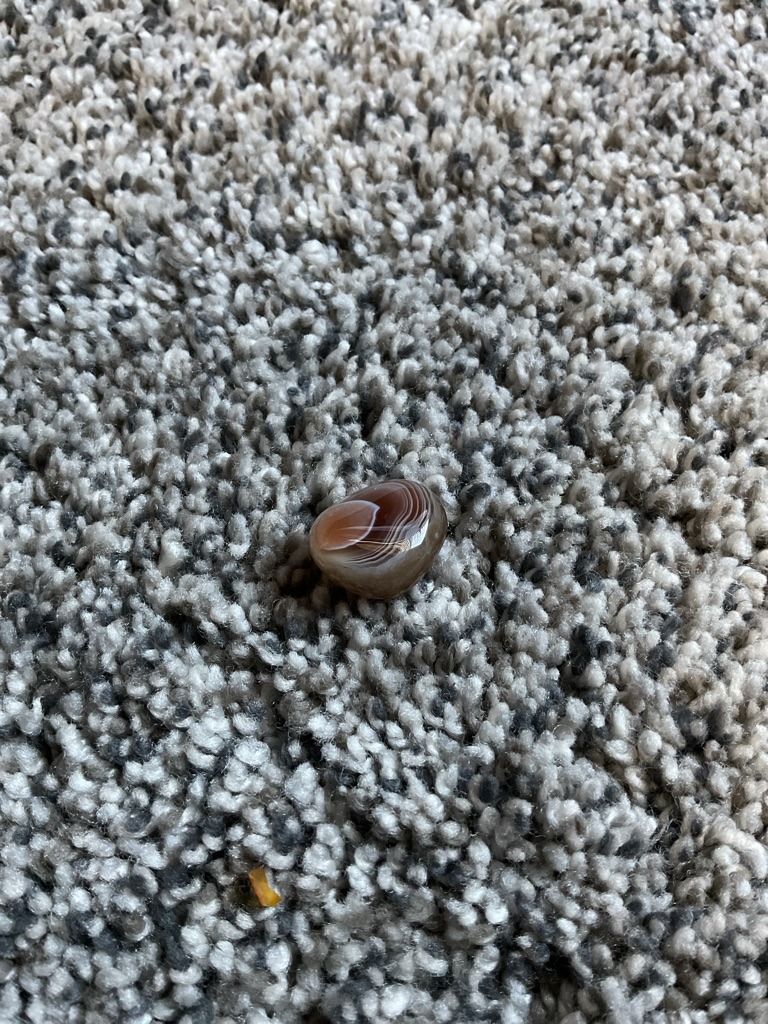
The specimen in the image is not a diamond; it is a variety of Chalcedony, specifically a Banded Agate or Lake Superior Agate.
The specimen in the image is not a diamond; it is a variety of Chalcedony, specifically a Banded Agate or Lake Superior Agate. · Tumbled/Organic (The stone is a rounded, polished river-rock style pebble, not a faceted gemstone cut.)
Not applicable (Tumbled polish rather than faceted cut). Cut
Carat
Approximately 5 to 15 carats (estimated based on size relative to carpet fibers).
Color
Non-applicable to D-Z scale; exhibits earth-toned banding in shades of reddish-brown, tan, and translucent white.
Clarity
Opaque to translucent; internal banding and fortification patterns are characteristic of agate rather than crystal clarity.
Shape
Tumbled/Organic (The stone is a rounded, polished river-rock style pebble, not a faceted gemstone cut.)
Overall Assessment
The object is a natural Agate pebble, not a diamond. It is valued for its unique banding patterns and natural aesthetic rather than gemstone rarity.
Cut Quality
Not applicable (Tumbled polish rather than faceted cut).
Brilliance
Very low (Waxy to vitreous luster rather than diamond-like brilliance).
Fire
None (Quartz-based minerals do not possess the dispersion required for fire).
Scintillation
None (The surface reflects light as a solid mass rather than through internal facets).
Proportions
Not applicable (No specific table, crown, or pavilion angles).
Symmetry
Asymmetrical/Organic.
Polish
Good (Smooth, glossy surface finish typical of rock tumbling).
Fluorescence
Likely None (though some agates show faint green under UV, this is not a diamond characteristic).
Inclusions
Distinctive concentric banding and potentially quartz crystallization centers.
Blemishes
Minor surface pits or scratches common in tumbled semi-precious stones.
Origin
Likely Northern United States (e.g., Lake Superior region) or Brazil, common sources for banded agates.
Treatment Detection
Possibly dyed, though the colors shown appear consistent with natural iron-oxide staining in agates.
Estimated Value
Nominal ($1.00 - $5.00 USD). These are common decorative and collectable stones.
Certification Estimate
Not eligible for diamond grading (GIA/IGI); would be classified as 'Banded Agate' by a gemological lab.
Investment Potential
None (Agate is an abundant semi-precious mineral with high availability and low resale value).
Similar Diamonds
None (This material is mineralogically unrelated to diamond).
Setting Suggestions
Wire-wrapped jewelry, decorative bowl filler, or a simple silver bezel pendant.
Care & Maintenance
Clean with warm soapy water. While durable (Mohs hardness 6.5-7), avoid harsh chemicals.
Interesting Facts
The bands in this stone were formed by silica-rich water depositing layers in gas bubbles within volcanic lava millions of years ago.