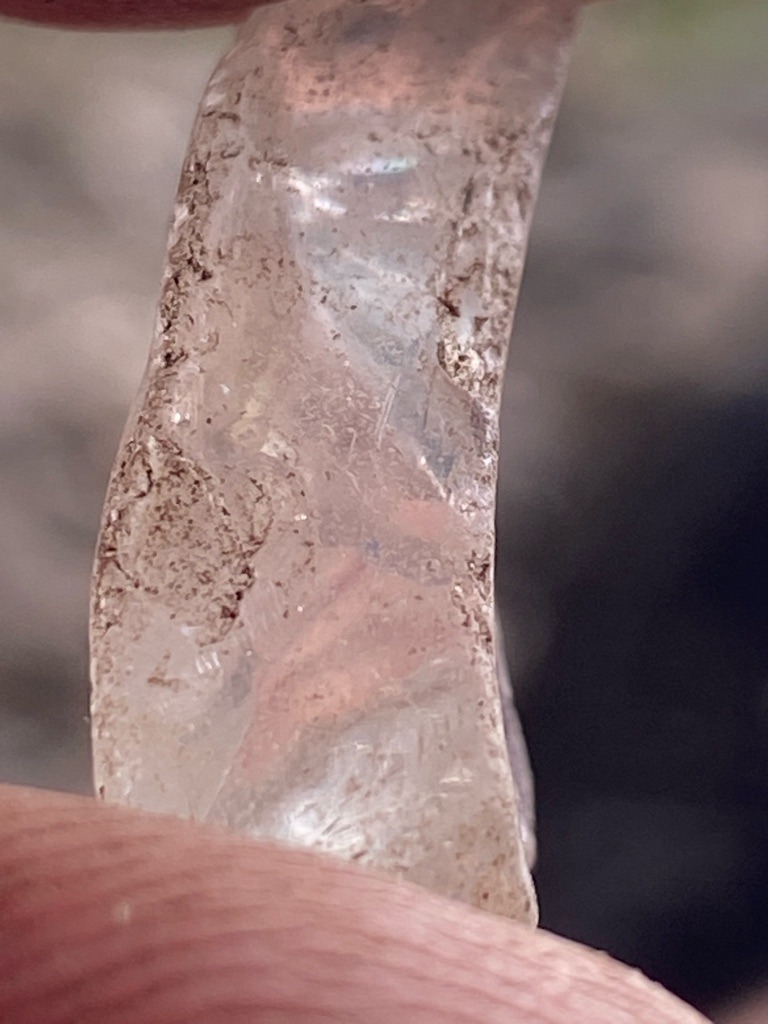
Rough natural crystal specimen, heavily weathered or alluvial, likely quartz or common opal rather than gemstone-quality diamond given the surface texture, fracture patterns, and lack of characteristic diamond crystal faces (octahedron/dodecahedron). However, assuming standard diamond analysis criteria applied to rough alluvial diamond.
Rough natural crystal specimen, heavily weathered or alluvial, likely quartz or common opal rather than gemstone-quality diamond given the surface texture, fracture patterns, and lack of characteristic diamond crystal faces (octahedron/dodecahedron). However, assuming standard diamond analysis criteria applied to rough alluvial diamond. · Uncut raw crystal fragment / irregular alluvial pebble shape
Not applicable (Rough uncut stone; would require full cutting and faceting to achieve a formal cut grade, likely grading Poor to Fair upon transformation) Cut
Carat
Estimated 4.50 to 6.00 carats based on visual scale against fingers (assuming diamond density)
Color
Near-colorless to light brown tint (equivalent to K-M range)
Clarity
I3 (Included 3) with heavy surface inclusions, fractures, and structural flaws
Shape
Uncut raw crystal fragment / irregular alluvial pebble shape
Overall Assessment
The specimen shown exhibits the characteristics of a heavily weathered, rough mineral or alluvial crystal fragment. While visually compelling as a raw stone, it lacks the optical properties, crystal morphology, and clarity required for high-end jewelry use without substantial cutting and significant loss of weight.
Cut Quality
Not applicable (Rough uncut stone; would require full cutting and faceting to achieve a formal cut grade, likely grading Poor to Fair upon transformation)
Brilliance
Very low to negligible due to rough, unpolished exterior and internal fractures
Fire
Minimal dispersion visible through the rough surface
Scintillation
Absent due to lack of flat polished facets to reflect and refract light dynamically
Proportions
Non-standard natural rough geometry; lacks traditional table, crown, and pavilion angles
Symmetry
Poor / Irregular natural asymmetry
Polish
Raw natural matte and etched surface texture with alluvial wear, zero artificial polish
Fluorescence
Indeterminate from visual inspection (typically tested via UV lamp)
Inclusions
Subsurface fractures, mineral crystals, and cloudiness throughout the bulk
Blemishes
Surface pitting, abrasion marks, natural etch channels, and heavy dirt/matrix residue
Origin
Alluvial secondary deposit (riverbed or marine terrace placement), indicated by rounded edges and surface wear
Treatment Detection
No evidence of artificial enhancement; completely untreated natural state
Estimated Value
Minimal as a rough gem specimen (likely industrial grade if confirmed diamond, higher if collectible mineral specimen)
Certification Estimate
GIA would likely issue a rough diamond report or identification note rather than a standard grading report due to lack of faceting
Investment Potential
Low investment value for gem purposes; primarily of interest as a raw geological specimen
Similar Diamonds
Industrial grade boart or low-quality alluvial rough parcels from African or South American river deposits
Setting Suggestions
Wire-wrapped raw organic pendant setting or bespoke protective bezel to preserve the raw, earthy aesthetic
Care & Maintenance
Gentle cleaning with warm soapy water and a soft brush; avoid harsh ultrasonic cleaners due to internal fractures that could propagate
Interesting Facts
Alluvial diamonds travel miles from their primary kimberlite pipes via river systems, enduring intense natural tumbling that wears down weaker stones and leaves only the toughest survivors