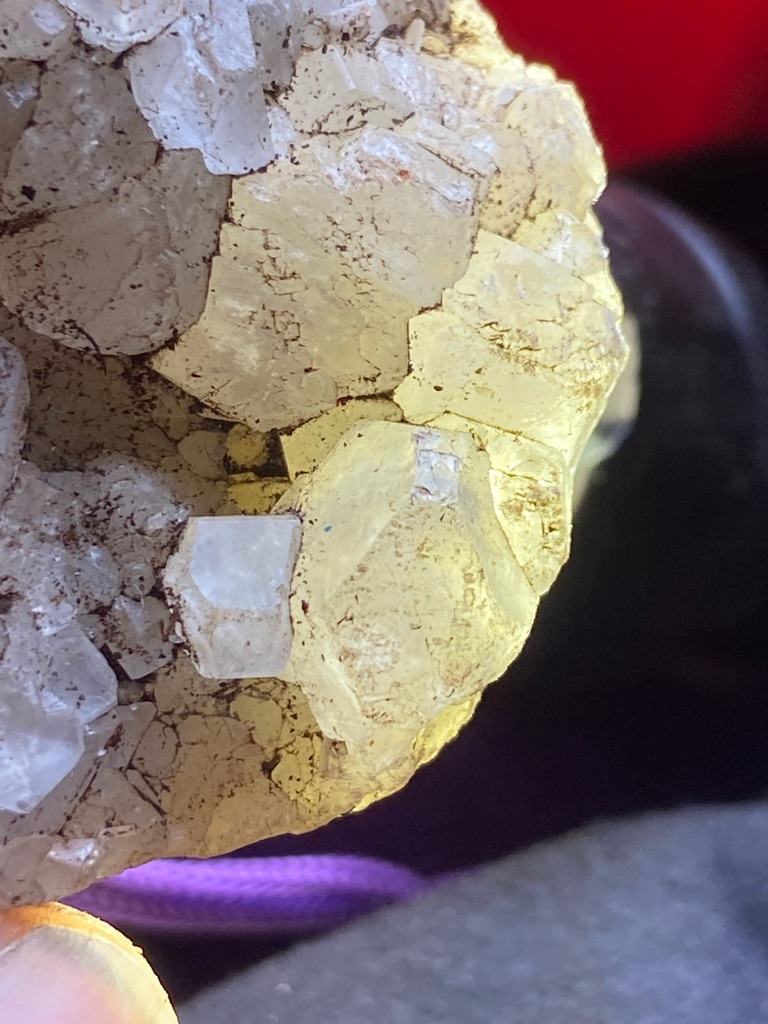
Not a diamond; this specimen appears to be a mineral crystal matrix, possibly quartz, calcite, or a similar rough crystalline silicate/carbonate rock cluster rather than gemstone diamond.
Not a diamond; this specimen appears to be a mineral crystal matrix, possibly quartz, calcite, or a similar rough crystalline silicate/carbonate rock cluster rather than gemstone diamond. · Raw, uncut crystal habit featuring natural faces and cubic/octahedral-like rough formations.
Not applicable (uncut raw mineral specimen). Cut
Carat
Not applicable; typically measured in total weight or size dimensions for rough mineral specimens.
Color
Off-white to yellowish-cream due to matrix staining and iron oxide inclusions.
Clarity
Included / Heavily flawed due to numerous internal fractures, inclusions, and matrix material.
Shape
Raw, uncut crystal habit featuring natural faces and cubic/octahedral-like rough formations.
Overall Assessment
An interesting raw mineral crystal cluster showing natural growth habits, matrix rock attachments, and surface staining, but definitively not a diamond.
Cut Quality
Not applicable (uncut raw mineral specimen).
Brilliance
Low to moderate due to rough surfaces and internal inclusions diffusing light.
Fire
Minimal dispersion, limited by crystal habit and surface texture.
Scintillation
Limited, reflecting light off raw crystal facets rather than precision-cut pavilion angles.
Proportions
Not applicable for faceted stones; exhibits natural crystal growth habits.
Symmetry
Natural crystal symmetry showing irregular growth patterns typical of raw mineral clusters.
Polish
Unpolished, natural rough surface with matte to vitreous crystal faces.
Fluorescence
Unknown without UV testing, though common in certain calcite or fluorite rough matrices.
Inclusions
Abundant internal fractures, mineral impurities, and surface matrix staining.
Blemishes
Natural surface etching, roughness, and pitting characteristic of rough mineral specimens.
Origin
Natural geological formation, likely from a sedimentary or hydrothermal mineral vein.
Treatment Detection
No signs of artificial enhancement; appears to be in its natural, un-treated state.
Estimated Value
Nominal value as a decorative mineral specimen or educational rock sample.
Certification Estimate
Gemological laboratories (like GIA or IGI) typically only certify cut and polished diamonds or standard gemstones; this would require mineralogical identification rather than diamond grading.
Investment Potential
Low investment potential; collected primarily for mineralogy enthusiasts rather than financial appreciation.
Similar Diamonds
None; this specimen is not a diamond.
Setting Suggestions
Wire-wrapped or displayed raw in a mineral collection rather than set in fine jewelry.
Care & Maintenance
Clean gently with a soft brush and mild soapy water if needed; avoid harsh chemicals and ultrasonic cleaners, especially if the matrix contains softer minerals like calcite.
Interesting Facts
Rough mineral clusters often showcase natural crystal systems that form deep within the Earth over millions of years before being exposed through tectonic activity or mining.