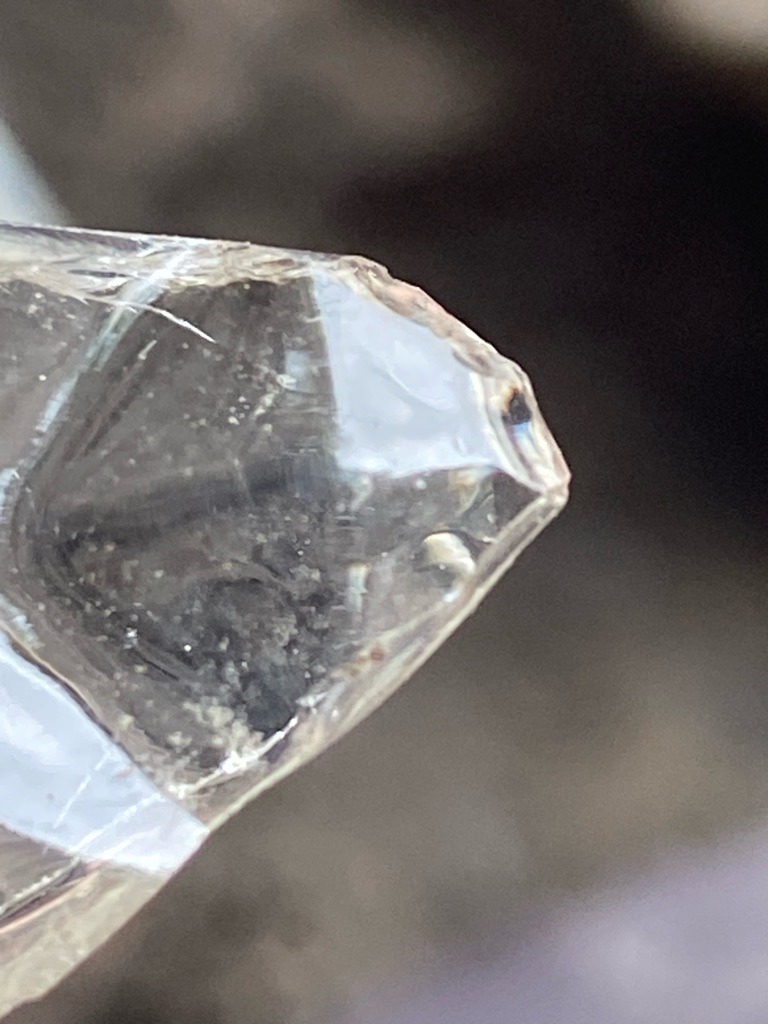
Natural rough crystal fragment (Quartz/Glass imitation visually, not a gem-quality diamond)
Natural rough crystal fragment (Quartz/Glass imitation visually, not a gem-quality diamond) · Irregular raw crystal fragment
Not applicable (Raw/uncut fragment with fracture surfaces) Cut
Carat
Undetermined visual estimate
Color
Colorless to faint greyish tint
Clarity
I3 (Heavy inclusions and fractures visible)
Shape
Irregular raw crystal fragment
Overall Assessment
Visual analysis indicates this specimen is a rough mineral fragment or glass shard rather than a genuine diamond. It lacks the optical properties, crystal habit, and facet symmetry required for gemological grading.
Cut Quality
Not applicable (Raw/uncut fragment with fracture surfaces)
Brilliance
Poor due to lack of standard diamond faceting and internal fractures
Fire
Minimal dispersion observed
Scintillation
Absent
Proportions
Non-standard raw crystal shard
Symmetry
Poor/Asymmetrical
Polish
Natural rough surface with conchoidal fracture patterns
Fluorescence
Unable to determine without UV testing
Inclusions
Heavy internal fracturing, crystal inclusions, and cloudiness
Blemishes
Surface scratches, chips, and irregular fracture edges
Origin
Natural mineral specimen or glass debris
Treatment Detection
No signs of enhancement treatments; appears in a natural or raw state
Estimated Value
Minimal to zero commercial value as a gemstone
Certification Estimate
Not gradable by major gemological laboratories (GIA/AGS) as a diamond
Investment Potential
None
Similar Diamonds
None; this specimen lacks standard diamond characteristics
Setting Suggestions
Not recommended for jewelry setting due to structural weakness
Care & Maintenance
Handle with care to prevent further chipping along fracture planes
Interesting Facts
The conchoidal fracture pattern visible on the surface is characteristic of quartz or glass rather than octahedral diamond cleavage