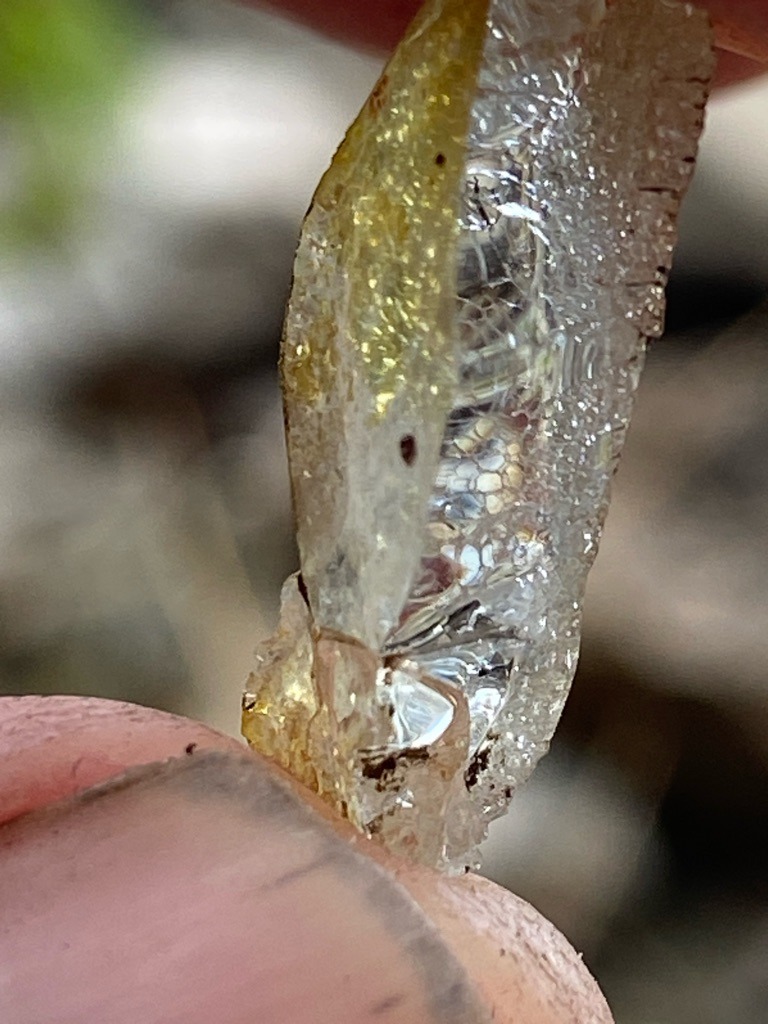
Not a diamond; this appears to be a natural mineral crystal, likely quartz, beryl, or a similar silicate with heavily weathered and etched surfaces, possibly an insect casing or organic material such as an empty cicada exuvia (shell) or degraded amber/resin rather than gemological diamond rough.
Not a diamond; this appears to be a natural mineral crystal, likely quartz, beryl, or a similar silicate with heavily weathered and etched surfaces, possibly an insect casing or organic material such as an empty cicada exuvia (shell) or degraded amber/resin rather than gemological diamond rough. · Irregular raw crystal / organic exuvia
Uncut / Raw / Natural form Cut
Carat
Not applicable (non-gem material)
Color
Not applicable (opaque to translucent yellow-brown and colorless areas)
Clarity
Included / heavily flawed due to natural fissures, cellular patterns, and weathering
Shape
Irregular raw crystal / organic exuvia
Overall Assessment
The specimen shown in the image is definitively not a diamond. It displays characteristics inconsistent with diamond crystallization (such as octahedral or dodecahedral habits), showing instead organic or heavily weathered silicate features.
Cut Quality
Uncut / Raw / Natural form
Brilliance
Poor due to lack of standard facet angles and optical symmetry
Fire
Minimal to none
Scintillation
Negligible
Proportions
N/A for raw mineral/biological specimen
Symmetry
Asymmetrical, irregular natural growth or biological structure
Polish
Unpolished, natural rough surface with extensive etching and texture
Fluorescence
Unknown without UV testing
Inclusions
Extensive internal fracturing, cellular matrices, and discoloration
Blemishes
Surface pitting, abrasion, and biological residue
Origin
Natural terrestrial origin (mineral specimen or biological exoskeleton)
Treatment Detection
No enhancements detected; appears completely natural or unaltered
Estimated Value
Minimal monetary value as a gem; of educational or specimen interest only
Certification Estimate
Not eligible for diamond certification (GIA, AGS, etc.) as it is not diamond or gem-grade material
Investment Potential
None as an investment asset
Similar Diamonds
None, as this is visually identified as a non-diamond mineral or organic shell specimen
Setting Suggestions
Not suitable for jewelry setting
Care & Maintenance
Handle gently to prevent breakage if delicate; keep away from harsh chemicals and moisture if organic
Interesting Facts
The intricate honeycomb-like texture resembles insect biological structures like a shed cicada skin rather than a crystalline diamond rough structure