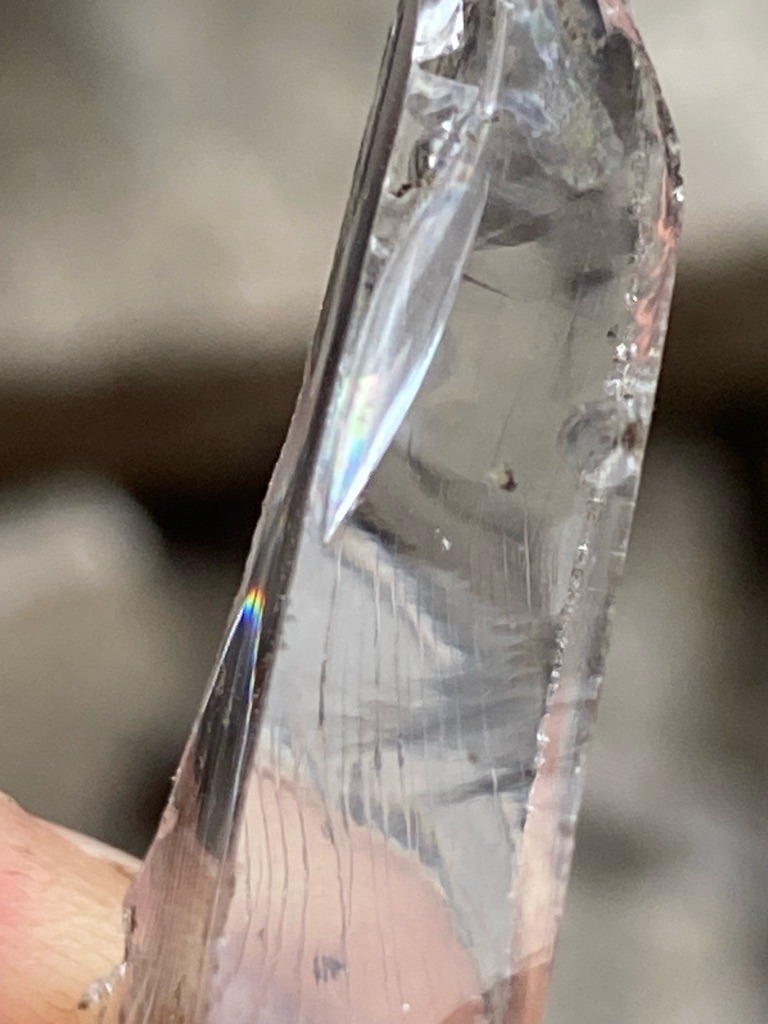
Not a diamond; this specimen appears to be a natural quartz crystal (rock crystal), showing typical prismatic growth habits and surface striations.
Not a diamond; this specimen appears to be a natural quartz crystal (rock crystal), showing typical prismatic growth habits and surface striations. · Rough crystal / Uncut natural mineral formation with prismatic habit
Not applicable (rough, uncut crystal specimen) Cut
Carat
Not applicable as a cut diamond (estimated mineral weight by size would be approximately 15-20 carats equivalent in volume, but sold as a specimen rather than gemstone weight)
Color
Colorless (transparent quartz), showing internal rainbow diffraction (iridescence) from micro-fractures
Clarity
Included (shows internal natural growth planes, striations, and stress fractures)
Shape
Rough crystal / Uncut natural mineral formation with prismatic habit
Overall Assessment
This specimen is a fascinating natural quartz crystal featuring internal stress fractures that create a beautiful rainbow effect, but it holds no gemological relation to diamond.
Cut Quality
Not applicable (rough, uncut crystal specimen)
Brilliance
Varies due to unpolished nature, displays vitreous luster on crystal faces
Fire
Exhibits localized spectral dispersion (rainbow colors) via thin-film interference within internal fractures
Scintillation
Limited flash effect primarily due to internal fracture planes reflecting light
Proportions
Elongated natural prism, not faceted
Symmetry
Natural crystal symmetry (trigonal system, elongated prismatic form)
Polish
Natural unpolished crystal faces with striated growth lines
Fluorescence
Undetermined without UV testing, typical quartz can show faint inert to blue under UV
Inclusions
Internal feather fractures causing rainbow light diffraction, growth tubes, and minor particulate inclusions
Blemishes
Natural crystal face striations and surface irregularities typical of rough quartz
Origin
Natural terrestrial mineral specimen, potentially sourced from pegmatite or hydrothermal vein deposits worldwide
Treatment Detection
No evidence of artificial enhancement; appears completely natural with characteristic stress cracks and natural iridescence
Estimated Value
Nominal value as a mineral specimen (roughly $10 - $50 USD depending on locality)
Certification Estimate
Not typically certified by major diamond grading labs like GIA; would be evaluated by mineralogical institutes if certified
Investment Potential
Low investment potential; valued for decorative, metaphysical, or specimen collection purposes rather than monetary appreciation
Similar Diamonds
None, as this is quartz and not a diamond; comparable to other raw quartz or transparent mineral specimens
Setting Suggestions
Wire-wrapped in sterling silver or gold-plated wire as a raw crystal pendant
Care & Maintenance
Clean with mild soapy water and a soft brush; avoid harsh chemicals and protect from drops as quartz can fracture along stress planes
Interesting Facts
Quartz crystals display piezoelectric properties and were historically used in early radio oscillators and watch movements