Natural
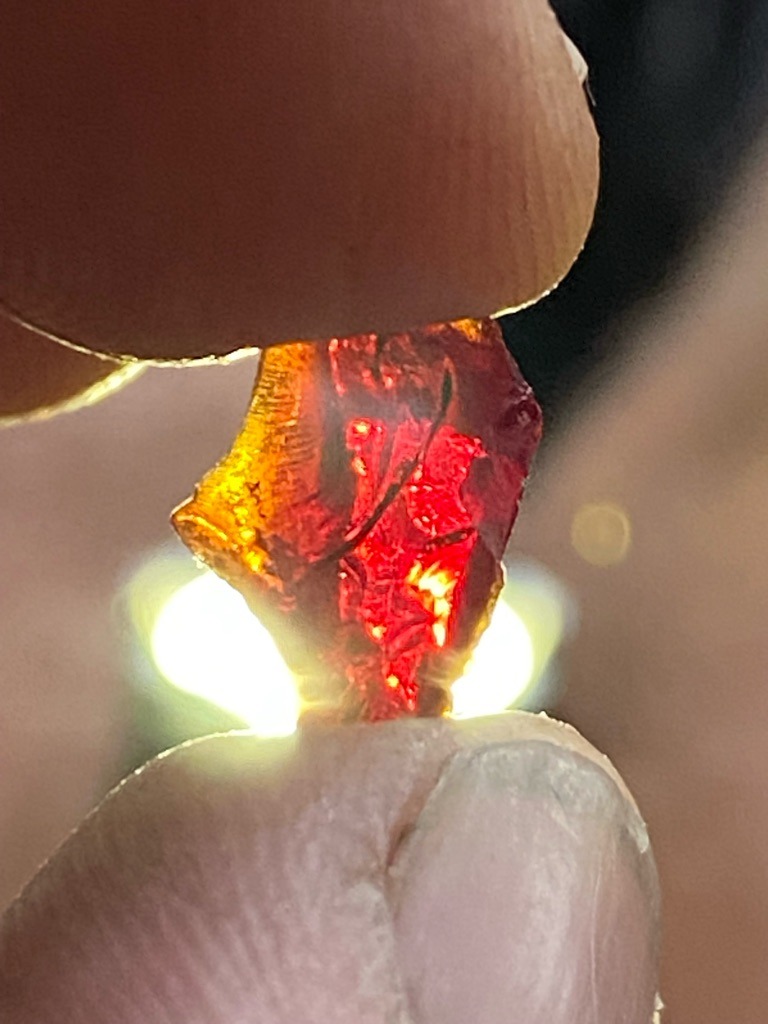
Natural · Rough crystal (unfaceted, irregular fragment)
Not applicable (Rough state) Cut
Carat
Estimated 1.5 to 2.5 carats
Color
Fancy Deep Red-Orange (Natural Color)
Clarity
Included (I1/SI2 equivalent)
Shape
Rough crystal (unfaceted, irregular fragment)
Overall Assessment
An interesting and rare raw colored diamond or heavy mineral specimen exhibiting strong back-lit red-orange coloration and distinct natural inclusions, suitable primarily for mineral collectors or bespoke organic jewelry.
Cut Quality
Not applicable (Rough state)
Brilliance
Low due to opaque/translucent rough nature and lack of facets
Fire
Limited dispersion visible internally through strong back-lighting
Scintillation
Minimal to none due to lack of facets and symmetry
Proportions
Natural rough proportions, varying thickness
Symmetry
Natural asymmetric crystal growth
Polish
Raw/Unpolished surface texture
Fluorescence
None to Faint
Inclusions
Prominent dark linear fractures and internal feather inclusions
Blemishes
Natural surface striations, growth lines, and minor pitting
Origin
Natural rough mineral deposit (Alluvial or primary kimberlite/lamproite indicator)
Treatment Detection
No obvious signs of artificial treatment or coating; appears entirely natural
Estimated Value
Varies widely based on exact mineral composition, approximately $100 - $500 as a collector specimen
Certification Estimate
GIA Colored Diamond Report (Natural origin confirmation)
Investment Potential
Low for resale, moderate as a unique educational mineral specimen or collector piece
Similar Diamonds
Natural colored rough diamond specimens, fancy dark orange-red alluvial rough
Setting Suggestions
Wire-wrapped pendant, custom organic bezel, or raw specimen mount in yellow gold or platinum
Care & Maintenance
Store separately from harder gemstones to prevent scratching; clean with mild soapy water and a soft brush
Interesting Facts
Natural red and orange colored diamonds are among the rarest in the world, usually colored by structural lattice deformations rather than trace elements like nitrogen or boron