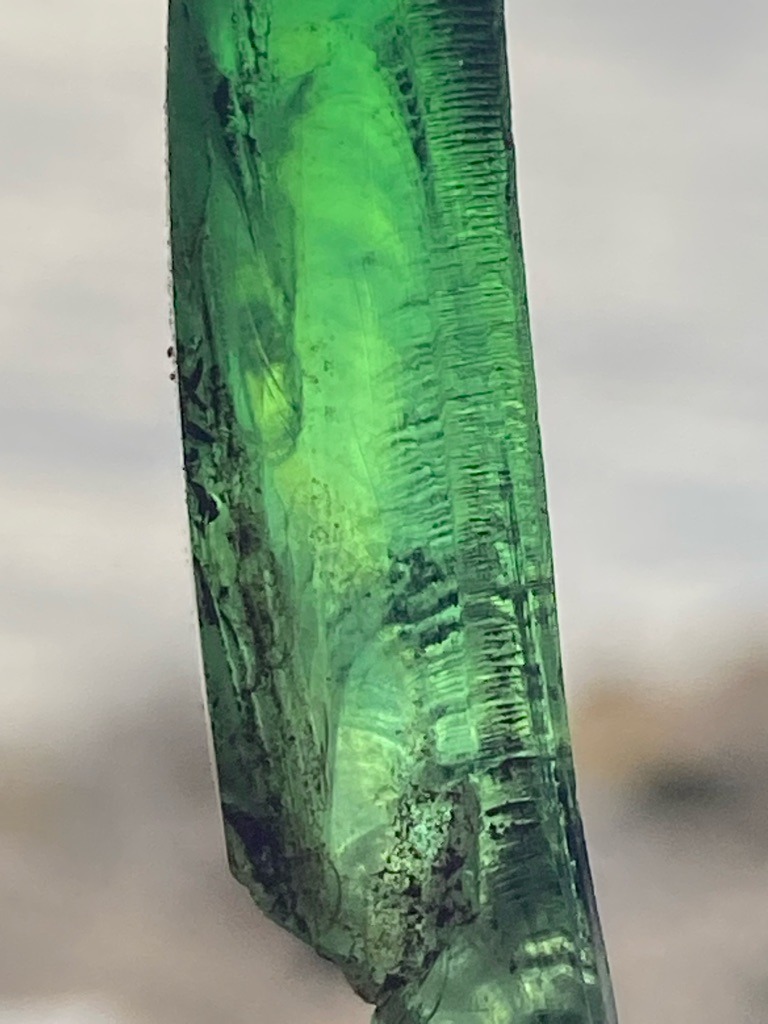
Not a diamond; this is a green mineral crystal, likely Tourmaline (Verdelite) or Emerald, characterized by distinct vertical striations typical of prismatic crystal growth.
Not a diamond; this is a green mineral crystal, likely Tourmaline (Verdelite) or Emerald, characterized by distinct vertical striations typical of prismatic crystal growth. · Rough prismatic crystal form with natural striations and termination fragment, unpolished.
Uncut / Raw (Not faceted, so standard diamond cut grades do not apply). Cut
Carat
Estimated around 15-25 carats based on visual dimensions (gemstone weight, not diamond).
Color
Vivid Green (Fancy Intense Green in gemstone grading terminology).
Clarity
Included (Contains natural inclusions, internal fractures, and growth features typical of raw crystals).
Shape
Rough prismatic crystal form with natural striations and termination fragment, unpolished.
Overall Assessment
This item is an attractive green raw crystal, likely a tourmaline or emerald specimen, valued for its natural crystal habit and vibrant color rather than diamond-like optical properties.
Cut Quality
Uncut / Raw (Not faceted, so standard diamond cut grades do not apply).
Brilliance
Vitreous to sub-resinous luster on natural faces, limited by transparency and rough state.
Fire
Low dispersion compared to diamond, typical of colored gemstone crystals.
Scintillation
Limited flash effect due to unpolished and translucent raw crystal surfaces.
Proportions
Elongated prismatic crystal habit with natural growth striations along the c-axis.
Symmetry
Natural crystal symmetry showing typical prismatic habit with vertical striations.
Polish
Unpolished natural crystal faces and fracture surfaces.
Fluorescence
Inert to faint, depending on specific mineral species.
Inclusions
Natural internal feathers, veils, and inclusion patterns characteristic of raw gemstone crystals.
Blemishes
Natural crystal surface irregularities, striations, and minor edge chipping at the base.
Origin
Natural pegmatite or metamorphic origin, common in localities worldwide producing green tourmaline or emeralds (e.g., Brazil, Africa, or Colombia).
Treatment Detection
Untreated raw crystal specimen; no evidence of enhancement.
Estimated Value
Varies widely depending on exact mineral identification (e.g., tourmaline vs. emerald), transparency, and weight, roughly estimated between $100 to $1,000+ for specimen grade.
Certification Estimate
Gemological laboratories such as GIA, GRS, or SSEF would issue a colored gemstone identification report confirming species and origin.
Investment Potential
Valued primarily as a mineral specimen for collectors rather than a liquid investment asset.
Similar Diamonds
Not applicable as this is a colored gemstone crystal, not a diamond.
Setting Suggestions
Best preserved as a raw mineral specimen or custom-crafted into an organic-style wire-wrapped pendant or bespoke bezel setting.
Care & Maintenance
Handle with care to prevent edge chipping; clean with mild soapy water and a soft brush; avoid ultrasonic cleaners and harsh chemicals.
Interesting Facts
The distinct parallel striations running vertically along the crystal face are a hallmark growth feature of tourmaline and certain other prismatic minerals.