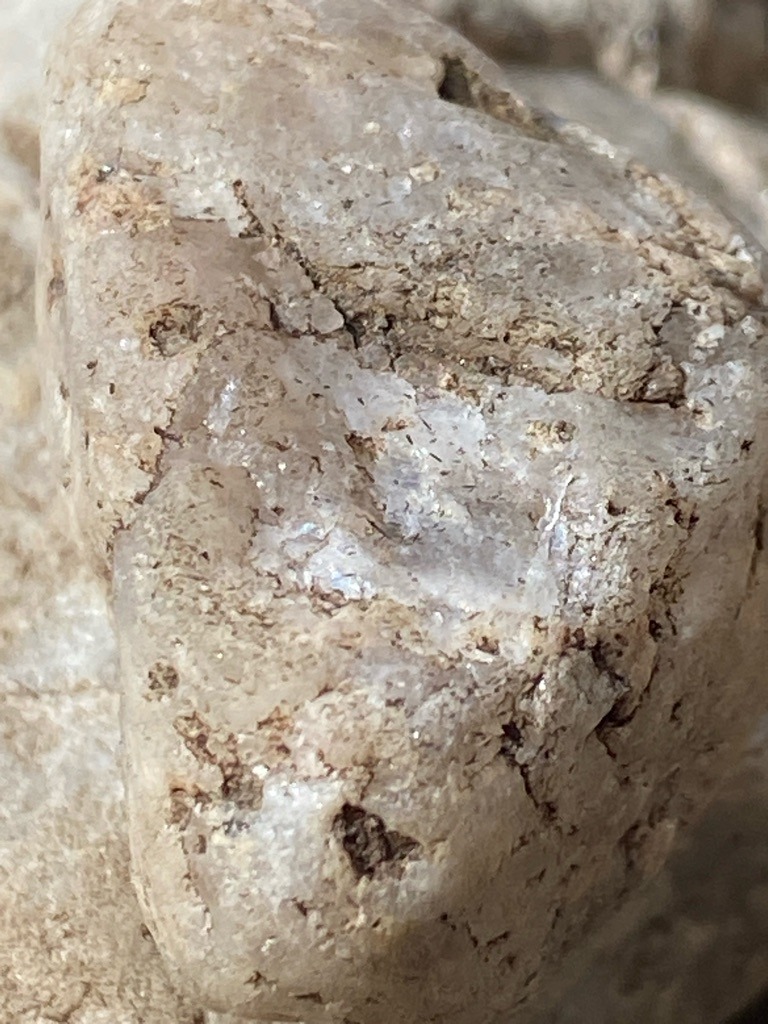
Not a diamond (Appears to be a rough mineral specimen, likely quartz or quartzite, heavily weathered)
Not a diamond (Appears to be a rough mineral specimen, likely quartz or quartzite, heavily weathered) · Uncut / Rough crystal aggregate / Irregular nodule
Not applicable (Rough, unpolished stone) Cut
Carat
Not applicable (Mineral matrix specimen, not a cut gemstone)
Color
Brownish-white / Off-white / Translucent to opaque
Clarity
I3 (Heavy inclusions, fractures, and surface matrix attachments)
Shape
Uncut / Rough crystal aggregate / Irregular nodule
Overall Assessment
The specimen shown in the image is not a diamond. It is a rough, weathered mineral nodule embedded in host rock or soil, displaying characteristics typical of quartz or a similar common rock-forming mineral rather than crystalline carbon.
Cut Quality
Not applicable (Rough, unpolished stone)
Brilliance
Very low due to rough and opaque nature
Fire
None
Scintillation
None
Proportions
Not applicable for rough stones
Symmetry
Irregular / Asymmetrical natural form
Polish
Unpolished / Rough natural surface
Fluorescence
Unknown / Not tested
Inclusions
Extensive internal fractures, crystal structures, and mineral inclusions
Blemishes
Deep surface pits, fractures, and matrix staining
Origin
Natural geological rock formation
Treatment Detection
No signs of artificial enhancement; entirely untreated natural matrix
Estimated Value
Nominal / Mineral specimen value only (virtually zero gemstone market value)
Certification Estimate
Not gradable by major diamond grading laboratories (GIA/AGS/IGI)
Investment Potential
None as a gemstone; only of interest to amateur rockhounds or mineral collectors
Similar Diamonds
None (This is a rough rock/mineral, not a diamond)
Setting Suggestions
Not suitable for standard jewelry settings unless wire-wrapped as a raw specimen
Care & Maintenance
Standard cleaning with warm soapy water and a soft brush if displayed as a mineral specimen
Interesting Facts
Many rough stones found outdoors are mistaken for diamonds due to surface glints, but are actually common quartz, quartzite, or feldspar