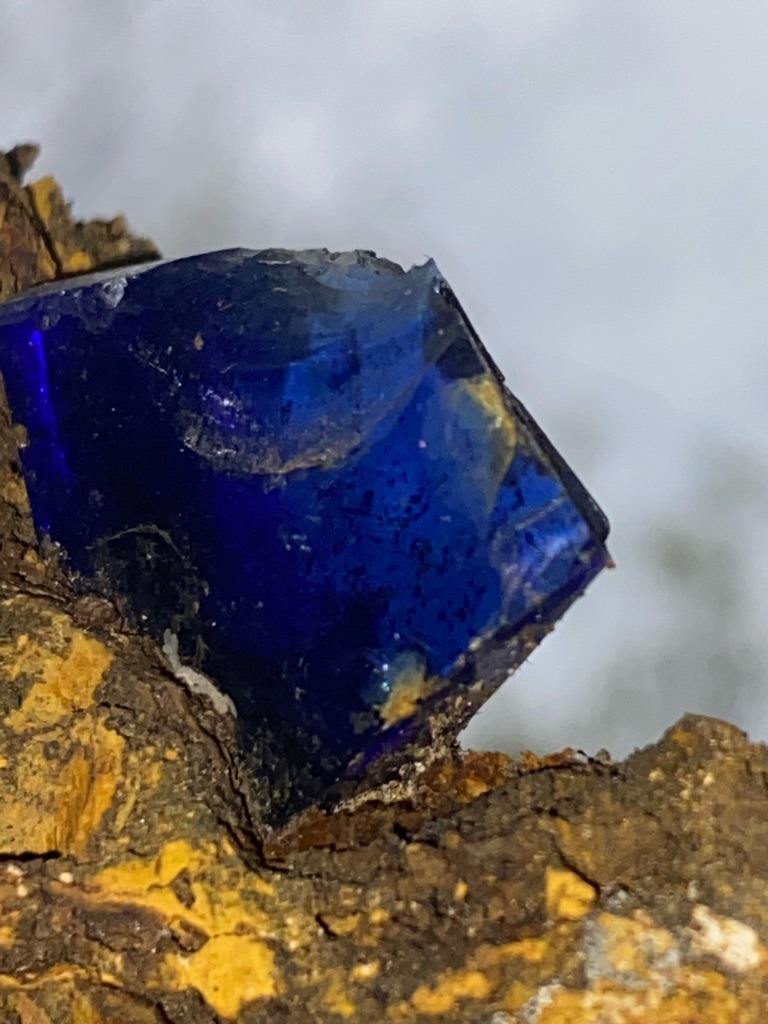
The specimen in the image is not a diamond; it appears to be a mineral specimen, likely Linarite or Azurite based on the deep blue color and crystalline structure within the host rock.
The specimen in the image is not a diamond; it appears to be a mineral specimen, likely Linarite or Azurite based on the deep blue color and crystalline structure within the host rock. · Rough/Uncut: The crystal exhibits a monoclinic or orthorhombic crystal habit rather than the octahedral or cubic habit typical of diamonds.
Not Applicable (Rough mineral). Cut
Carat
Estimated at 10 to 15 carats for the primary blue crystal cluster visible.
Color
Deep Vivid Blue (Non-standard for white diamond scales; resembles a rich sapphire or azurite hue).
Clarity
Translucent to Opaque: Contains significant internal matrix and fractures typical of raw mineral specimens.
Shape
Rough/Uncut: The crystal exhibits a monoclinic or orthorhombic crystal habit rather than the octahedral or cubic habit typical of diamonds.
Overall Assessment
This is a beautiful mineral specimen, not a diamond. Its deep blue color and crystalline habit suggest it is a copper-based mineral like Azurite or Linarite embedded in a limonite or gossan matrix.
Cut Quality
Not Applicable (Rough mineral).
Brilliance
Low: The specimen has a vitreous luster but does not reflect light like a faceted diamond.
Fire
None: No spectral dispersion of light is visible.
Scintillation
Low: Limited to surface reflections from crystal facets.
Proportions
N/A: Irregular natural growth.
Symmetry
Poor: Natural, irregular crystal formation in matrix.
Polish
Natural unpolished crystal faces with some conchoidal fracturing.
Fluorescence
None observed under visible light conditions.
Inclusions
Significant primary mineral inclusions, matrix material, and internal cleavages.
Blemishes
Surface abrasions, natural pitting, and contact points with the host rock.
Origin
Likely Arizona, USA (Bisbee or Morenci) or Tsumeb, Namibia, known for blue secondary copper minerals.
Treatment Detection
None visible; appears to be a natural specimen in matrix.
Estimated Value
$50 - $200 as a mineralogical specimen, depending on the rarity of the specific location.
Certification Estimate
GIA (Colored Stones) or a mineralogy lab; likely identified as a copper-based mineral.
Investment Potential
Low for gemstone markets; moderate for specialized mineral collectors if provenance is established.
Similar Diamonds
Vivid Blue Diamonds (e.g., Hope Diamond) share the color but differ entirely in refractive index and chemistry.
Setting Suggestions
Collection display case; not suitable for traditional jewelry due to likely low Mohs hardness.
Care & Maintenance
Keep away from acids and high heat; clean only with a soft brush and distilled water if stable.
Interesting Facts
The vibrant blue is often caused by copper content within the chemical structure of the mineral.