Likely Diamond (Natural or Lab-Grown) or Moissanite
Likely Diamond (Natural or Lab-Grown) or Moissanite · Round Brilliant
Good to Very Good Cut
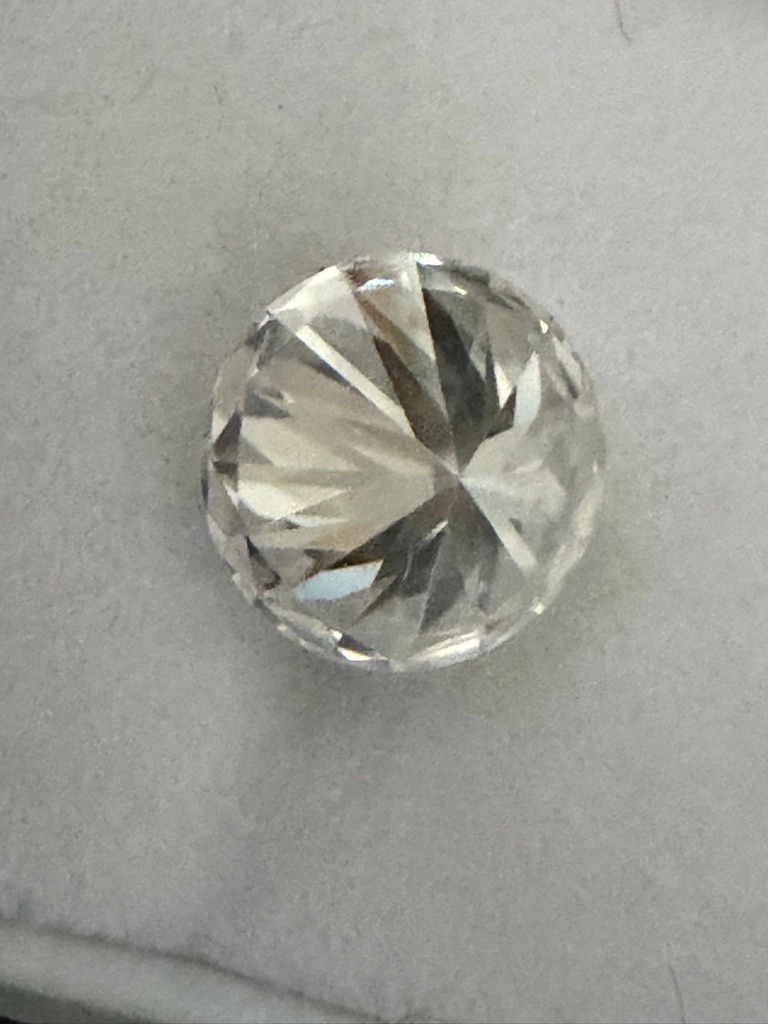
Carat
Estimated 0.75 - 1.25 carats
Color
H-J (Near Colorless)
Clarity
SI1 - SI2 (Slightly Included)
Shape
Round Brilliant
Overall Assessment
A standard commercial quality round brilliant stone exhibiting typical brilliance but showing some visible inclusions and light leakage in the center likely due to cut proportions
Cut Quality
Good to Very Good
Brilliance
Moderate; some light leakage is visible in the center area
Fire
Fair; visible dispersion of light in the outer crown facets
Scintillation
Good contrast pattern between light and dark facets
Proportions
Standard modern brilliant proportions with a moderate table size and steep pavilion angles suggested by shadowing
Symmetry
Good
Polish
Very Good
Fluorescence
Indeterminable from photo alone
Inclusions
Visible dark crystal inclusions and feathers near the 9 o'clock and 12 o'clock positions
Blemishes
Minor surface reaching graining or abrasions visible on the table and crown facets
Origin
Indeterminable; requires spectroscopic testing
Treatment Detection
No obvious signs of fracture filling; HPHT or CVD would requires lab testing
Estimated Value
$1,500 - $3,500 (dependent on lab-grown vs natural origin)
Certification Estimate
GIA or IGI (Estimate: H color, SI1 clarity, Very Good cut)
Investment Potential
Moderate to Low; standard commercial grades hold value less effectively than D-IF or large fancy colors
Similar Diamonds
Standard 1-carat commercial grade round brilliants
Setting Suggestions
A six-prong platinum or white gold solitaire to maximize light entry and security
Care & Maintenance
Regular cleaning with warm soapy water and a soft brush; professional prong checks every 6 months
Interesting Facts
The Round Brilliant cut is designed with 57 or 58 facets to maximize the mathematical return of light through the top of the stone