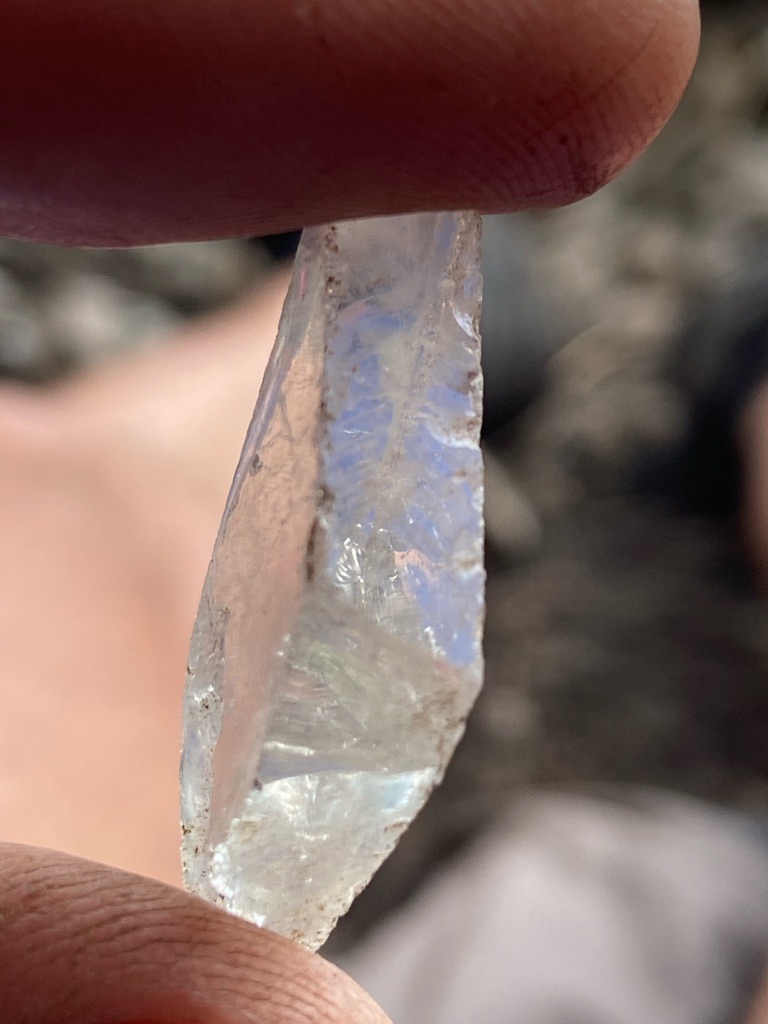
The specimen shown in the image is not a diamond; it appears to be a natural rough quartz crystal, possibly quartz or a similar clear mineral/silica-based gemstone, lacking the characteristic octahedral crystal habit and adamantine luster of rough diamond.
The specimen shown in the image is not a diamond; it appears to be a natural rough quartz crystal, possibly quartz or a similar clear mineral/silica-based gemstone, lacking the characteristic octahedral crystal habit and adamantine luster of rough diamond. · Rough crystal form, elongated irregular crystal habit with natural faces and fractures.
Not applicable (Rough uncut stone). Cut
Carat
Estimated at approximately 5.0 to 8.0 carats based on visual size relative to human fingers, though exact weight requires scale measurement.
Color
Colorless / Transparent.
Clarity
Included (Contains visible internal fractures, feather inclusions, and surface impurities/dirt in crevices).
Shape
Rough crystal form, elongated irregular crystal habit with natural faces and fractures.
Overall Assessment
The specimen is a fascinating natural rough mineral crystal—likely quartz—held by hand, displaying natural growth lines and internal fractures. It holds no gemological relation to diamond and is best appreciated as a raw geological specimen.
Cut Quality
Not applicable (Rough uncut stone).
Brilliance
Low to moderate vitreous luster, characteristic of quartz rather than the adamantine brilliance of diamond.
Fire
Minimal to none, typical of quartz dispersion.
Scintillation
Poor, as the stone lacks facet geometry required for patterned light return.
Proportions
Irregular raw crystal proportions.
Symmetry
Natural asymmetrical crystal formation.
Polish
Unpolished natural crystal faces and fracture surfaces.
Fluorescence
Unknown without UV testing, though typical quartz may show faint inertness or weak luminescence.
Inclusions
Heavy internal feathering, cleavage planes, and fractures running through the body of the crystal.
Blemishes
Surface abrasions, natural irregularities, and trapped matrix/dirt in crevices.
Origin
Natural terrestrial mineral specimen, commonly found in pegmatites or hydrothermal veins worldwide.
Treatment Detection
No signs of artificial treatments; appears entirely natural and untreated.
Estimated Value
Nominal value as a mineral specimen (under $10 to $50 depending on locality and collector interest).
Certification Estimate
Standard gemological laboratories (like GIA or local gem labs) would identify this as quartz rather than issuing a diamond grading report.
Investment Potential
Low; valued primarily as a decorative mineral specimen or educational piece rather than an investment asset.
Similar Diamonds
None, as this is quartz and not diamond.
Setting Suggestions
Wire-wrapped pendant setting or custom organic prong setting to showcase its raw crystal form.
Care & Maintenance
Clean gently with warm soapy water and a soft brush; avoid harsh chemicals and protect from impact to prevent breakage along internal fracture lines.
Interesting Facts
Raw quartz is one of the most abundant minerals on Earth, forming the basis of many gemstones, whereas rough diamonds require extreme pressure and temperature deep within the Earth's mantle.