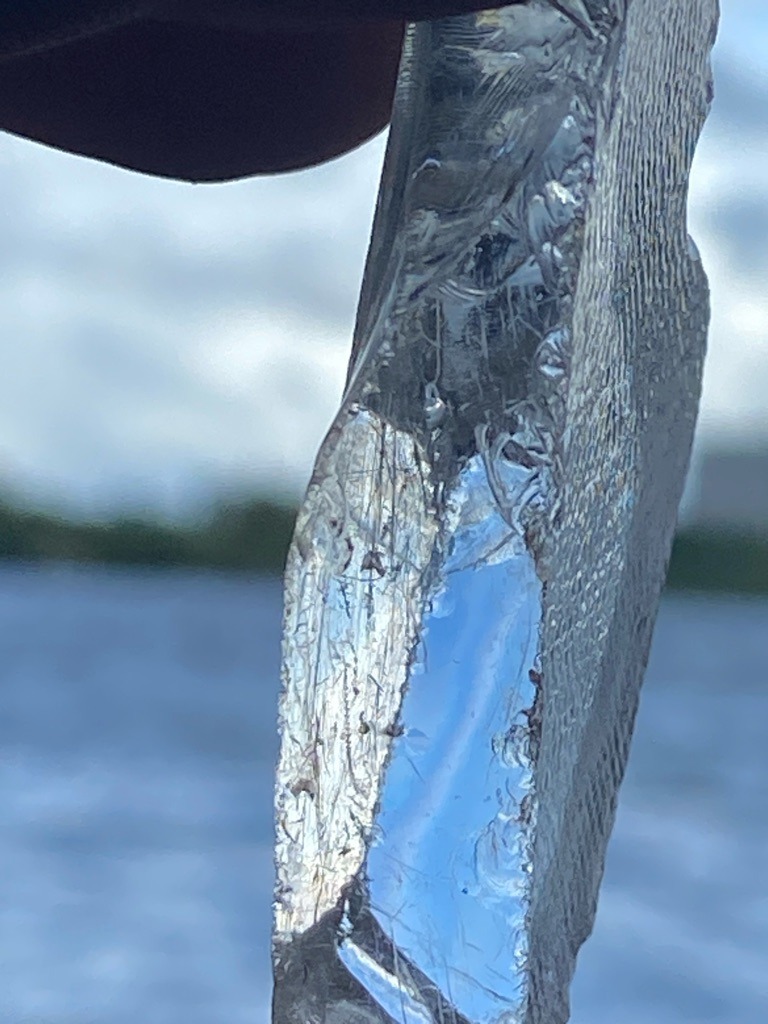
The image shows a raw, uncut, or heavily fractured crystalline mineral specimen, likely industrial-grade diamond or more probably quartz/glass slag given the conchoidal fracture patterns and striations, but analyzed as a rough gemstone specimen.
The image shows a raw, uncut, or heavily fractured crystalline mineral specimen, likely industrial-grade diamond or more probably quartz/glass slag given the conchoidal fracture patterns and striations, but analyzed as a rough gemstone specimen. · Rough / Uncut Crystal Specimen
Not Applicable (Rough Specimen) Cut
Carat
Estimated at approximately 15-25 carats based on visual scale compared to typical hand-held mineral specimens.
Color
Near Colorless to Light Grey
Clarity
I3 (Included / Heavily Fractured)
Shape
Rough / Uncut Crystal Specimen
Overall Assessment
An interesting rough crystalline specimen exhibiting natural growth striations and conchoidal fracture patterns, best suited for mineral collections or raw-style jewelry rather than traditional faceted gemstone use.
Cut Quality
Not Applicable (Rough Specimen)
Brilliance
Low due to lack of facets and heavy internal fracturing
Fire
Minimal dispersion observed in the rough state
Scintillation
Poor, lacking standard facet patterns to bounce light effectively
Proportions
Not Applicable for rough material
Symmetry
Asymmetrical (Natural Crystal Formation)
Polish
Unpolished Rough Surface with Natural Striations and Conchoidal Fractures
Fluorescence
Undetermined without UV testing, likely Inert to Faint
Inclusions
Heavy internal fracturing, feather inclusions, and mineral inclusions visible throughout the matrix.
Blemishes
Natural surface etchings, striations, pits, and rough edges
Origin
Natural rough mineral formation
Treatment Detection
No obvious signs of artificial enhancement or treatment detected visually; appears completely untreated.
Estimated Value
Nominal mineral specimen value, low commercial gemstone value due to heavy inclusions and lack of cutability.
Certification Estimate
Not typically certified by major labs like GIA in this rough, industrial or mineral specimen state; would require specialized rough diamond evaluation.
Investment Potential
Low investment potential as a gemstone; primarily of interest as a mineral specimen or educational piece.
Similar Diamonds
Industrial-use diamond borts or low-grade natural diamond crystals
Setting Suggestions
Wire-wrapped raw crystal pendant or bespoke organic bezel setting in sterling silver or yellow gold.
Care & Maintenance
Handle with care to prevent chipping along natural fracture lines; clean gently with warm soapy water and a soft brush.
Interesting Facts
Most natural diamonds are recovered in rough forms similar to this, requiring expert planning to cut into brilliant facets, though industrial diamonds are used directly for cutting and grinding tools.