Likely Non-Diamond (Glass or Quartz)
Likely Non-Diamond (Glass or Quartz) · Rough / Uncut (Irregular Fragment)
None (Not faceted) Cut
Carat
Estimated 2.0 - 5.0 carats based on scale relative to fingertip
Color
Colorless to Near-Colorless (appears D-F functionally in its current state)
Clarity
Highly Included / Fractured (I2-I3 or lower equivalent due to large internal breaks)
Shape
Rough / Uncut (Irregular Fragment)
Overall Assessment
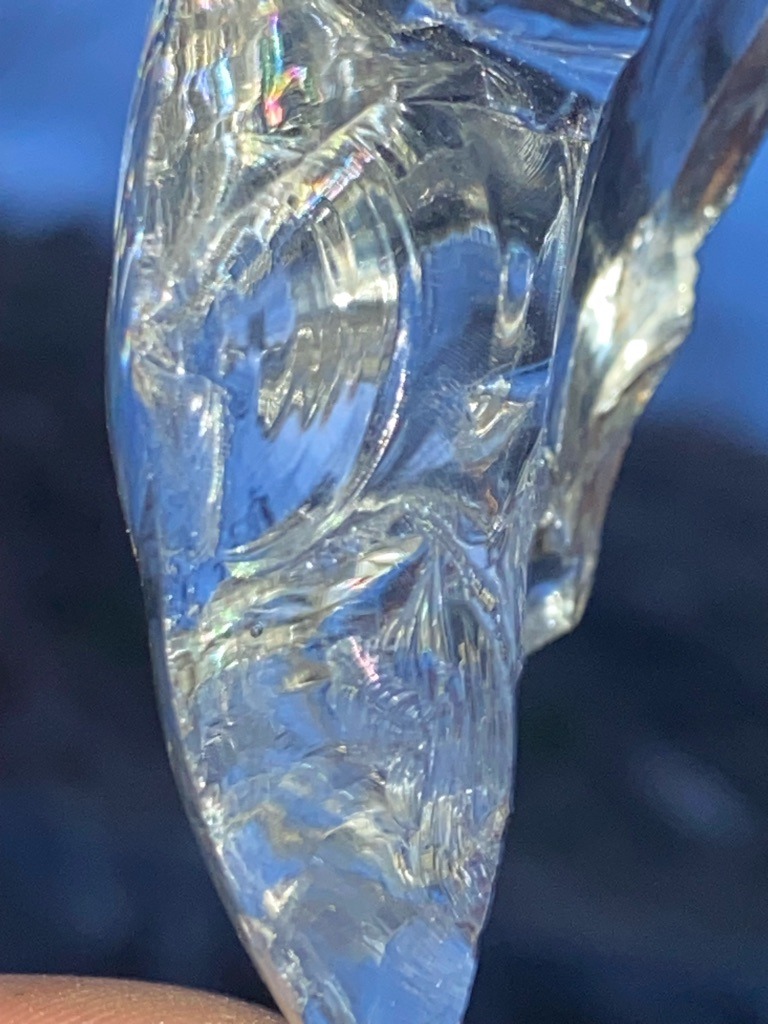
This specimen is not a diamond. It lacks the crystal structure, luster, and specific gravity of diamond. It appears to be a fragment of clear glass or a common mineral like quartz.
Cut Quality
None (Not faceted)
Brilliance
Low (typical of low refractive index materials like glass or quartz)
Fire
Moderate (visible in the upper left as spectral dispersion from internal fractures)
Scintillation
Poor (lacks facets to reflect light systematically)
Proportions
Not applicable for rough material
Symmetry
None (Asymmetrical)
Polish
None (Natural/Rough surfaces)
Fluorescence
Cannot determine without UV light (visible rainbow dispersion is refractive, not fluorescence)
Inclusions
Extensive internal conchoidal fracturing and heavy internal veining
Blemishes
Heavy surface abrasions and chips consistent with glass or low-hardness minerals
Origin
Likely synthetic industrial glass or common silica mineral
Treatment Detection
None detected; appears to be raw waste material or natural mineral fragment
Estimated Value
Low ($0 - $10 USD)
Certification Estimate
Unlikely to be graded by GIA/AGS as a gemstone; would likely be identified as glass or mineral specimen
Investment Potential
None
Similar Diamonds
This does not resemble a diamond; behaves more like a glass 'slug' or quartz crystal fragment
Setting Suggestions
Not suitable for traditional jewelry settings; could be used in a wire wrap if significant to the owner
Care & Maintenance
Avoid impact; the material shows signs of fragility and easy chipping/fracturing
Interesting Facts
The shell-like (conchoidal) fracture patterns are highly characteristic of glass and quartz, whereas diamonds fracture along cleavage planes.