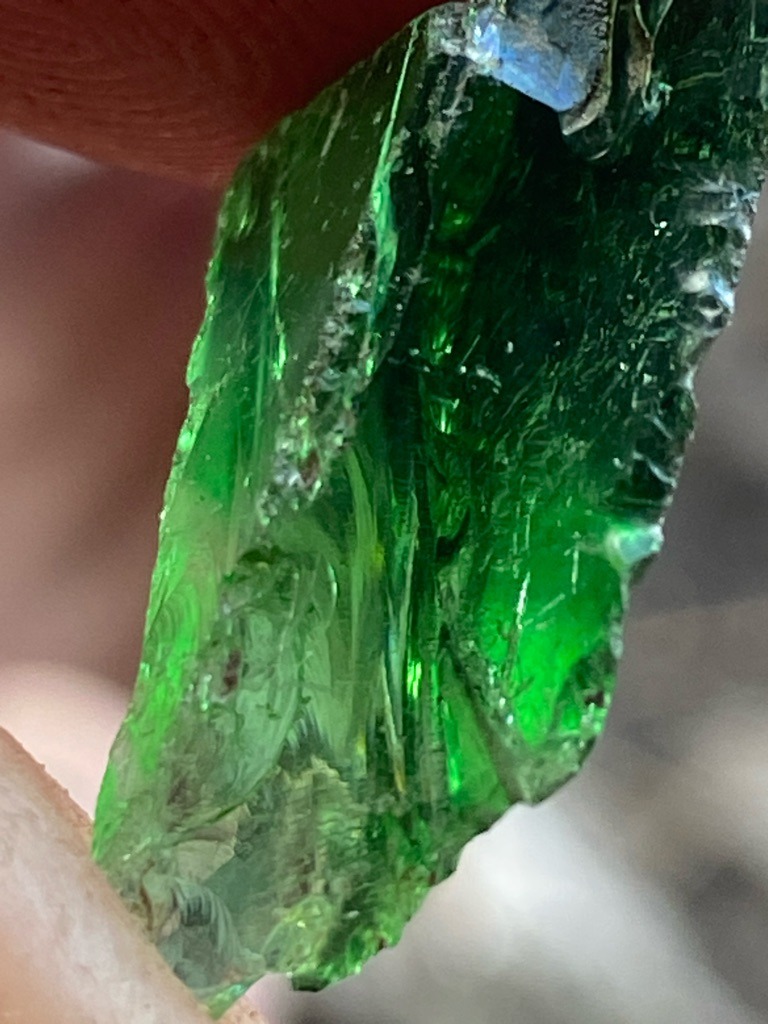
Not a diamond; this specimen appears to be green glass or a green mineral crystal such as rough tourmaline or diopside, lacking diamond crystal habit and optical properties.
Not a diamond; this specimen appears to be green glass or a green mineral crystal such as rough tourmaline or diopside, lacking diamond crystal habit and optical properties. · Rough crystal / raw irregular form
Not applicable (uncut raw specimen) Cut
Carat
Estimated at approximately 15-20 carats based on visual size relative to fingers (approx. 3-4 grams)
Color
Deep vivid green (Fancy Green)
Clarity
Included / Heavily fractured
Shape
Rough crystal / raw irregular form
Overall Assessment
This specimen is a raw, vibrant green rough material—most likely colored glass or a green silicate mineral—rather than a genuine diamond. It has no gem-grade diamond characteristics and should be formally tested with a thermal or electrical conductivity tester to confirm its non-diamond status.
Cut Quality
Not applicable (uncut raw specimen)
Brilliance
Vitreous to sub-adamantine luster across fracture faces
Fire
Low to moderate dispersion depending on the exact material composition
Scintillation
Limited due to raw, unfaceted surface texture
Proportions
Not applicable to raw rough specimens
Symmetry
Asymmetrical raw crystal
Polish
Unpolished natural crystal faces and conchoidal fracture surfaces
Fluorescence
Unknown without UV testing
Inclusions
Visible internal fractures, stress lines, and possible gas bubbles or mineral inclusions typical of raw glass/crystals
Blemishes
Surface scratches, chips, and uneven conchoidal fracture planes
Origin
Natural rough mineral or synthetic glass surrogate
Treatment Detection
No obvious artificial treatments detected visually, though potential glass manufacturing indicators (conchoidal ripples) are prominent
Estimated Value
Nominal value as a mineral specimen or decorative piece (low market value, typically under $50 depending on exact mineral ID)
Certification Estimate
Standard gemological laboratories (GIA, GRS) would issue a species identification report rather than a diamond grading report.
Investment Potential
None; ornamental or educational value only
Similar Diamonds
None, as this is a green colored rough mineral/glass rather than a diamond
Setting Suggestions
Wire-wrapped or custom bezel settings if polished into a cabochon or display specimen
Care & Maintenance
Store separately to prevent scratching softer materials; clean gently with warm soapy water and a soft brush
Interesting Facts
Green rough materials are often mistaken for rare fancy colored diamonds by untrained observers, but true green diamonds are exceedingly rare and derive their color from natural irradiation.