Non-diamond (Glass/Silicon or Quartz shard)
Non-diamond (Glass/Silicon or Quartz shard) · Irregular/Rough Shard
Not Applicable (Rough) Cut
Carat
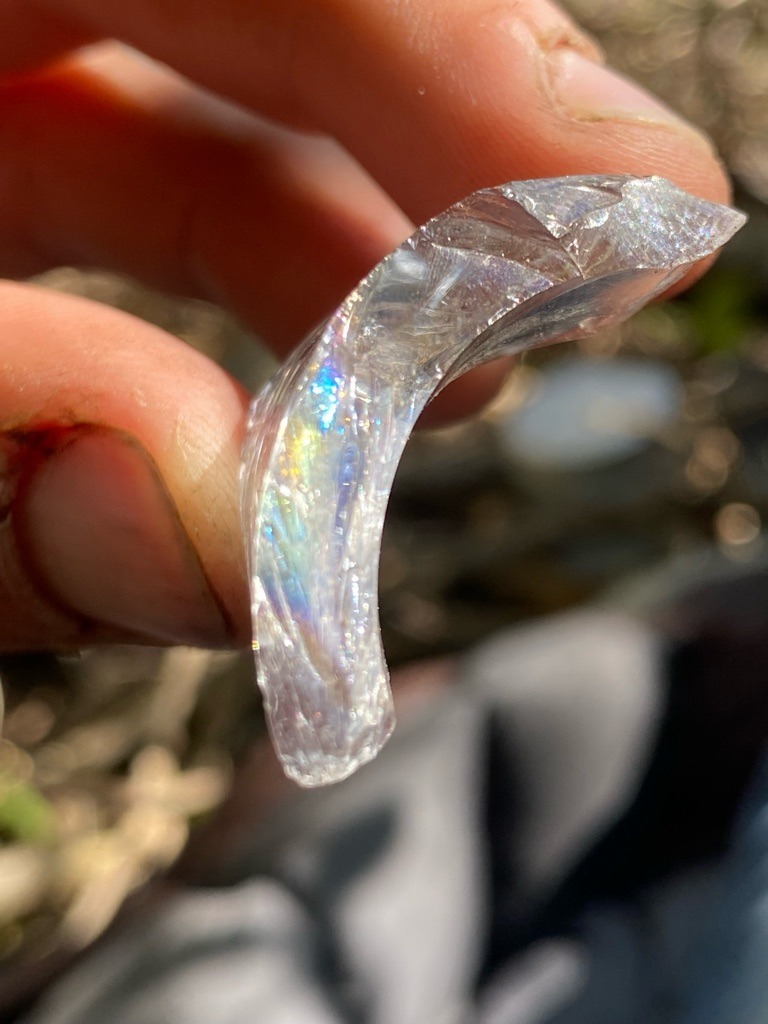
Estimated 15-20 carats (based on physical size compared to fingers)
Color
Colorless/Transparent with high dispersion
Clarity
Included (I3 equivalent) due to visible internal fracturing
Shape
Irregular/Rough Shard
Overall Assessment
This is not a diamond. The conchoidal (shell-like) fracture patterns and the way the material has broken indicate it is likely a shard of glass or a common silica-based mineral. It lacks the cubic crystal symmetry of a diamond.
Cut Quality
Not Applicable (Rough)
Brilliance
Low (lacks geometric facets for total internal reflection)
Fire
High (significant rainbow-like spectral dispersion along fracture lines)
Scintillation
Low to Moderate across jagged surfaces
Proportions
Irregular (conchoidal fracture patterns visible)
Symmetry
Poor/None
Polish
None (Naturally rough or broken surface)
Fluorescence
None visible in sunlight
Inclusions
Significant internal fractures and heavy veining
Blemishes
Surface abrasions and sharp, jagged edges
Origin
Terrestrial (Likely man-made glass waste or industrial silica)
Treatment Detection
None (appears to be a raw broken material)
Estimated Value
Negligible market value ($1 - $5)
Certification Estimate
Unlikely to be graded by GIA/AGS as it is not a diamond; likely glass
Investment Potential
Zero
Similar Diamonds
None (the material's conchoidal fracture is inconsistent with diamond crystal structures)
Setting Suggestions
Not suitable for traditional jewelry settings; artistic wire wrapping only
Care & Maintenance
Handle with care as edges appear sharp (glass-like properties); avoid impact
Interesting Facts
The rainbow effect (fire) is caused by thin-film interference or refraction through internal fractures, typical of glass or quartz shards.