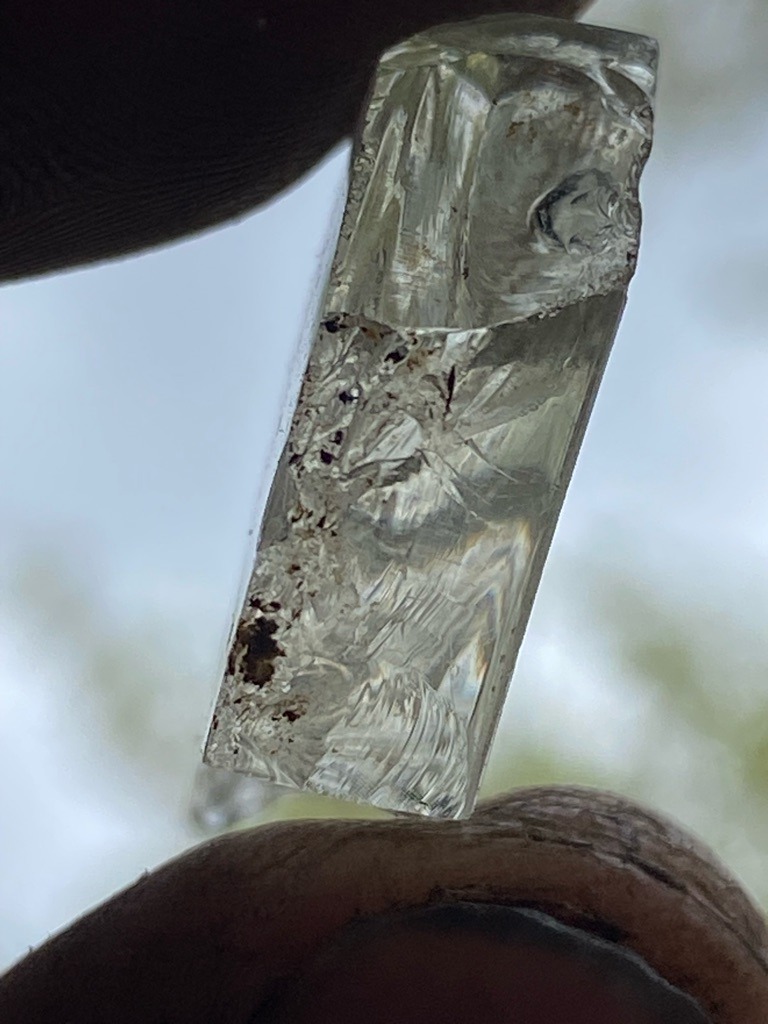
Rough natural diamond specimen (potential Macle or elongated octahedron fragment)
Rough natural diamond specimen (potential Macle or elongated octahedron fragment) · Rough / Uncut (elongated crystalline structure)
N/A (Rough state) Cut
Carat
Estimated 2.0 - 4.0 carats based on finger scale
Color
L - N (Estimated faint yellow/brown tint in rough state)
Clarity
I2 - I3 (Included 2-3 due to significant visible fractures and mineral inclusions)
Shape
Rough / Uncut (elongated crystalline structure)
Overall Assessment
This is a natural, unpolished diamond fragment of lower gem quality. While it has significant size, the heavy internal 'salt and pepper' inclusions and structural fractures make it more suitable as a specimen or for rustic jewelry rather than high-end faceted gemstone production.
Cut Quality
N/A (Rough state)
Brilliance
Low (typical of uncut rough; surface reflection only)
Fire
Non-visible in rough state
Scintillation
Minimal on crystal faces
Proportions
Natural elongated fragment with uneven termination
Symmetry
N/A (Natural crystal asymmetry)
Polish
N/A (Natural crystal faces and cleavage planes)
Fluorescence
Indeterminable without UV light, appears inert
Inclusions
Significant internal fractures (feathers), dark mineral crystals (carbon/graphite), and needles
Blemishes
Natural trigons, percussion marks, and surface graining typical of alluvial or primary deposits
Origin
Likely alluvial deposit (Africa or Brazil) given surface wear
Treatment Detection
None visible; appears to be raw earth-mined material
Estimated Value
$200 - $600 (Lower value due to heavy inclusions and industrial/lower gem quality)
Certification Estimate
GIA Rough Diamond Evaluation Report; IGI Rough analysis
Investment Potential
Low; primarily a collector's specimen or lower-yield cutting material
Similar Diamonds
Low-grade industrial rough or 'Salt and Pepper' diamond source material
Setting Suggestions
Wire-wrapped pendant or custom organic 'rough' jewelry set in 18k yellow gold to complement the tint
Care & Maintenance
Avoid ultrasonic cleaners as internal fractures may expand; clean with soft brush and mild soap
Interesting Facts
The specimen shows classic conchoidal fracture patterns on the upper right, typical of diamond cleavage planes despite its hardness