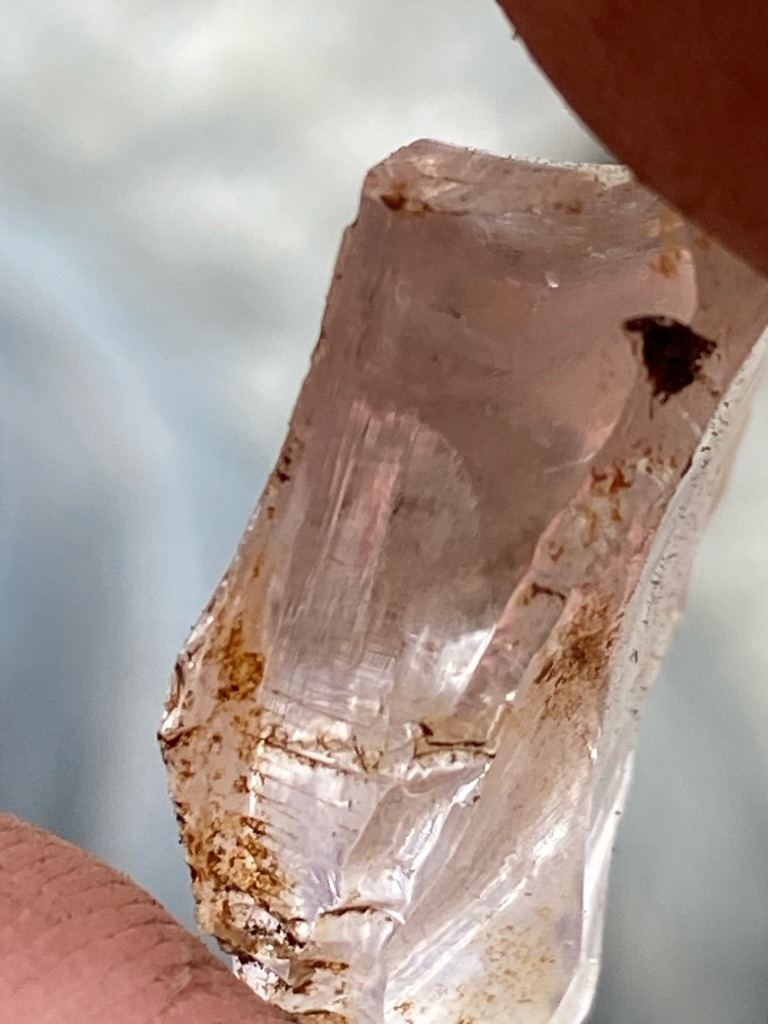
Natural rough mineral crystal, likely quartz, beryl, or possibly uncut corundum/topaz rather than diamond due to crystal habit and striated prismatic faces.
Natural rough mineral crystal, likely quartz, beryl, or possibly uncut corundum/topaz rather than diamond due to crystal habit and striated prismatic faces. · Rough uncut crystal shard with irregular, elongated prismatic form.
Not applicable (raw, uncut, unpolished crystal specimen). Cut
Carat
Estimated around 3.5 to 5.0 carats based on visual dimensions.
Color
Pale pinkish or brownish tint, characteristic of matrix-stained raw mineral specimens.
Clarity
Included (I1-I3 equivalent for rough stones), showing visible dark mineral inclusions and internal fractures.
Shape
Rough uncut crystal shard with irregular, elongated prismatic form.
Overall Assessment
An interesting, natural raw crystal specimen with visible matrix and growth lines, ideal for mineral collectors rather than jewelry use.
Cut Quality
Not applicable (raw, uncut, unpolished crystal specimen).
Brilliance
Low brilliance due to rough, unpolished surface scattering light externally.
Fire
Minimal to none observable on raw, unfaceted surfaces.
Scintillation
Absent due to the lack of precision-cut facets.
Proportions
Irregular raw crystal shape; standard faceted proportions do not apply.
Symmetry
Natural crystal symmetry showing distinct parallel striations along the prism face.
Polish
Unpolished, raw natural crystal face showing striations and matrix remnants.
Fluorescence
Cannot be determined without UV testing, though typical for untreated raw mineral specimens.
Inclusions
Large dark mineral inclusion visible near the upper right corner, alongside internal feather fractures.
Blemishes
Surface cavities, rough edges, and adhering matrix dirt/clay stained with iron oxide.
Origin
Alluvial deposit or pegmatite pocket, indicated by the adhering earthy matrix.
Treatment Detection
No signs of artificial treatment; completely natural as-mined state.
Estimated Value
Nominal mineral specimen value, typically ranging from $10 to $50 depending on the exact mineral species.
Certification Estimate
Gemological laboratories like GIA or GRS would issue a gemstone identification report rather than a diamond grading report.
Investment Potential
Low investment potential; valued primarily as a decorative or educational mineral specimen.
Similar Diamonds
Not applicable; comparable to other raw gemstone and mineral crystal specimens.
Setting Suggestions
Wire-wrapped pendant setting or custom organic prong setting to showcase the natural raw crystal form.
Care & Maintenance
Clean gently with warm soapy water and a soft brush; avoid harsh chemicals and ultrasonic cleaners due to internal fractures.
Interesting Facts
Raw crystals often display natural growth lines called striations, which help gemologists identify the mineral species.