Non-Diamond (Likely Glass or Quartz)
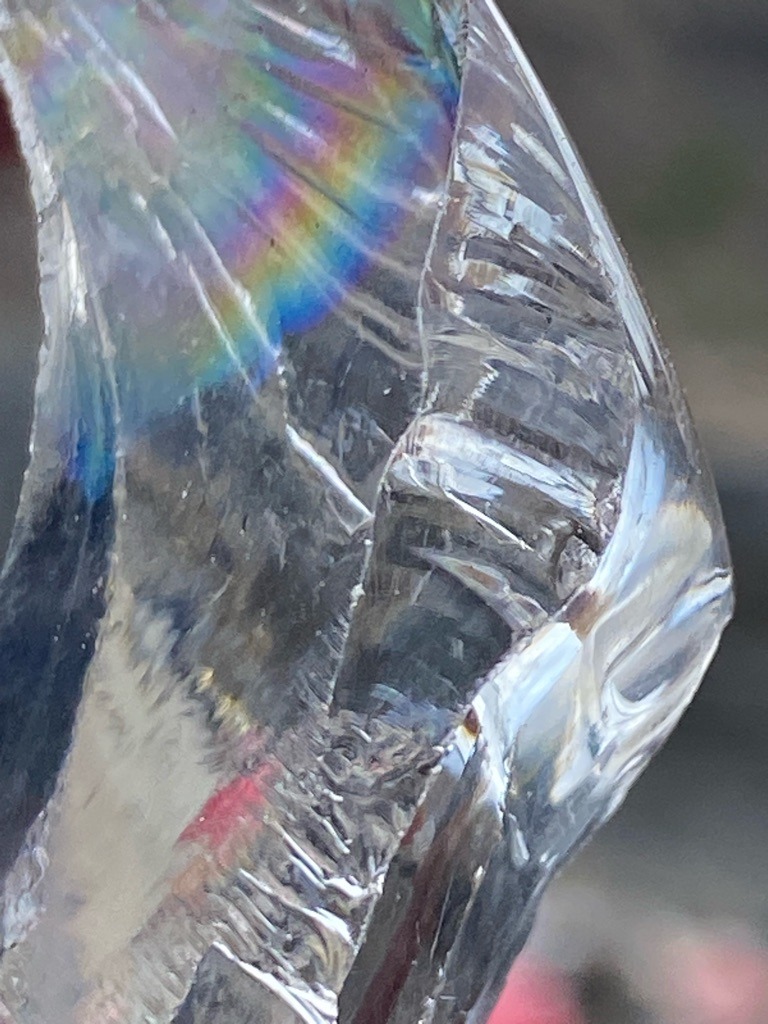
Non-Diamond (Likely Glass or Quartz) · Rough / Uncut (Conchoidal Fracture)
None (Uncut raw material) Cut
Carat
Difficult to estimate without scale; appears large (over 50 carats)
Color
Colorless / Transparent
Clarity
Included (Contains visible internal fractures)
Shape
Rough / Uncut (Conchoidal Fracture)
Overall Assessment
The specimen is not a diamond. The visible conchoidal (shell-like) fractures and the nature of the internal 'rainbow' reflections are characteristic of glass or quartz rather than the octahedral cleavage of a diamond.
Cut Quality
None (Uncut raw material)
Brilliance
Low; lacks the high refractive index of diamond
Fire
Static iridescence observed due to light diffraction in internal cracks rather than material dispersion
Scintillation
Poor; no faceted planes to produce sparkle
Proportions
N/A
Symmetry
None
Polish
Natural conchoidal surface luster
Fluorescence
Indeterminate from image
Inclusions
Large internal cleavage planes and fractures exhibiting iridescent thin-film interference
Blemishes
Surface ridges and jagged edges typical of glass-like fracture
Origin
Likely man-made glass cullet or a common silicate mineral fragment
Treatment Detection
N/A
Estimated Value
Minimal; decorative or specimen value only
Certification Estimate
Not applicable for grading; specimen would be identified as glass or mineral fragment
Investment Potential
None
Similar Diamonds
None; does not resemble diamond crystalline structure
Setting Suggestions
Display specimen only; not suitable for traditional jewelry setting due to fragility and lack of cut
Care & Maintenance
Handle with care to avoid further fracturing; clean with soft cloth/water
Interesting Facts
The rainbow effect seen is 'thin-film interference' caused by light reflecting between microscopic gaps in a fracture, not the 'fire' of a diamond