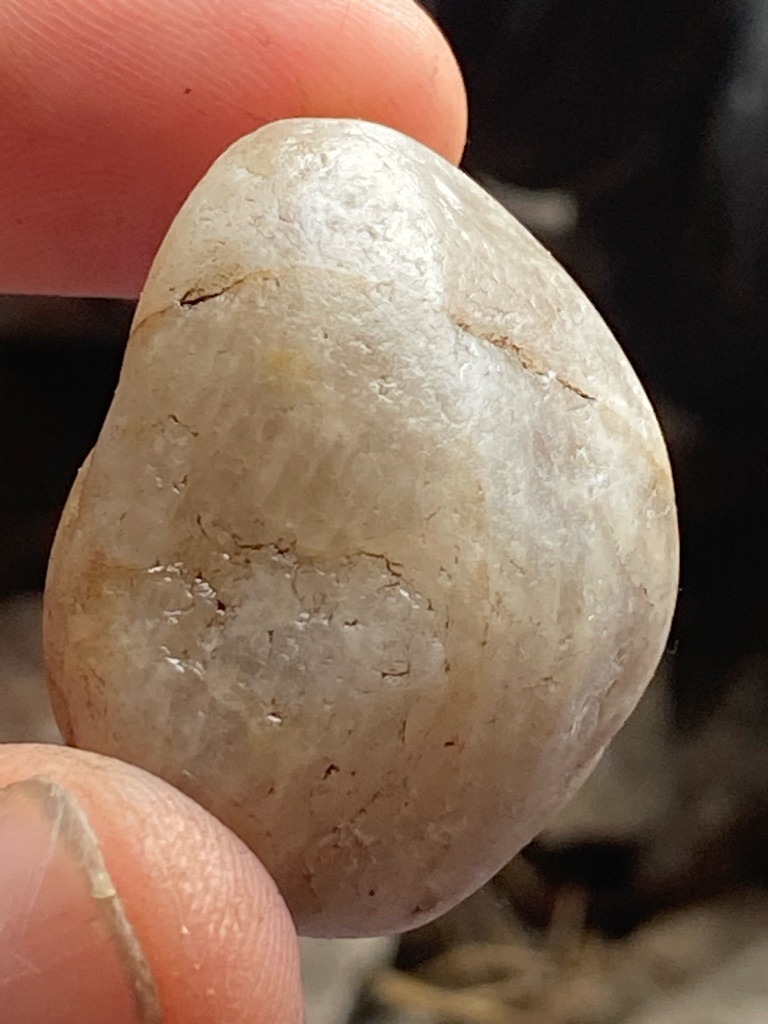
Not a diamond; this specimen appears to be an alluvial quartz or quartzite pebble, potentially quartz or chalcedony, displaying natural water-worn characteristics rather than crystalline diamond structure.
Not a diamond; this specimen appears to be an alluvial quartz or quartzite pebble, potentially quartz or chalcedony, displaying natural water-worn characteristics rather than crystalline diamond structure. · Irregular tumbled / water-worn pebble shape (non-faceted)
Not applicable (natural rough stone, unpolished by human hands, shaped by natural erosion) Cut
Carat
Cannot be precisely determined without density testing, but visually estimated between 3 to 5 carats equivalent volume in gemstone material (approx. 0.8 to 1.2 grams)
Color
Off-white to yellowish-brown (undetermined GIA color scale, consistent with natural mineral staining/iron oxides)
Clarity
Included (I3 equivalent or opaque rock matrix with visible fractures and inclusions)
Shape
Irregular tumbled / water-worn pebble shape (non-faceted)
Overall Assessment
This specimen is an interesting natural water-worn rock pebble (likely quartz or quartzite) rather than a diamond. It possesses no commercial diamond value, but makes a neat geological keepsake.
Cut Quality
Not applicable (natural rough stone, unpolished by human hands, shaped by natural erosion)
Brilliance
Poor to minimal; opaque/translucent stone lacking faceted internal light reflection
Fire
None; quartz/quartzite does not exhibit diamond-like fire or dispersion
Scintillation
None; lacks facets to create sparkle or patterns of light and dark
Proportions
Non-standard, irregular pebble proportions without defined table, crown, or pavilion
Symmetry
Asymmetrical due to natural weathering and water tumbling
Polish
Natural matte to slightly satin finish caused by river tumbling and abrasion
Fluorescence
Cannot be determined without UV testing (likely inert or faint weak fluorescence)
Inclusions
Heavy internal fracturing, mineral veins, and micro-inclusions typical of natural quartz or quartzite
Blemishes
Surface pitting, natural cracks, and abrasion marks from alluvial transport
Origin
Alluvial deposit (riverbed, stream, or beach gravels)
Treatment Detection
No treatments detected; completely natural unheated, untreated rough mineral pebble
Estimated Value
Nominal to low (under $5 USD as a raw mineral specimen or beach/river collectible)
Certification Estimate
Not eligible for diamond certification (GIA/AGS would not grade non-diamond or rough quartz minerals for gem jewelry)
Investment Potential
None as an investment; purely of educational, geological, or sentimental value as a found object
Similar Diamonds
None (this is not a diamond)
Setting Suggestions
Wire-wrapping in sterling silver or copper for rustic organic jewelry
Care & Maintenance
Requires standard care for quartz minerals; durable (Mohs hardness 7), clean with warm soapy water and a soft brush
Interesting Facts
Stones found worn smooth by water in rivers are often mistaken for rough diamonds by novices due to their rounded shape and greasy or waxy luster