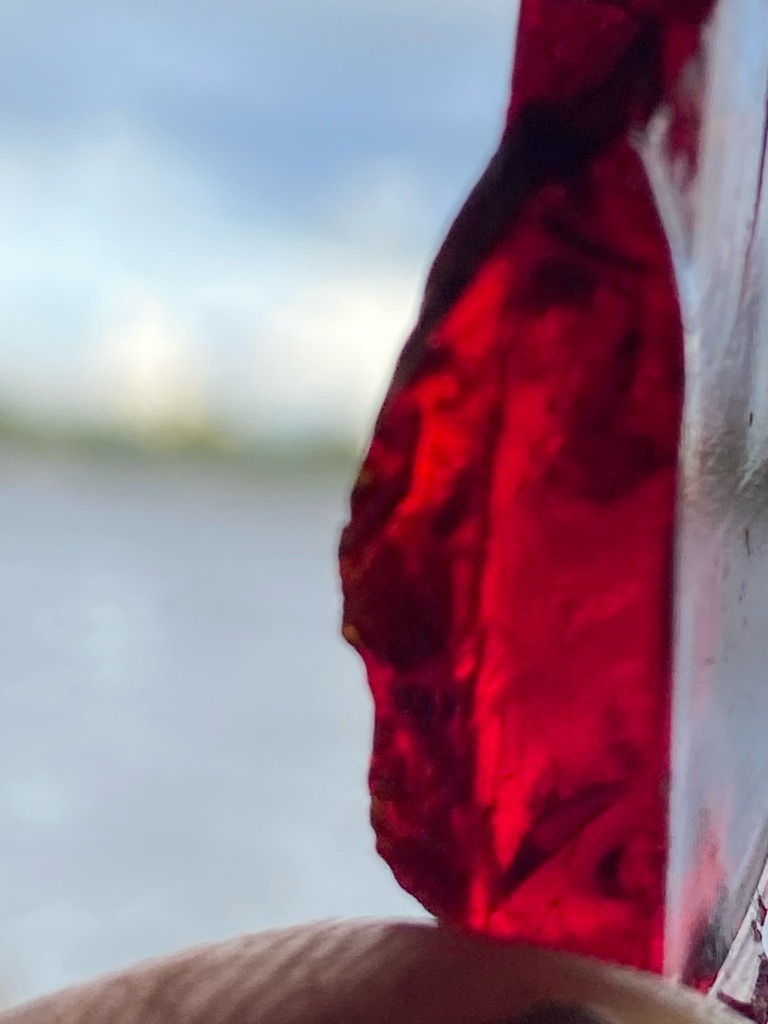
Not a diamond; appears to be a raw or rough red gemstone material, potentially quartz, spinel, or glass rather than diamond.
Not a diamond; appears to be a raw or rough red gemstone material, potentially quartz, spinel, or glass rather than diamond. · Rough crystal / Irregular uncut fragment
Not applicable (Rough uncut stone) Cut
Carat
Cannot be reliably determined from visual angle, roughly estimated over 5+ carats based on visible scale
Color
Fancy Deep Red
Clarity
Included (Contains visible internal fractures and structural impurities)
Shape
Rough crystal / Irregular uncut fragment
Overall Assessment
The specimen displayed is a vibrant red rough crystalline material rather than a diamond. Further gemological testing (refractive index, specific gravity) is necessary to determine the exact mineral species.
Cut Quality
Not applicable (Rough uncut stone)
Brilliance
Low due to lack of standard facet angles and rough surface
Fire
Minimal dispersion observed in current rough state
Scintillation
Poor, as facets are absent or unstructured
Proportions
Not applicable to rough stones
Symmetry
Asymmetrical (Natural rough state)
Polish
Unpolished (Natural/rough surface texture)
Fluorescence
Unknown without UV testing
Inclusions
Internal fractures, feathering, and localized mineral inclusions typical of rough gemstone material
Blemishes
Natural surface irregularities, pits, and rough patches
Origin
Natural rough mineral formation
Treatment Detection
Requires professional microscopic and spectroscopic examination to rule out dyeing, heating, or composite assembly
Estimated Value
Nominal value depending on actual mineral species identification (significantly lower than a diamond of equivalent size)
Certification Estimate
Standard gemological laboratories (GIA, GRS) would classify it as a colored gemstone rough rather than a diamond certificate
Investment Potential
Low investment liquidity compared to certified standard diamonds
Similar Diamonds
None, as diamonds do not naturally occur in this vivid saturated red rough form without intense treatment or lab creation
Setting Suggestions
Wire-wrapped or bespoke organic bezel setting if polished into a cabochon or kept as a raw specimen
Care & Maintenance
Avoid harsh chemicals, ultrasonic cleaners, and protect from impact due to internal fractures
Interesting Facts
Natural red is one of the rarest colors in diamonds, making most vivid red rough stones actually alternative minerals like ruby, spinel, or treated quartz