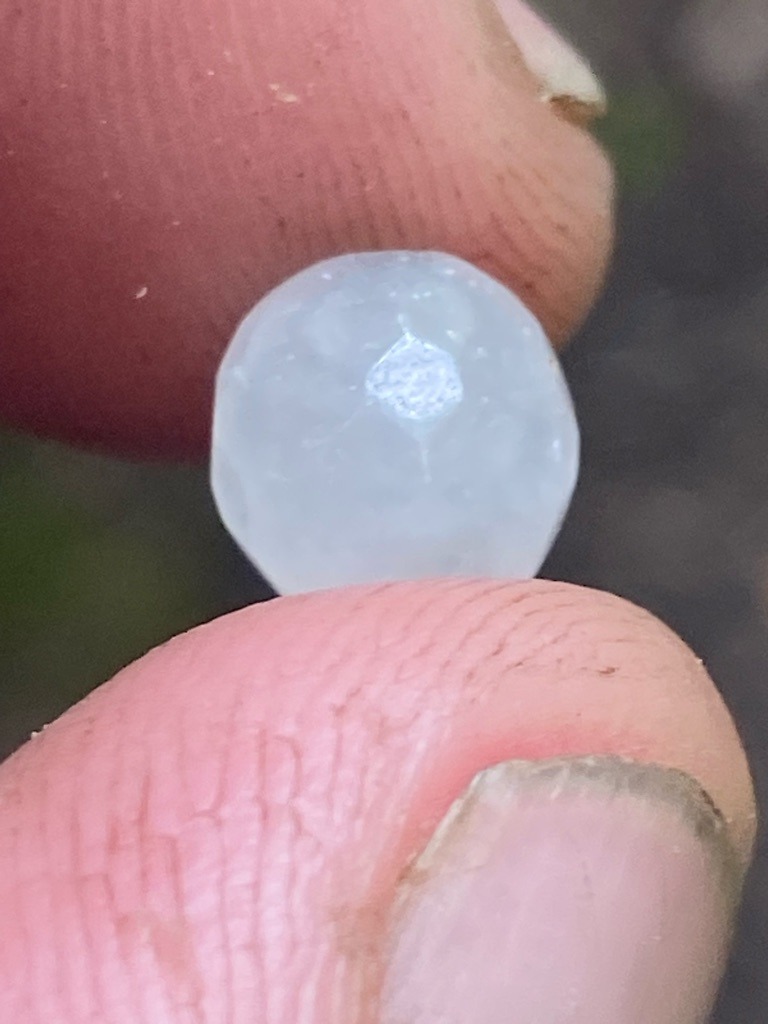
Natural rough diamond / translucent crystal with native crystal growth features
Natural rough diamond / translucent crystal with native crystal growth features · Rough crystal / Natural rounded dodecahedral or heavily weathered octahedron form
Not applicable (Rough, unpolished natural crystal state) Cut
Carat
Estimated approximately 0.40 to 0.60 carats based on visual proportions relative to human fingers
Color
Milky white / translucent to near-colorless body color with cloudy characteristics
Clarity
Included (I1 to I3 equivalent due to heavy cloudiness and internal feather inclusions)
Shape
Rough crystal / Natural rounded dodecahedral or heavily weathered octahedron form
Overall Assessment
This is a fascinating specimen of a natural, unpolished rough diamond crystal. While lacking the optical brilliance and clarity of faceted commercial gems, its natural form holds unique charm for mineral collectors and custom jewelry artisans specializing in raw stone designs.
Cut Quality
Not applicable (Rough, unpolished natural crystal state)
Brilliance
Low brilliance due to translucent-to-milky nature and lack of faceted optical geometry
Fire
Minimal fire dispersion because of rough surfaces and internal cloudiness
Scintillation
Poor scintillation; light is diffused rather than reflected in distinct flashes
Proportions
Natural asymmetrical rough form; standard table and depth percentages do not apply
Symmetry
Natural crystalline symmetry, showing rounded faces typical of rough alluvial stones
Polish
Natural unpolished surface texture showing frosted or etched crystal faces
Fluorescence
Cannot be definitively determined without UV testing, likely inert to moderate blue
Inclusions
Heavy internal clouds, feather fractures, and potential pinpoint inclusions scattering light
Blemishes
Natural surface pitting, trigons (growth marks), and etching features typical of rough diamonds
Origin
Likely alluvial deposit origin given the rounded, water-worn appearance of the rough crystal
Treatment Detection
Untreated natural rough diamond with no indications of artificial enhancements
Estimated Value
Nominal collector or specimen value, typically ranging from $20 to $100 depending on specific weight and exact mineral verification
Certification Estimate
GIA or similar major labs would issue a gemstone identification report rather than a standard diamond grading report due to rough status
Investment Potential
Low investment potential for resale, primarily valuable as a unique conversation piece or raw mineral specimen
Similar Diamonds
Other low-grade industrial or specimen-grade raw diamond crystals and alluvial rough stones
Setting Suggestions
Best suited for organic-style wire-wrapped jewelry, bezel settings designed for raw stones, or kept as a mineral specimen
Care & Maintenance
Standard gentle cleaning with warm soapy water and a soft brush; avoid harsh ultrasonic cleaners due to internal fractures
Interesting Facts
Raw diamond crystals like this have spent millions or billions of years deep within the Earth's mantle before being brought to the surface by kimberlite pipes or alluvial action