Simulant (likely Cubic Zirconia or Glass crystals)
Simulant (likely Cubic Zirconia or Glass crystals) · Round Brilliant
Fair to Poor (mismatched facets and asymmetrical alignment) Cut
Carat
Approx. 0.02 - 0.05 carats per individual stone
Color
Likely equivalent to G-H (Colorless to Near-Colorless range)
Clarity
Visual equivalent of SI1 to I1 (notable surface wear)
Shape
Round Brilliant
Overall Assessment
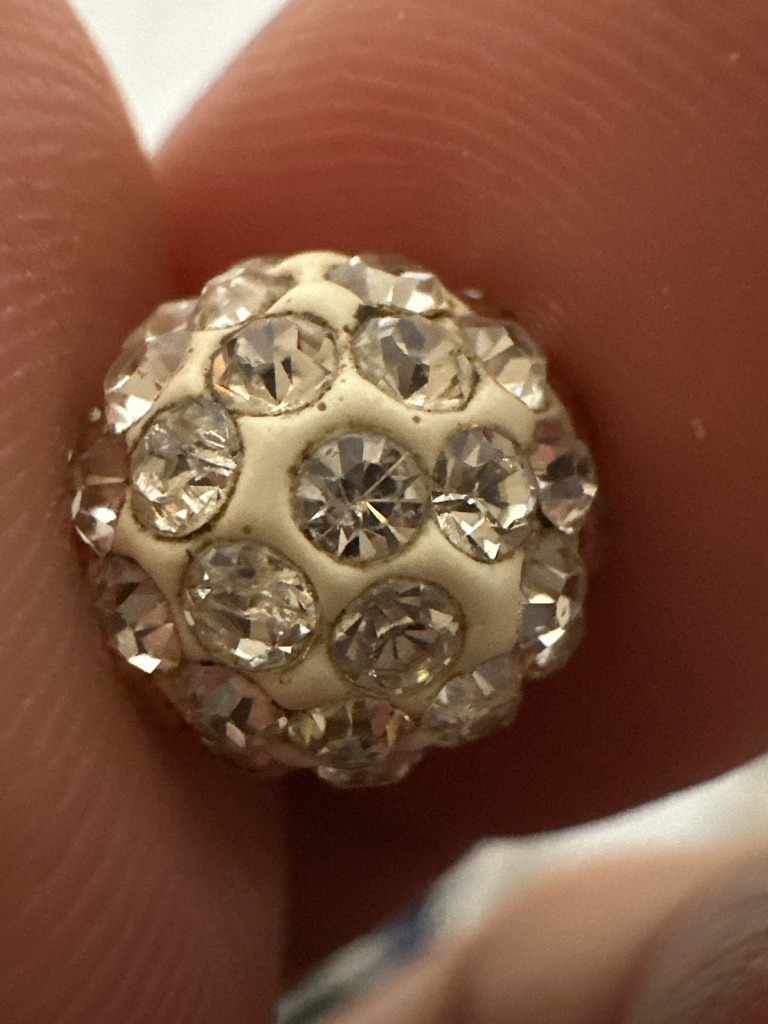
This is a piece of costume jewelry featuring synthetic simulant stones. It does not possess the physical or optical properties of a natural diamond.
Cut Quality
Fair to Poor (mismatched facets and asymmetrical alignment)
Brilliance
Low; the stones appear dull with limited internal reflection
Fire
Low dispersion; lack of characteristic spectral fire seen in real diamonds
Scintillation
Poor; stagnant light return with dead zones
Proportions
High crowns and shallow pavilions consistent with machine-cut simulants
Symmetry
Poor (stones are haphazardly set into a spherical base)
Polish
Fair (visible surface scratches and dullness)
Fluorescence
Inconclusive from image; typical for simulants to be inert
Inclusions
Visible bubbles or internal mold lines characteristic of glass or low-quality CZ
Blemishes
Surface abrasions, dirt buildup, and chipped facets
Origin
Factory manufactured (Mass-produced synthetic)
Treatment Detection
None applicable to simulants of this grade
Estimated Value
$1 - $10 (Costume jewelry value)
Certification Estimate
Unlikely to be graded by major labs like GIA or AGS
Investment Potential
None (depreciating costume item)
Similar Diamonds
Rhinestones or glass chatons used in costume accessories
Setting Suggestions
Pave or glue-set into base metal fashion jewelry (current state)
Care & Maintenance
Clean with warm soapy water and a soft brush; avoid harsh chemicals that may strip the adhesive or base polish
Interesting Facts
Spherical 'ball' settings like this are common in late 20th-century costume jewelry and often utilize clay-like epoxy to hold the stones in place