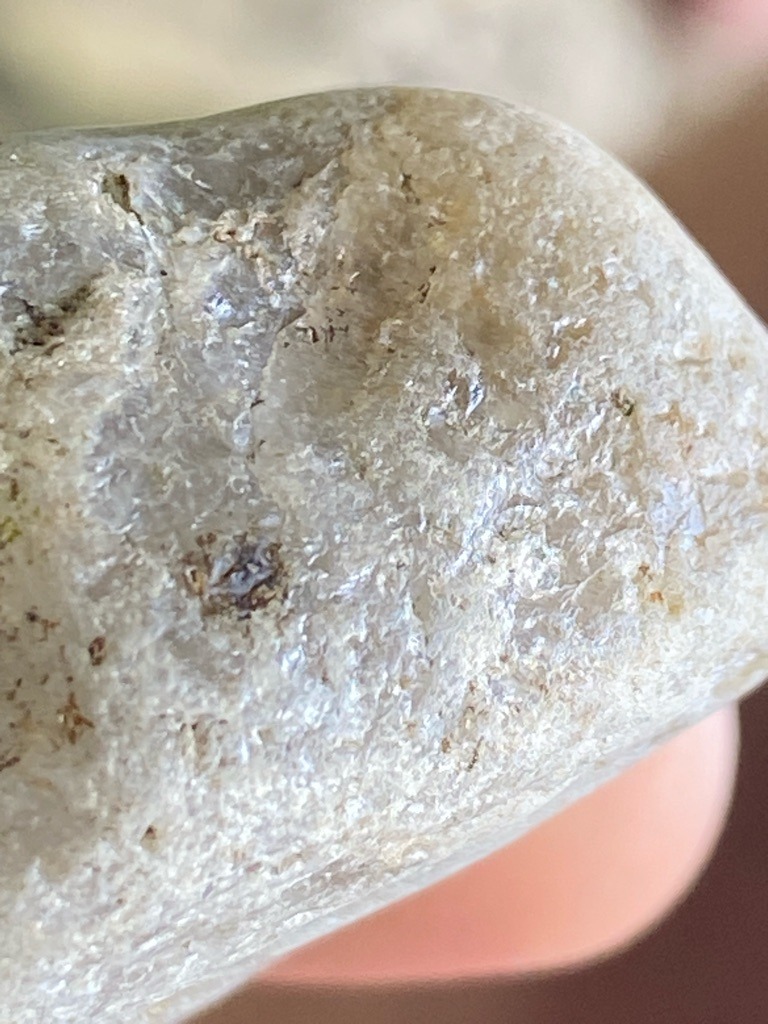
The specimen shown in the image is not a diamond; it appears to be a rough quartz pebble, likely chalcedony, quartzite, or quartz-rich rock displaying natural weathered crystal surfaces.
The specimen shown in the image is not a diamond; it appears to be a rough quartz pebble, likely chalcedony, quartzite, or quartz-rich rock displaying natural weathered crystal surfaces. · Irregular / Rough Pebble (uncut, unpolished natural form)
Not Applicable (Uncut rough stone) Cut
Carat
Not applicable as this is a mineral specimen, not a gem-quality diamond.
Color
Off-white / Translucent grayish-white with brownish surface staining (limonite)
Clarity
Included / Heavily fractured internal structure typical of raw quartz
Shape
Irregular / Rough Pebble (uncut, unpolished natural form)
Overall Assessment
The specimen in the image is a rough, naturally weathered quartz pebble rather than a diamond. A physical scratch test, specific gravity test, or thermal conductivity probe would easily confirm it is quartz, not diamond.
Cut Quality
Not Applicable (Uncut rough stone)
Brilliance
Low to minimal due to the rough, unpolished surface scattering light diffusely
Fire
None (Quartz lacks the high dispersion of a diamond)
Scintillation
Poor, as faceted surfaces are required for proper scintillation
Proportions
Not Applicable (Not faceted)
Symmetry
Asymmetrical, natural irregular formation
Polish
Unpolished, natural weathered texture with frosted/pitted appearance
Fluorescence
Undetermined without UV testing, though typical quartz may show weak patchy fluorescence
Inclusions
Abundant internal fractures, mineral impurities, and micro-crystalline structures typical of raw quartz
Blemishes
Surface pitting, abrasion marks, and weathering discoloration
Origin
Natural terrestrial mineral deposit (alluvial quartz pebble)
Treatment Detection
No signs of human treatment; appears completely natural
Estimated Value
Nominal / Specimen value only (negligible commercial gemstone value)
Certification Estimate
Not eligible for diamond grading labs (GIA, AGS). Requires testing by a general gemological lab or geologist for mineral identification.
Investment Potential
None; educational or mineral specimen value only.
Similar Diamonds
None, as this material is quartz and shares no optical or physical properties with diamond.
Setting Suggestions
Not recommended for fine jewelry settings due to low hardness relative to precious gemstones, though wire-wrapping could be used for rustic jewelry.
Care & Maintenance
Standard cleaning with mild soap and water; quartz has a Mohs hardness of 7 and can be scratched by harder minerals.
Interesting Facts
Quartz is one of the most abundant minerals on Earth's continental crust and is often mistaken by novices for rough diamond due to its glassy luster.