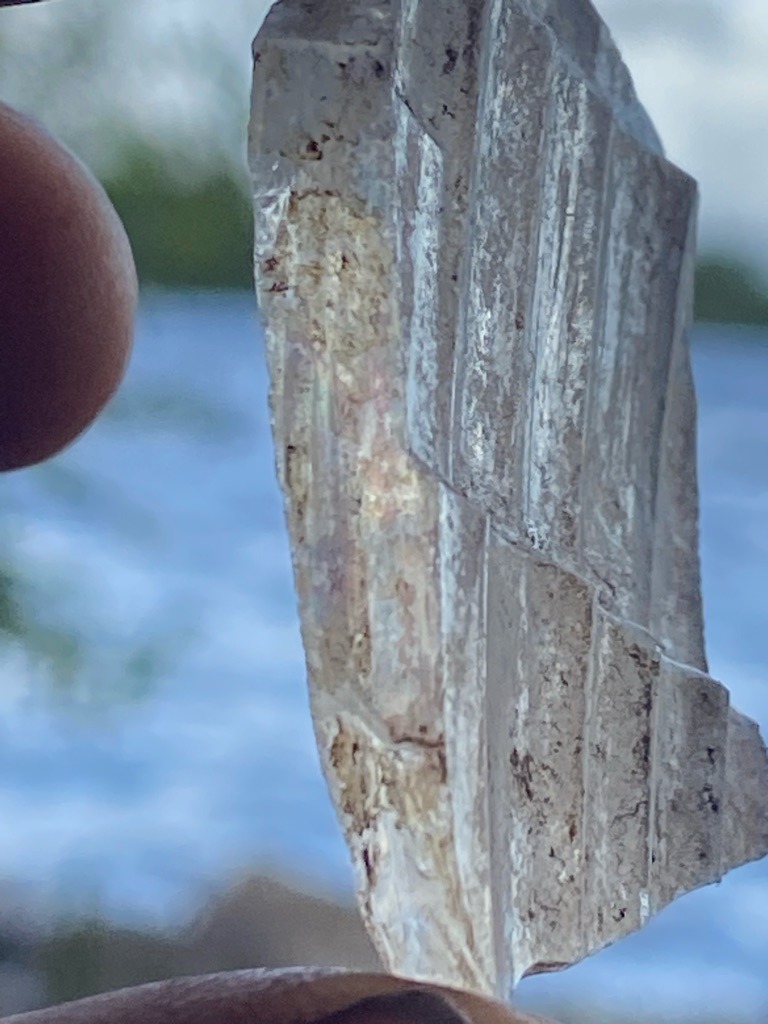
Not a diamond; this specimen appears to be a raw, unpolished mineral crystal, likely quartz, feldspar, or a silicate mineral (such as tourmaline or beryl fragment), displaying striated prismatic faces and rough cleavage planes rather than diamond crystal habits (such as octahedrons).
Not a diamond; this specimen appears to be a raw, unpolished mineral crystal, likely quartz, feldspar, or a silicate mineral (such as tourmaline or beryl fragment), displaying striated prismatic faces and rough cleavage planes rather than diamond crystal habits (such as octahedrons). · Rough crystal / Irregular elongated fragment
Not applicable (rough, uncut mineral specimen) Cut
Carat
Not applicable for a gemological diamond grading; specimen weight requires physical scale measurement
Color
Translucent to opaque with brownish-white and earthy surface staining
Clarity
Included / heavily included with internal fractures and surface matrix inclusions
Shape
Rough crystal / Irregular elongated fragment
Overall Assessment
The specimen shown in the image is a rough, unpolished mineral crystal fragment showing natural striations and cleavage planes, clearly distinct from a faceted diamond in both composition and physical characteristics.
Cut Quality
Not applicable (rough, uncut mineral specimen)
Brilliance
Low to none due to lack of standard facet alignment and opaque/fractured interior
Fire
None visible in current rough, untempered state
Scintillation
None; lacks polished facets to return moving patterns of light
Proportions
Elongated prismatic crystal fragment with irregular dimensions
Symmetry
Natural crystal striations present; asymmetric due to fracturing and cleavage
Polish
Unpolished, raw natural surface textures and fracture faces
Fluorescence
Undetermined without ultraviolet testing
Inclusions
Heavy internal feather fractures, mineral inclusions, and surface pitting
Blemishes
Natural surface etching, chips, fractures, and adhering matrix material
Origin
Natural geological mineral formation (terrestrial pegmatite or metamorphic host rock)
Treatment Detection
No obvious signs of artificial enhancement; appears completely untreated and natural
Estimated Value
Nominal mineral specimen value (low commercial value depending on exact mineral species and locality)
Certification Estimate
Not eligible for standard diamond grading laboratories (GIA/IGI); requires geological or mineralogical analysis (e.g., GIA colored stone report or university lab identification)
Investment Potential
Collector mineral specimen value only; no traditional diamond investment liquidity
Similar Diamonds
None; this specimen is not a diamond
Setting Suggestions
Wire-wrapped pendant setting or custom artisan prong setting to preserve the raw, organic aesthetic
Care & Maintenance
Handle with care to prevent further cleavage or fracturing along natural planes; clean gently with mild soapy water and a soft brush
Interesting Facts
Raw crystals often display striations (parallel growth lines) on their prism faces, which are characteristic growth features in certain silicate minerals