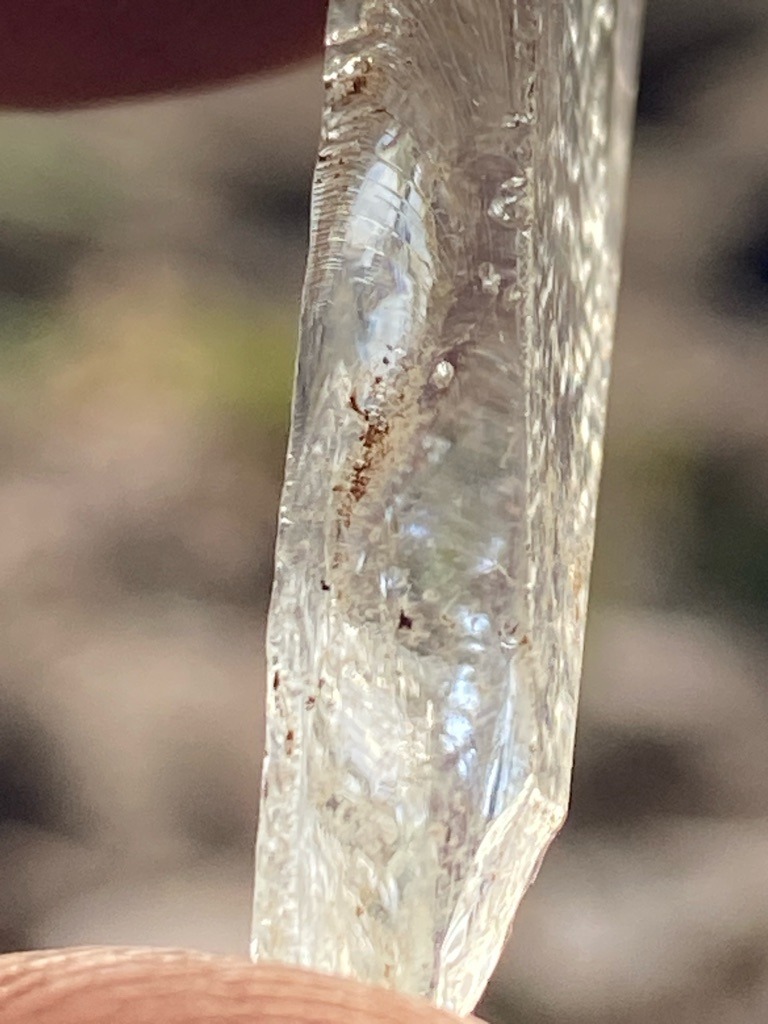
The image shows a raw mineral specimen, likely quartz or a similar crystalline rock, rather than a genuine faceted diamond. The striated growth lines and amorphous structure are inconsistent with rough diamond crystals.
The image shows a raw mineral specimen, likely quartz or a similar crystalline rock, rather than a genuine faceted diamond. The striated growth lines and amorphous structure are inconsistent with rough diamond crystals. · Raw, unpolished elongated crystal fragment with irregular natural formation.
Uncut / Raw (Not applicable for gem-grade cut proportions). Cut
Carat
Not applicable to standard cut diamonds; visually significant as a mineral fragment, roughly estimated over 10 carats in total mass.
Color
Colorless to slightly brownish-white due to mineral impurities trapped inside.
Clarity
Included (I3 equivalent); highly included with visible internal fractures, mineral inclusions, and surface irregularities.
Shape
Raw, unpolished elongated crystal fragment with irregular natural formation.
Overall Assessment
The specimen displayed is a raw, natural mineral crystal fragment (likely quartz) featuring visible growth striations and internal inclusions, rather than a genuine diamond. It lacks the crystal habit, hardness, and optical properties of diamond.
Cut Quality
Uncut / Raw (Not applicable for gem-grade cut proportions).
Brilliance
Low brilliance due to lack of standard facet angles and internal inclusions diffusing light.
Fire
Minimal to none, characteristic of raw silicate minerals rather than high-dispersion diamond.
Scintillation
Poor, as there are no precision-cut facets to return light flashes.
Proportions
Not applicable as this is an unproportioned, uncut mineral fragment.
Symmetry
Asymmetrical, typical of natural rough crystal growth.
Polish
Raw, unpolished surface showing natural striations (growth lines) typical of quartz crystal faces.
Fluorescence
Unknown without UV testing, though typical quartz or raw silicates may show weak inert or faint blue/green under UV.
Inclusions
Heavy internal clouding, mineral deposits (possibly iron oxide staining giving the brownish hue), and internal fractures.
Blemishes
Rough surface pitting, natural striations, and irregular fracture planes.
Origin
Natural terrestrial mineral formation (likely found in pegmatite or hydrothermal veins).
Treatment Detection
No evidence of artificial treatments; appears entirely natural and untreated.
Estimated Value
Minimal commercial value as a gemstone; primarily of interest as a raw mineral specimen or educational rock sample (under $50).
Certification Estimate
Standard gemological laboratories (such as GIA or AGS) would identify this as a non-diamond mineral specimen rather than issuing a diamond grading report.
Investment Potential
None as a financial investment; holds value solely as a natural specimen for mineral collectors.
Similar Diamonds
None, as this specimen is not a diamond; comparable to raw quartz or beryl crystal shards.
Setting Suggestions
Wire-wrapped in sterling silver or copper for rustic, bohemian-style raw crystal jewelry.
Care & Maintenance
Clean gently with warm soapy water and a soft brush; avoid harsh chemicals and protect from impact to prevent fracturing along natural cleavage or inclusion planes.
Interesting Facts
The visible linear striations on the surface are growth lines commonly found on quartz crystal prism faces, helping distinguish quartz from other transparent minerals.