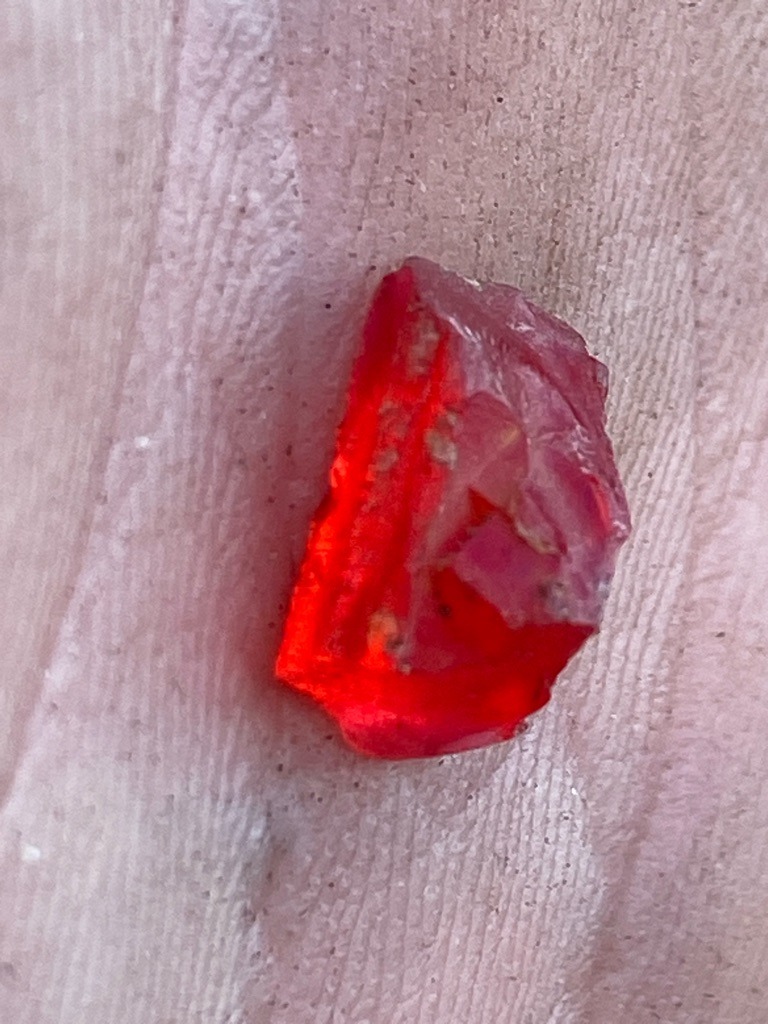
The specimen shown in the image appears to be a rough gemstone, likely a ruby or red spinel, rather than a diamond. Naturally occurring red diamonds are extremely rare, and this sample lacks the characteristic crystal habit and adamantine luster of rough diamond.
The specimen shown in the image appears to be a rough gemstone, likely a ruby or red spinel, rather than a diamond. Naturally occurring red diamonds are extremely rare, and this sample lacks the characteristic crystal habit and adamantine luster of rough diamond. · Rough uncut crystal / irregular fragment with natural crystal faces.
Not applicable as this is an uncut, unpolished rough crystal specimen. Cut
Carat
Estimated at approximately 1.5 to 2.5 carats based on visual scale against a human hand, though precise weight requires a scale.
Color
Vivid red / Fancy Intense Red hue with strong saturation.
Clarity
Included (I1-I2 equivalent for rough stone), displaying internal fractures and inclusions visible to the naked eye.
Shape
Rough uncut crystal / irregular fragment with natural crystal faces.
Overall Assessment
The visual evidence indicates a natural red rough gemstone crystal (likely ruby or spinel) rather than a diamond. Further physical and gemological testing (refractive index, specific gravity) is required for definitive identification.
Cut Quality
Not applicable as this is an uncut, unpolished rough crystal specimen.
Brilliance
Vitreous to sub-adamantine luster, dependent on transparency and light transmission through the rough facets.
Fire
Low to moderate dispersion, characteristic of colored gemstones rather than diamond.
Scintillation
Limited flash effect due to rough, unpolished surface preventing internal light return symmetry.
Proportions
Non-standard natural proportions; unfaceted raw mineral specimen.
Symmetry
Natural asymmetric crystal formation, typical of rough corundum or spinel growth.
Polish
Raw, unpolished natural surface texture with rough fracture planes.
Fluorescence
Strong red fluorescence under UV light is characteristic if this is ruby, though indeterminate strictly from ambient lighting.
Inclusions
Feathers, internal fractures, and mineral inclusions typical of natural rough gemstones.
Blemishes
Natural surface pitting, rough patches, and growth irregularities.
Origin
Likely alluvial or primary deposit origin from regions known for ruby/spinel mining such as Myanmar, Mozambique, or Madagascar.
Treatment Detection
Requires advanced spectroscopic testing (FTIR, EDXRF) to rule out heat treatment or fracture filling if identified as corundum.
Estimated Value
Valued significantly lower than a red diamond; dependent on exact mineral species (ruby vs. spinel) and geographic origin, likely ranging from $100 to $500 as a rough specimen.
Certification Estimate
Gemological laboratories such as GIA or Gübelin would identify this as a natural ruby or spinel rather than issuing a standard diamond grading report.
Investment Potential
Low investment potential in its current rough, heavily included state unless faceted by a master cutter to maximize yield and clarity.
Similar Diamonds
Red diamonds (though chemically and structurally unrelated; visually shares only the color hue).
Setting Suggestions
If cut and polished, would suit a custom gold prong or bezel setting designed for colored gemstones.
Care & Maintenance
Store separately in a soft pouch to prevent scratching other stones; clean with warm soapy water and a soft brush; avoid harsh ultrasonic cleaners if fractures are present.
Interesting Facts
Natural red diamonds are among the rarest colored diamonds in the world, often commanding millions per carat, whereas red rough stones like ruby are much more common.