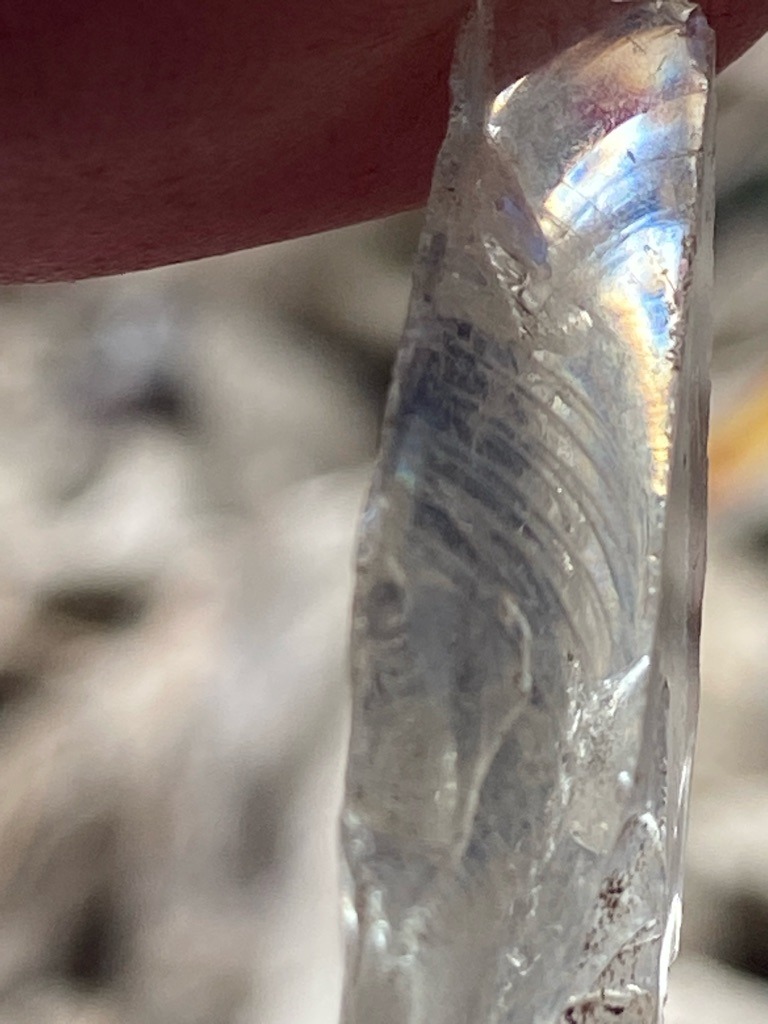
Not a diamond; appears to be quartz crystal or glass with conchoidal fractures and optical interference colors.
Not a diamond; appears to be quartz crystal or glass with conchoidal fractures and optical interference colors. · Rough / Irregular fragment
Uncut / Raw fragment Cut
Carat
Estimated around 2.50 to 3.50 carats based on visual scale
Color
Colorless / Transparent with surface iridescence
Clarity
Included / Heavily fractured (Not applicable to standard diamond grading)
Shape
Rough / Irregular fragment
Overall Assessment
This specimen is a raw, fractured transparent mineral fragment (likely quartz) showing conchoidal fracture patterns and surface iridescence. It is definitely not a diamond.
Cut Quality
Uncut / Raw fragment
Brilliance
Low to moderate vitreous luster, interrupted by internal fractures
Fire
Minimal native dispersion; optical colors visible are likely thin-film interference (rainbow iridescence)
Scintillation
Poor due to lack of standard facet arrangement
Proportions
N/A - Non-standard faceted geometry
Symmetry
Asymmetrical raw mineral piece
Polish
Unpolished natural cleavage/fracture surfaces
Fluorescence
Indeterminate from visual assessment
Inclusions
Internal fractures, feathering, and inclusions typical of natural quartz or similar silicates
Blemishes
Surface conchoidal fracture lines, chips, and iridescence films
Origin
Natural mineral specimen (likely quartz or hydrothermal quartz vein fragment)
Treatment Detection
Possible surface coating or stress-induced thin-film interference creating rainbow effects
Estimated Value
Nominal value (under $20 USD as a mineral specimen)
Certification Estimate
Standard gemological laboratories (GIA, IGI) would identify this as quartz or glass rather than a diamond
Investment Potential
None; ornamental or educational mineral specimen only
Similar Diamonds
None, as this specimen lacks diamond crystal structure, hardness, and optical properties
Setting Suggestions
Wire-wrapped pendant or raw mineral collector display
Care & Maintenance
Avoid harsh chemicals, ultrasonic cleaners, and hard impacts due to inherent internal fracturing
Interesting Facts
The rainbow effect on the surface is caused by light interference reflecting off micro-fractures, often confused by novices with diamond fire