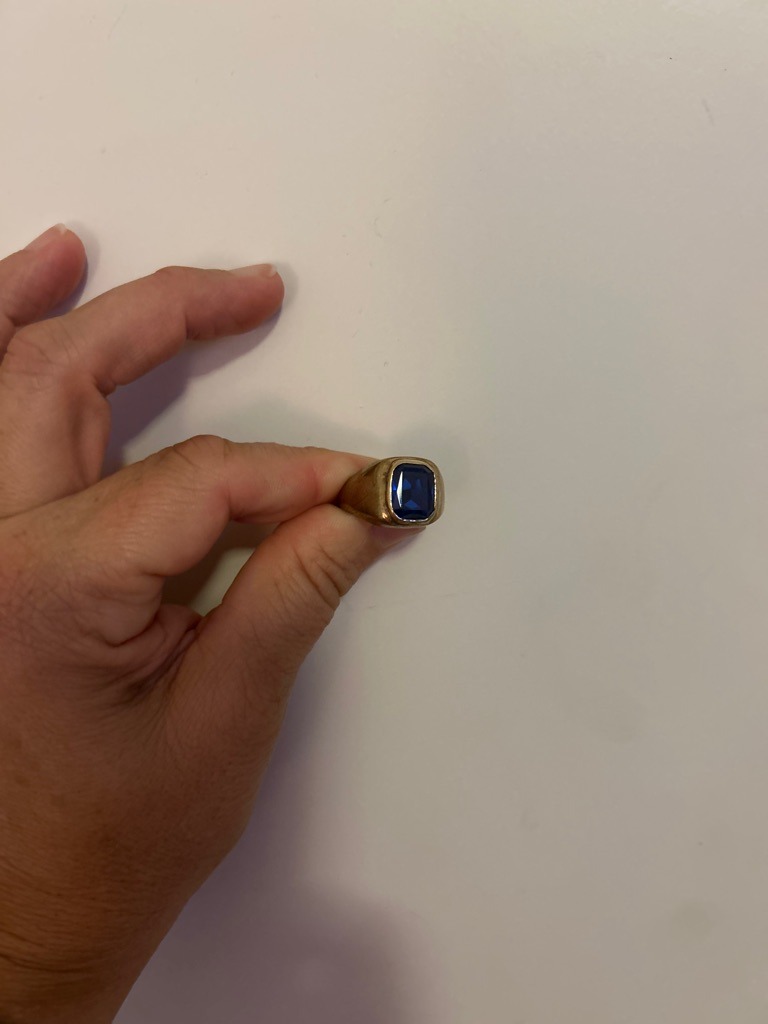
Not a diamond; this gemstone appears to be a natural or synthetic blue sapphire or spinel set in a yellow gold ring.
Not a diamond; this gemstone appears to be a natural or synthetic blue sapphire or spinel set in a yellow gold ring. · Cushion or emerald cut with rounded corners
Good to Very Good (stepped/faceted pavilion with broad flash) Cut
Carat
Estimated at approximately 2.0 to 3.0 carats based on visual proportions in the setting
Color
Deep royal blue with vivid saturation
Clarity
Eye-clean to slightly included (VS equivalent)
Shape
Cushion or emerald cut with rounded corners
Overall Assessment
An attractive vintage or antique-style men's or heavy signet ring featuring a vivid deep blue gemstone (likely sapphire) securely mounted in a bezel setting, offering a classic and durable presentation
Cut Quality
Good to Very Good (stepped/faceted pavilion with broad flash)
Brilliance
Moderate to good vitreous luster typical of blue corundum
Fire
Low (sapphires exhibit lower dispersion/fire compared to diamond)
Scintillation
Broad flashes of deep blue light reflecting from step-like facets
Proportions
Medium to deep pavilion with a moderate table characteristic of antique or vintage colored stone cuts
Symmetry
Good symmetrical rectangular/cushion alignment
Polish
Good surface polish with clear facet junctions
Fluorescence
Cannot be determined without UV testing (typically inert to faint in sapphires)
Inclusions
Likely contains characteristic fine rutile needles or minor crystal inclusions typical of natural sapphires, though magnification is needed
Blemishes
Minor surface wear consistent with age on the bezel edges
Origin
Cannot be accurately determined visually; potential sources for fine blue sapphires include Ceylon (Sri Lanka), Madagascar, or Kashmir, though synthetic flame-fusion or flux-grown origins are also possible
Treatment Detection
Thermal enhancement (heat treatment) is common in commercial sapphires; advanced laboratory testing (FTIR, EDXRF) required to confirm
Estimated Value
Depends heavily on whether the stone is natural (untreated vs. heated) or synthetic; could range from $500 to several thousand dollars
Certification Estimate
AGL or GUE (if tested for origin and heat treatment)
Investment Potential
Moderate for fine unheated natural sapphires of high clarity and color; synthetic stones hold minimal investment value
Similar Diamonds
Not applicable as this is a colored gemstone, not a diamond
Setting Suggestions
Currently set in a classic yellow gold gypsy or bezel flush setting, which provides excellent protection for everyday wear
Care & Maintenance
Clean with warm soapy water and a soft brush; avoid harsh ultrasonic cleaners if the stone has fracture-filling treatments
Interesting Facts
Blue sapphires are composed of corundum (aluminum oxide) where trace amounts of iron and titanium impart the rich blue color