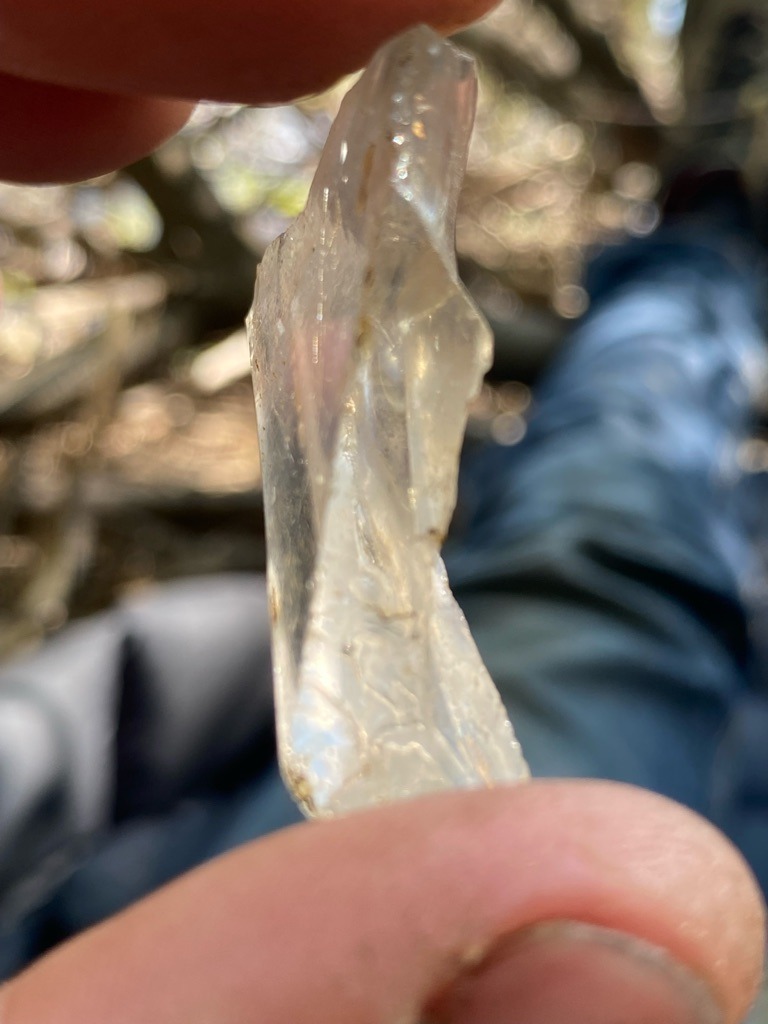
The specimen appears to be non-diamond mineral, likely a piece of Quartz (rock crystal) or potentially common glass slag/silica, as it lacks the characteristic octahedral or dodecahedral crystal habit of raw diamond.
The specimen appears to be non-diamond mineral, likely a piece of Quartz (rock crystal) or potentially common glass slag/silica, as it lacks the characteristic octahedral or dodecahedral crystal habit of raw diamond. · Irregular / Rough (Uncut)
N/A - Rough specimen. Cut
Carat
Estimated 5.0 to 10.0 carats based on size relative to fingers, though mass depends on specific gravity of the material.
Color
Near-colorless with a slight yellowish or grayish tint; inconsistent with high-gem quality white diamonds.
Clarity
Included (I) - presence of heavy fractures, internal veining, and visible surface-reaching fissures.
Shape
Irregular / Rough (Uncut)
Overall Assessment
This specimen is highly unlikely to be a diamond. Its fracture pattern (conchoidal), luster (vitreous), and elongated shape strongly suggest it is a common macrocrystalline quartz or possibly a piece of weather-worn glass.
Cut Quality
N/A - Rough specimen.
Brilliance
Low; the material displays low refractive index properties compared to diamond.
Fire
None visible; lack of high dispersion characteristic of carbon crystals.
Scintillation
None; surface reflections only.
Proportions
N/A - Lacks geometric facets.
Symmetry
N/A - Natural irregular formation.
Polish
N/A - Natural or fractured surface luster is vitreous (glassy) rather than adamantine (diamond-like).
Fluorescence
Indeterminable without UV light exposure.
Inclusions
Heavy internal fracturing, cloudy veining, and linear inclusions typical of terrestrial quartz.
Blemishes
Conchoidal (shell-like) fractures on the edges, which is a key indicator of quartz or glass rather than diamond.
Origin
Terrestrial; likely found in a riverbed or mountain environment (alluvial or vein quartz).
Treatment Detection
None apparent; appears to be a natural raw mineral or industrial byproduct.
Estimated Value
Minimal; if quartz or glass, the value is nominal ($1-$5).
Certification Estimate
Unlikely to be certified by major diamond labs like GIA as it does not present as diamond material.
Investment Potential
Low; specimen lacks gemological rarity or high-demand properties.
Similar Diamonds
None; significantly different optical and structural properties than a diamond rough.
Setting Suggestions
Not recommended for fine jewelry setting without significant lapidary work; could be used in wire-wrap jewelry.
Care & Maintenance
Avoid heavy impact; if it is quartz, it is softer (Mohs 7) than diamond and will scratch and chip easily.
Interesting Facts
Quartz is often mistaken for diamond by hikers due to its clarity and prevalence in many geological formations.