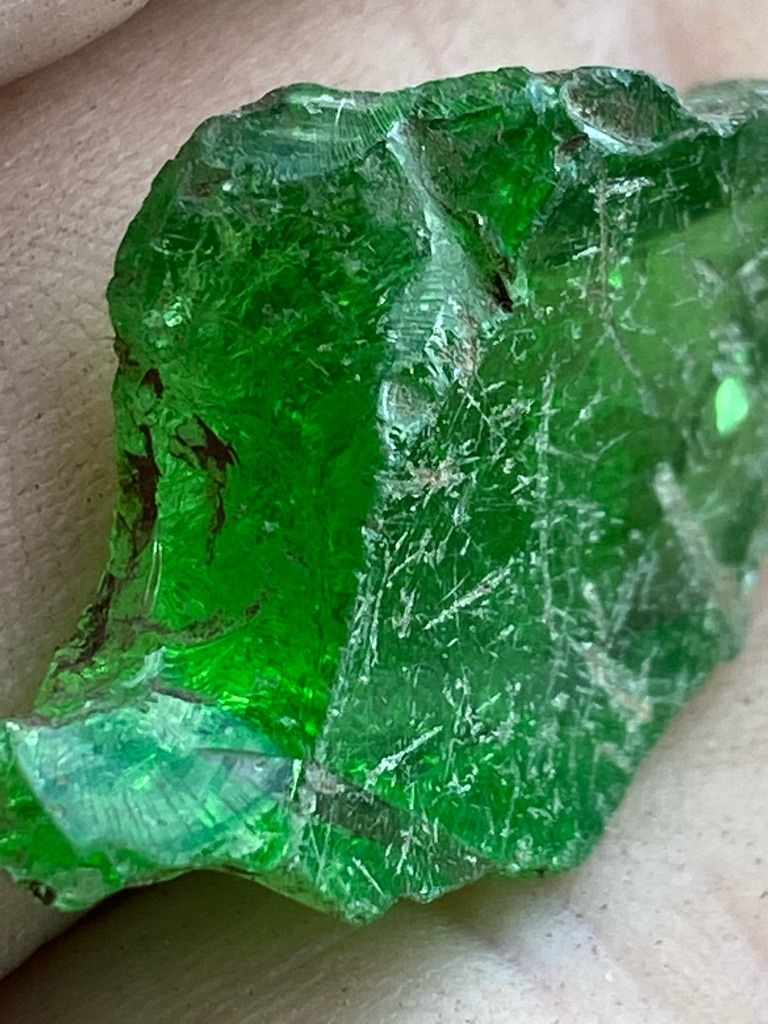
Not a diamond; this specimen appears to be a rough, vividly green crystalline mineral or glass, possibly green tourmaline, tsavorite garnet, chrome diopside, or colored glass.
Not a diamond; this specimen appears to be a rough, vividly green crystalline mineral or glass, possibly green tourmaline, tsavorite garnet, chrome diopside, or colored glass. · Raw, uncut, and unpolished rough crystal fragment with natural conchoidal fractures.
Not applicable (Rough, un-faceted mineral specimen). Cut
Carat
Cannot be accurately determined by visual estimation without specific dimensional measurements and density testing, but visually substantial as a rough piece.
Color
Vivid green / Fancy Intense Green (not applicable to standard white diamond D-Z scale).
Clarity
Included / Heavily included with internal fractures, stress cracks, and surface striations (Not applicable on standard diamond clarity grades like VS/SI since it is not a diamond).
Shape
Raw, uncut, and unpolished rough crystal fragment with natural conchoidal fractures.
Overall Assessment
An interesting, vividly green rough crystal specimen that is definitely not a diamond. Further gemological testing (refractive index, specific gravity, spectroscopy) is recommended to confirm the exact mineral species.
Cut Quality
Not applicable (Rough, un-faceted mineral specimen).
Brilliance
Vitreous to sub-adamantine luster across fracture faces, though limited due to lack of faceting.
Fire
Low dispersion compared to a diamond, characteristic of colored gemstone rough.
Scintillation
Minimal to none due to lack of precision cut facets.
Proportions
Irregular raw crystal proportions with no standard table, depth, crown, or pavilion angles.
Symmetry
Natural asymmetric rough formation.
Polish
Raw/Unpolished surface showing natural cleavage and fracture planes.
Fluorescence
Unknown without UV light testing.
Inclusions
Abundant internal fractures, feather inclusions, and mineral or gas inclusions typical of natural rough stones.
Blemishes
Surface scratches, natural chipping, and rough textural lines.
Origin
Natural rough mineral, exact geographic origin requires advanced spectroscopic testing.
Treatment Detection
No obvious visible treatments, but advanced testing (FTIR, Raman spectroscopy) is necessary to rule out artificial coloration or fracture filling.
Estimated Value
Nominal value as a rough mineral specimen, highly dependent on the exact mineral species (e.g., lower if glass, moderate if chrome diopside or tourmaline, higher if fine tsavorite garnet).
Certification Estimate
Gemological laboratories such as GIA, GRS, or SSEF would evaluate this if submitted as a colored gemstone rather than a diamond.
Investment Potential
Low to moderate as an investment, primarily valued by mineral collectors or custom jewelry designers.
Similar Diamonds
None, as this is visually a green gemstone or mineral rough rather than a diamond.
Setting Suggestions
Best suited for wire-wrapping, bespoke organic jewelry settings, or as a raw mineral specimen in a collection.
Care & Maintenance
Handle with care to prevent further chipping along natural fracture planes; avoid harsh chemical cleaners or ultrasonic cleaners depending on the exact mineral identification.
Interesting Facts
Bright green rough stones are frequently mistaken for diamonds or emeralds by novices, but their crystal structure and fracture patterns typically reveal their true identity.