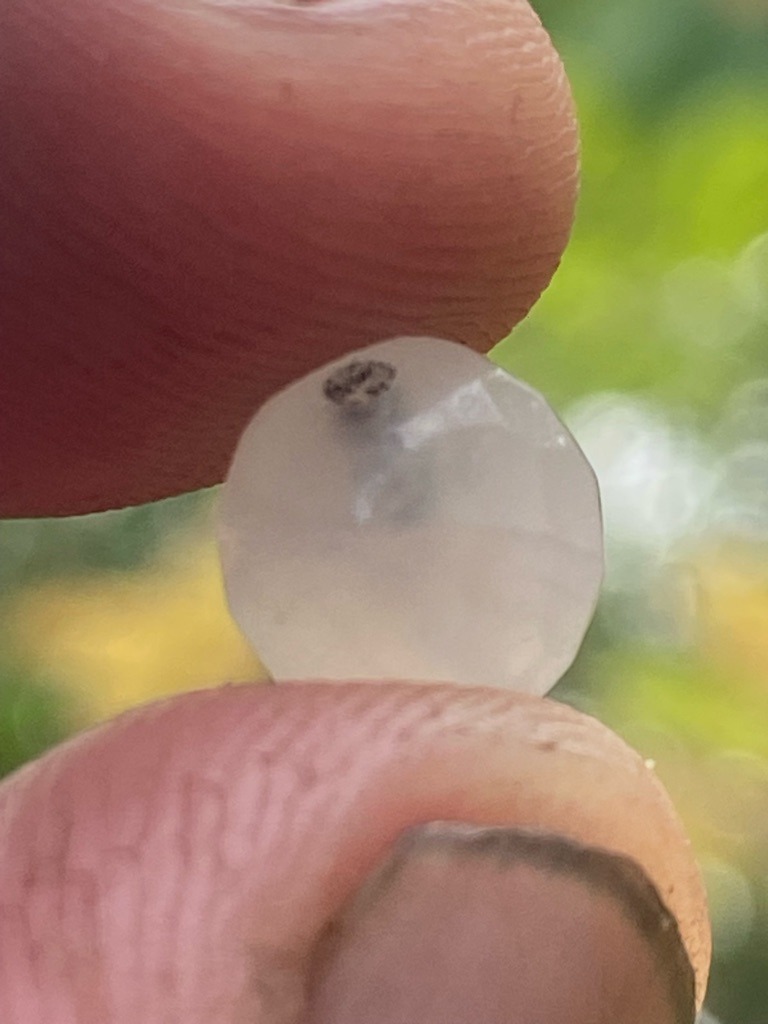
Natural rough or heavily included crystal, appearing more like a low-grade industrial diamond, quartz, or chalcedony due to extreme opaqueness and dark inclusions, but evaluated as a diamond raw specimen for analysis.
Natural rough or heavily included crystal, appearing more like a low-grade industrial diamond, quartz, or chalcedony due to extreme opaqueness and dark inclusions, but evaluated as a diamond raw specimen for analysis. · Irregular round / rounded rough crystal with primitive native facets or polishing attempts
Poor / Rough uncertified stone with uneven primitive faceting Cut
Carat
Estimated 1.5 - 2.5 carats based on visual scale against fingers
Color
Milky white / translucent with a dark central inclusion (I1 to I3 or Industrial grade equivalent)
Clarity
I3 (Included - highly visible dark knot or inclusion near the surface)
Shape
Irregular round / rounded rough crystal with primitive native facets or polishing attempts
Overall Assessment
This specimen represents a low-grade, heavily included rough stone with significant opacity and a prominent dark inclusion. While fascinating as a raw mineral sample, it lacks the optical properties required for traditional fine jewelry use.
Cut Quality
Poor / Rough uncertified stone with uneven primitive faceting
Brilliance
Very low due to opacity, milkiness, and heavy inclusions
Fire
Minimal to none, masked by the translucent body color and internal clouding
Scintillation
Extremely limited due to lack of proper faceting and high degree of internal inclusion
Proportions
Non-standard proportions, deep and irregular bulk shape
Symmetry
Poor, highly asymmetric natural rough form
Polish
Poor, matte to translucent waxy luster with rough surface texture
Fluorescence
Cannot be determined accurately without UV light testing, likely inert or faint
Inclusions
Prominent dark inclusion/knot near the edge, extensive internal cloudiness and feathering
Blemishes
Natural surface pits, minor abrasions, and uneven texture
Origin
Likely alluvial or primary kimberlite rough source, unverified
Treatment Detection
No obvious signs of artificial treatments; appears completely untreated and natural
Estimated Value
Nominal value (under $50) as an industrial specimen or mineral sample rather than a gemstone
Certification Estimate
Not viable for standard grading labs like GIA or AGS for jewelry; would receive an industrial or rough sorting classification
Investment Potential
None as a gemstone; purely a mineral specimen curiosity
Similar Diamonds
Low-grade industrial bort or unpolished low-quality diamond rough
Setting Suggestions
Not recommended for fine jewelry due to heavy inclusions and lack of durability; better suited for mineral collections or wire-wrapped organic/raw jewelry if securely mounted
Care & Maintenance
Handle with care to prevent chipping around the inclusion area; clean gently with warm soapy water and a soft brush
Interesting Facts
Most mined diamonds (roughly 80%) are of industrial grade rather than gem quality, often used for cutting, grinding, and drilling tools