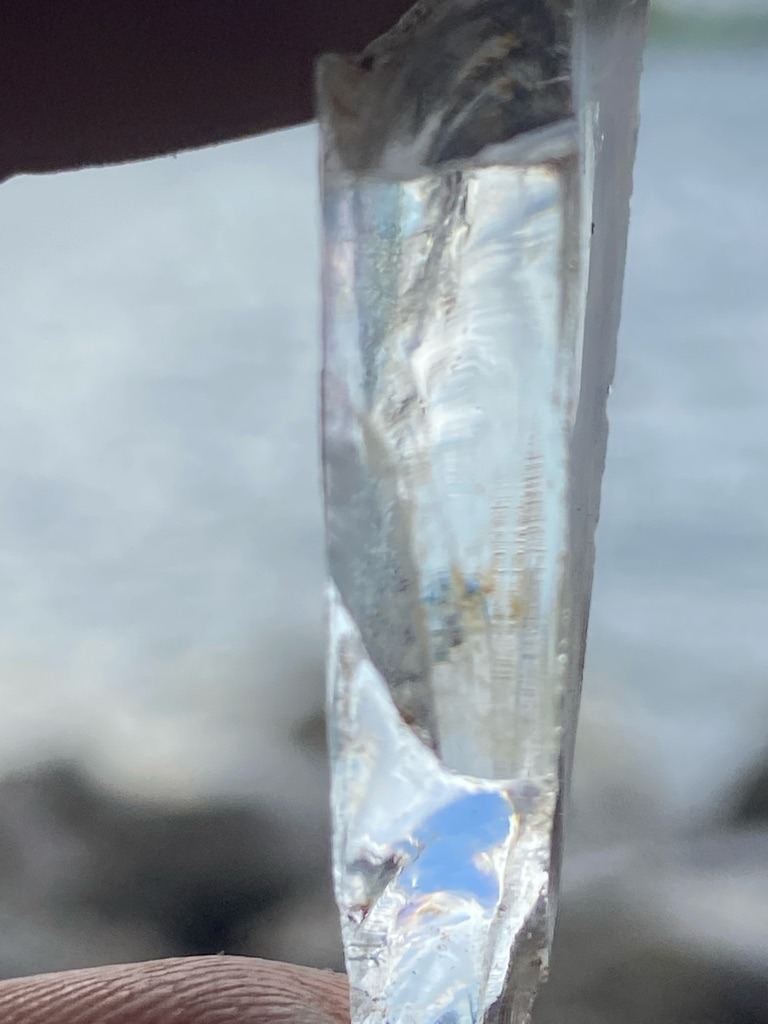
The specimen displayed in the image is not a diamond; it appears to be a raw piece of clear quartz crystal, glass, or potentially colorless beryl/topaz due to its elongated prismatic habit, striations on the crystal face, and conchoidal fracture pattern.
The specimen displayed in the image is not a diamond; it appears to be a raw piece of clear quartz crystal, glass, or potentially colorless beryl/topaz due to its elongated prismatic habit, striations on the crystal face, and conchoidal fracture pattern. · Raw, uncut crystal specimen with a naturally elongated, prismatic habit rather than a faceted gem shape.
Not applicable as this is an uncut, raw crystal specimen. Cut
Carat
Due to being a raw mineral specimen rather than a cut gemstone, weight cannot be accurately estimated visually without specific density and dimension measurements, but visually substantial.
Color
Colorless (transparent)
Clarity
Included (contains visible internal fractures, striations, and particulate inclusions characteristic of natural quartz or raw mineral specimens).
Shape
Raw, uncut crystal specimen with a naturally elongated, prismatic habit rather than a faceted gem shape.
Overall Assessment
The item shown is a raw, transparent mineral crystal (likely quartz or glass) and is definitively not a diamond. It lacks the cubic crystal system, hardness, high refractive index, and dispersion characteristic of genuine diamonds.
Cut Quality
Not applicable as this is an uncut, raw crystal specimen.
Brilliance
Vitreous to glass-like luster typical of quartz or similar clear minerals.
Fire
Very low dispersion compared to diamond, typical of quartz or glass.
Scintillation
Limited facet-based scintillation due to the lack of standard cutting and faceting; reflects light via natural crystal planes.
Proportions
Not applicable; raw elongated crystal form.
Symmetry
Natural crystal symmetry showing elongation along the c-axis with striated prism faces.
Polish
Unpolished natural crystal surface with typical growth striations.
Fluorescence
Cannot be determined without ultraviolet (UV) lighting analysis.
Inclusions
Visible internal feathers, fractures, and minor mineral or fluid inclusions within the crystal matrix.
Blemishes
Natural surface growth features, striations, and a rough fracture surface at the base.
Origin
Likely natural pegmatite or hydrothermal vein origin if quartz, or anthropogenic if glass.
Treatment Detection
No obvious signs of artificial enhancement; appears in a natural or raw state.
Estimated Value
Nominal value as a mineral specimen or raw material, significantly lower than gem-grade diamond.
Certification Estimate
Standard gemological laboratories (like GIA) would issue a gemstone identification report identifying it as quartz or glass rather than a diamond grading report.
Investment Potential
Low investment potential; decorative or mineral specimen value only.
Similar Diamonds
None, as the specimen lacks diamond optical and physical properties entirely.
Setting Suggestions
Wire-wrapped or organic bezel settings are typically used for raw crystal specimens in artisan jewelry.
Care & Maintenance
Standard care for quartz or crystal specimens; avoid harsh impacts to prevent breakage along cleavage or fracture planes.
Interesting Facts
Natural quartz crystals often form hexagonal prisms with distinct horizontal striations on their faces, which is clearly visible on this specimen.