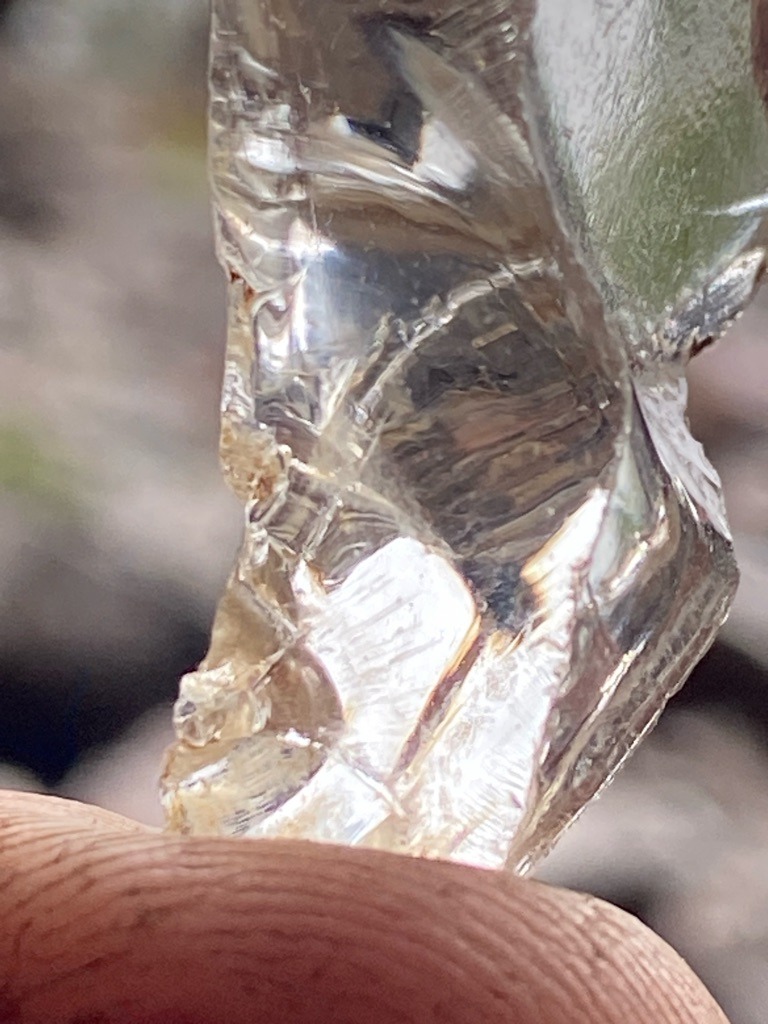
Not a diamond; this specimen appears to be raw quartz or glass slag based on the conchoidal fracture patterns and lack of crystal habit typical of rough diamond.
Not a diamond; this specimen appears to be raw quartz or glass slag based on the conchoidal fracture patterns and lack of crystal habit typical of rough diamond. · Raw / Uncut Fragment
Not applicable (Rough/Uncut) Cut
Carat
Cannot be reliably determined by visual inspection alone, roughly estimated over 10-15 carats equivalent volume.
Color
Colorless / Near-colorless
Clarity
Included / Heavily Fractured
Shape
Raw / Uncut Fragment
Overall Assessment
The specimen shown in the image lacks the characteristic crystal form, octahedral planes, and optical properties of a diamond, resembling raw quartz or glass instead.
Cut Quality
Not applicable (Rough/Uncut)
Brilliance
Low to moderate due to internal fractures and lack of precise facet geometry
Fire
Minimal dispersion observed
Scintillation
Poor due to lack of standard faceting
Proportions
Not applicable to raw crystalline material
Symmetry
Asymmetrical (Natural/Raw form)
Polish
Rough / Unpolished surface
Fluorescence
Unknown without UV testing
Inclusions
Extensive internal fracturing, cleavage planes, and inclusions visible
Blemishes
Surface chips, rough patches, and natural irregularities
Origin
Natural mineral specimen (likely quartz) or manufactured glass slag
Treatment Detection
No obvious enhancements detected, appears in its raw state.
Estimated Value
Minimal monetary value as a gemstone; primarily of specimen or decorative interest.
Certification Estimate
Not eligible for diamond grading reports (GIA/AGS); would require basic gemological identification by labs like GIA as quartz or glass if submitted.
Investment Potential
None as an investment asset
Similar Diamonds
None (this is not a diamond)
Setting Suggestions
Wire-wrapping or bespoke organic bezel settings if used in artisan jewelry.
Care & Maintenance
Handle with care to prevent further chipping along fracture lines; clean with warm soapy water and a soft brush.
Interesting Facts
Conchoidal fracture is typical of quartz, glass, and diamond, often leading to misidentification by novices.