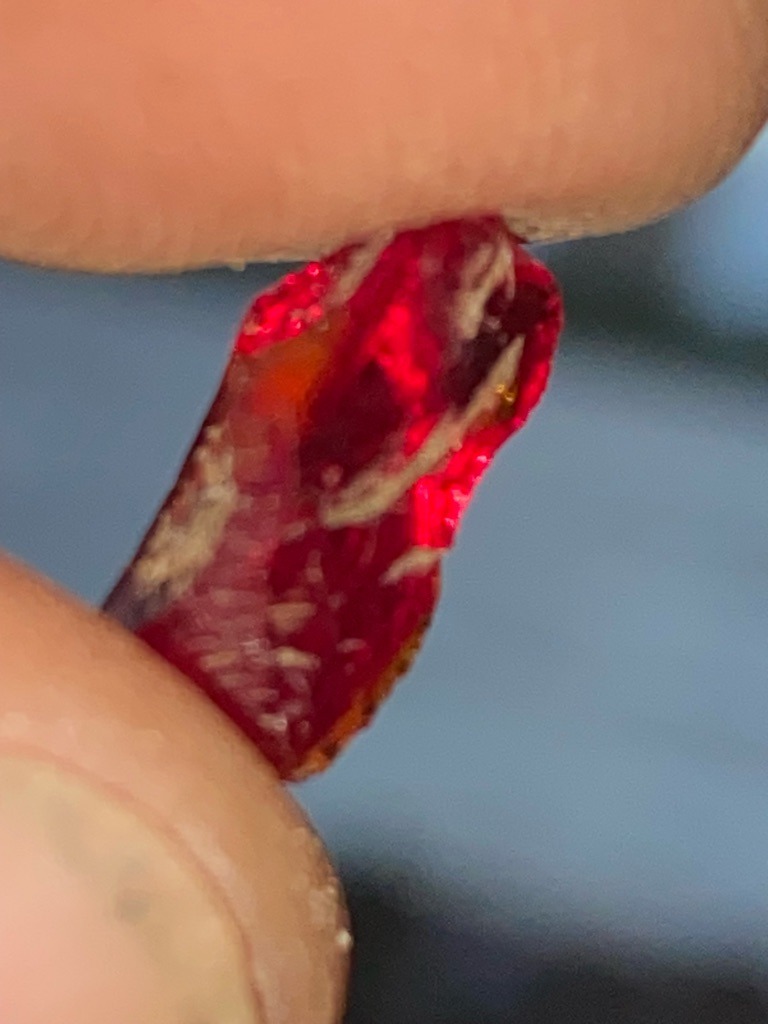
Not a diamond; this specimen appears to be a natural rough corundum (ruby) or possibly a garnet crystal, characterized by its deep red color and raw crystal habit.
Not a diamond; this specimen appears to be a natural rough corundum (ruby) or possibly a garnet crystal, characterized by its deep red color and raw crystal habit. · Raw, uncut, or partially fractured rough crystal form
Uncut / Rough (Not applicable for standard diamond cut grades) Cut
Carat
Estimated between 1.5 to 3.0 carats based on visual scale against fingers
Color
Natural Fancy Deep Red / Pigeon Blood hue
Clarity
Included / I1 to I3 (significant natural inclusions and internal fractures visible)
Shape
Raw, uncut, or partially fractured rough crystal form
Overall Assessment
An intriguing raw red gemstone crystal, visually striking due to its deep saturation and natural state, though requiring professional gemological testing to definitively separate ruby from red garnet or spinel.
Cut Quality
Uncut / Rough (Not applicable for standard diamond cut grades)
Brilliance
Vitreous to sub-adamantine luster across polished or reflective cleavage planes
Fire
Low dispersion compared to diamond, typical of corundum or garnet
Scintillation
Limited flash effect due to opaque or heavily fractured interior
Proportions
Not applicable due to raw, un-faceted state
Symmetry
Asymmetrical raw crystal formation
Polish
Unpolished natural crystal faces with some rough fracture surfaces
Fluorescence
Likely moderate to strong red fluorescence under UV light (typical for chromium-rich ruby)
Inclusions
Heavy internal feather fractures, rutile needles (silk), and mineral inclusions typical of untreated natural rough gemstones
Blemishes
Natural surface etching, rough growth lines, and matrix adherence
Origin
Likely metamorphic origin, potentially from regions known for ruby deposits such as Myanmar, Mozambique, or Madagascar
Treatment Detection
Requires microscopic analysis; raw appearance suggests unheated state, but surface residues may be present
Estimated Value
Varies widely from $50 to $500 depending on exact mineral species (Ruby vs. Garnet) and precise weight
Certification Estimate
GIA or SSEF would identify it as Natural Ruby with possible indications of thermal enhancement (or unheated if pristine)
Investment Potential
Moderate collector value as a mineral specimen rather than a faceted investment-grade gemstone
Similar Diamonds
Not applicable; comparable to other raw corundum, ruby, or pyrope garnet specimens
Setting Suggestions
Custom wire-wrap, bezel setting, or organic organic-style prong setting to preserve its raw aesthetic
Care & Maintenance
Store separately to avoid scratching softer stones; clean gently with warm soapy water, avoiding harsh ultrasonic cleaners due to internal fractures
Interesting Facts
Deep red rubies owe their vivid color to trace amounts of chromium replacing aluminum in the crystal lattice